THE ASAHI SHIMBUN
January 6, 2026 at 17:07 JST
 Prime Minister Sanae Takaichi visits Ise Jingu shrine in Ise, Mie Prefecture, on Jan. 5 before her New Year’s news conference there. She is holding a portrait of former Prime Minister Shinzo Abe, who was assassinated in 2022. (Tadashi Mizowaki)
While her administration faces challenges at home and abroad, Prime Minister Sanae Takaichi is at the center of speculation in the political world of Nagatacho for an opportunity where the timing seems right.
Will she take advantage of her historically high approval ratings to dissolve the Lower House for a snap election?
Asked this at a news conference on Jan. 5, Takaichi said, “It is important that the public can feel the tangible effects of our measures against rising prices and our economic policies. We are working hard to tackle the issues before us.”
Until now, she had clearly dismissed similar questions by saying she had “no time to think about dissolution,” but this time she did not employ that phrase.
A senior official of Takaichi’s Liberal Democratic Party suggested that dissolving the Diet’s lower chamber after the passage of the initial budget for fiscal 2026 is one option.
“Once the budget is passed, the prime minister will have a free hand (on the issue),” the official said.
Deliberations on the budget bill begin after the ordinary Diet session convenes on Jan. 23.
The ruling coalition of the LDP and Nippon Ishin (Japan Innovation Party) still lacks a majority in the Upper House, creating a “twisted Diet.”
Takaichi hopes to secure support from the opposition Democratic Party for the People to ensure the budget passes within the current fiscal year.
“Without political stability, we cannot advance strong economic policies, nor robust diplomacy and security,” Takaichi said at the Jan. 5 news conference.
While basing her administration on the LDP’s coalition with Nippon Ishin, the prime minister openly made an overture to the DPP by name, saying, “We will call for cooperation from opposition parties, starting with the DPP.”
Takaichi has laid the groundwork for cooperation with the DPP.
During last year’s extraordinary Diet session, the ruling bloc accepted in full the DPP’s demand to raise the income tax threshold to 1.78 million yen ($11,000).
At a news conference on Jan. 4, DPP leader Yuichiro Tamaki said his party will “take a positive view” on supporting the fiscal 2026 budget bill.
“The budget will likely pass the Diet without issue,” a former LDP Cabinet minister said.
The LDP suffered a significant loss of seats in the last Lower House election in 2024, and many within the party are calling for dissolving the chamber at an early date.
“With the birth of the Takaichi administration, we lost our longtime electoral partner Komeito and accepted Nippon Ishin’s demand to reduce the number of Diet seats,” a former Cabinet minister said. “The reward that justifies these ‘costs’ is an early dissolution while (the Cabinet’s) approval ratings remain high.”
When Takaichi gathered with LDP lawmakers close to her late last year, she said, “We have to put ourselves in a position to win with LDP endorsements alone in the next election.”
One of the attendees said the remark made them feel “the election is near.”
However, the yen’s continued depreciation is driving higher prices, and Japan’s worsening relations with China following Takaichi’s remarks on a Taiwan contingency have raised concerns about the broader economic fallout.
“High approval ratings do not last forever,” a Cabinet minister said. “Whether it is measures against inflation or anything else, ‘making the public feel the tangible effects,’ as the prime minister says, is no easy task.”
On the diplomatic front, attention is focused on the outcome of Takaichi’s visit to the United States for talks with U.S. President Donald Trump, which is being arranged for March.
The prime minister hopes to reaffirm coordination of the Japan-U.S. alliance before a summit between Trump and Chinese President Xi Jinping scheduled for April.

With no majority in Lower House, Diet affairs now in disarray
November 6, 2024
Takaichi zeroes in on cost of living, scraps cash handout
October 22, 2025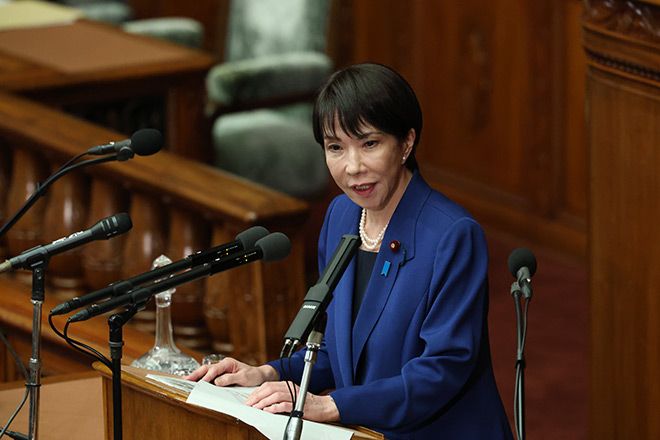
Takaichi pledges to build strong economy with fiscal stimulus
October 24, 2025
Takaichi’s win lifts DPP as likely partner, pushes aside Ishin
October 6, 2025
Supplementary budget bill likely to pass Diet with DPP support
December 10, 2025
A whole new ball game comes into play after coalition change
October 11, 2025








A peek through the music industry’s curtain at the producers who harnessed social media to help their idols go global.

A series based on diplomatic documents declassified by Japan’s Foreign Ministry

Here is a collection of first-hand accounts by “hibakusha” atomic bomb survivors.

Cooking experts, chefs and others involved in the field of food introduce their special recipes intertwined with their paths in life.

A series about Japanese-Americans and their memories of World War II



