THE ASAHI SHIMBUN
January 6, 2026 at 16:34 JST
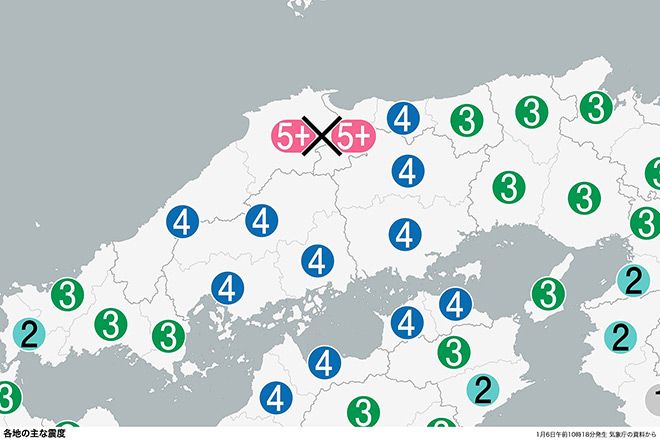 A seismic intensity map of the earthquake that struck the western part of Japan at 10:18 a.m. on Jan. 6
A powerful earthquake shook Tottori and Shimane prefectures on Jan. 6 resulting in the report of some injuries due to falls, but there was no danger of a tsunami, according to the Japan Meteorological Agency.
The earthquake struck with a maximum seismic intensity of upper 5 on the Japanese scale of 7 around 10:18 a.m. on Jan. 6, according to the JMA.
According to the Fire and Disaster Management Agency, as of noon on Jan. 6, one person was transported by ambulance after falling due to the earthquake in Yonago, Tottori Prefecture, and four people were transported in Matsue, capital of Shimane Prefecture, for similar reasons.
The JMA advised the public to be on the alert against aftershocks.
"In this region, there have been past instances where a larger earthquake followed the initial one," the JMA said at a news conference. "We ask that people be vigilant for strong tremors for about a week."
The initial quake's epicenter was in the eastern part of Shimane Prefecture with a depth of about 11 kilometers and an estimated magnitude of 6.4.
AFTERSHOCKS CONTINUE
Eastern Shimane Prefecture and western Tottori Prefecture both registered a seismic intensity of upper 5 in this earthquake. The last time Tottori Prefecture logged a quake of this size was 2016, while Shimane Prefecture experienced one of this magnitiude in 2018.
Other areas of both prefectures recorded an intensity of 4 along with Okayama, Hiroshima, Kagawa and Ehime prefectures.
An intensity of 3 was observed in prefectures including Kyoto, Osaka, Hyogo and Yamaguchi.
In western Shimane Prefecture, a Class 4 long-period ground motion was also documented.
Long-period ground motion involves slow yet major swaying that can even affect tall buildings located far from an earthquake's epicenter.
Class 4 is defined as shaking so intense that it is impossible to move about unless an individual crawls.
A series of earthquakes continued to shake the region.
A maximum seismic intensity of 3 was observed around 10:24 a.m., followed by an intensity of lower 5 at about 10:28 a.m.
This dipped to a reading of 2 around 10:34 a.m., 4 around 10:37 a.m. and 2 around 10:50 a.m.
According to the JMA, while there are no major active faults around the current epicenter, it is a seismically active region.
"Earthquakes can happen anywhere in Japan," a JMA official said. "We want people to be prepared, regardless of the presence of active faults."
NUCLEAR PLANT SAFE
According to the Nuclear Regulation Authority, there are no abnormalities in the safety functions of the Chugoku Electric Power Co.’s Shimane nuclear power plant in Matsue.
The city recorded an intensity of upper 5.
The restarted No. 2 reactor with an output of 820,000 kilowatts continues to operate, and there are no abnormalities in the environmental radiation level readings from surrounding monitoring posts.
At the Shimane plant, the No. 1 reactor is being decommissioned while the No. 2 reactor was restarted in December 2024 after approximately 13 years offline.
The No. 3 reactor, which is under construction, is undergoing a safety review by the NRA to begin operations.
OFFICIAL, LOCAL RESPONSE
The central government established a liaison office at the Prime Minister's Office Crisis Management Center at 10:20 a.m. on Jan. 6.
Prime Minister Sanae Takaichi arrived at the office around 11:10 a.m.
Takaichi told reporters, "I have been briefed that personal and property damage is currently being confirmed, but we will continue to ensure a thorough response."
She added, "We ask everyone in the regions with strong shaking to remain cautious of the occurrence of similar-sized earthquakes and to reconfirm their daily preparations."
Chief Cabinet Secretary Minoru Kihara said at a morning news conference, "Regarding nuclear facilities, including the Shimane plant, we have not received any reports of abnormalities at this time."
DISRUPTION IN VARIOUS AREAS
On the local level, the Matsuejozan Park management office reported that Matsue Castle's keep and other parts of the national treasure located in the park lost power due to the earthquake.
Staff evacuated tourists outside, and no injuries or building damage have been confirmed.
The Shimane prefectural government established a disaster response headquarters that morning.
A male employee at the prefectural disaster prevention and crisis management division in Matsue said, "I felt horizontal shaking and the slow swaying continued for about 30 seconds."
According to the Matsue city fire department, it has received several related emergency calls that include reports of injuries from falls.
Tottori Prefecture, where cities like Sakaiminato observed an intensity of upper 5, also set up a disaster response headquarters.
An official from the prefectural crisis management and information division said, "A heavy, horizontal swaying lasted for seven or eight seconds, and the prefectural office staff all took cover. Nothing fell from the shelves."
Near the epicenter in Yasugi, Shimane Prefecture, an official from the disaster prevention division said, "Long tremors are occurring repeatedly. The staff are responding calmly."
According to Yasugi city's fire department, there was a report of a cliff collapsing behind a house after the earthquake.
At the city hall in Yonago, the violent shaking reportedly caused books to fall from shelves.
As tremors continued, citizens and staff were advised to wait inside the building.
At the Mizuki Shigeru Memorial Museum in Sakaiminato, about 20 visitors were evacuated outside during the first tremors.
As the shaking continued, the museum issued refunds and closed temporarily.
Famed writer Lafcadio Hearn’s former residence in Matsue was another attraction that also closed for the day.
According to the city officials, during the current broadcast of the Japan Broadcasting Corp. (NHK) morning drama "Bakebake," modeled on Hearn's wife, the number of visitors to the residence in November increased to 27,172.
This is a 4.3-fold increase compared to the same month the previous year.
TRAVEL DISRUPTED
Transportation systems were also affected.
According to West Japan Railway Co. (JR West), a power outage occurred on the Sanyo Shinkansen line between Aioi and Tokuyama stations around 10:20 a.m. on Jan. 6, and service was suspended between Shin-Osaka and Hakata stations until around 1 p.m.
Ichibata Electric Railway in Izumo, Shimane Prefecture, which runs through Matsue and other areas, suspended all its lines as well.
According to West Nippon Expressway Co., some sections of the Yonago Expressway that connects the Sanin and Sanyo regions as well as the Sanin Expressway were temporarily closed.

Quake off Aomori hurts 30; special advisory issued for first time
December 9, 2025

Quakes now shaking island in Kagoshima Prefecture
December 7, 2021
Tokyo high-rises install early warning network for far-off quakes
September 29, 2024
Earthquake that hit Mie shook faraway Ibaraki and Fukushima
November 15, 2022
JMA quake early warning to cover shakes that affect high-rises
November 2, 2022
Illogical disaster plans undercut Shimane nuclear plant’s return
December 9, 2024








A peek through the music industry’s curtain at the producers who harnessed social media to help their idols go global.

A series based on diplomatic documents declassified by Japan’s Foreign Ministry

Here is a collection of first-hand accounts by “hibakusha” atomic bomb survivors.

Cooking experts, chefs and others involved in the field of food introduce their special recipes intertwined with their paths in life.

A series about Japanese-Americans and their memories of World War II



