By NAOTAKA FUJITA/ Senior Staff Writer
January 6, 2026 at 14:49 JST
 Part of a record of a meeting between Foreign Minister Tsutomu Hata and U.S. Defense Secretary William Perry in February 1994, which was released by the Foreign Ministry (Naotaka Fujita)


During the 1994 North Korean nuclear crisis, Foreign Minister Tsutomu Hata sought to dispel concerns over a nuclear-armed Japan during a meeting with U.S. Defense Secretary William Perry, a newly declassified document shows.
It is unusual for a Japan-U.S. ministerial exchange on Japan’s potential nuclear armament to be made public.
Hata, the foreign minister and deputy prime minister in the administration of Prime Minister Morihiro Hosokawa, met with Perry in the United States in February 1994.
Prior to the meeting, he attended a summit between Hosokawa, who led a non-Liberal Democratic Party coalition government, and U.S. President Bill Clinton.
North Korea had declared to withdraw from the Nuclear Nonproliferation Treaty in 1993.
A briefing paper prepared by the Foreign Ministry for the Japan-U.S. summit noted that Perry testified in a congressional hearing earlier that month that Japan might aspire to become a nuclear-armed state like North Korea.
The record of the meeting between Hata and Perry, marked “top secret: limited distribution” and released last month, suggests that the two engaged in a carefully calibrated exchange based on prior Japan-U.S. working-level coordination aimed at defusing the issue.
Referring to speculation in the United States that Japan had the technology and financial resources and might one day acquire nuclear arms, Hata said, “Our country will continue to uphold the Three Non-Nuclear Principles and will absolutely never possess nuclear weapons.”
He also mentioned the U.S. obligation to defend Japan, saying, “Our national policy is premised on the Japan-U.S. Security Treaty.”
Perry responded that he viewed discussions in the U.S. media about Japan’s nuclear armament as purely hypothetical.
He indicated that those arguments were based on the notion that one could not rule out the possibility that Japan might show an interest in nuclear development if North Korea were to acquire a large-scale nuclear capability and develop long-range missiles in the future.
Perry added that the U.S. government understood and supported Japan’s non-nuclear stance.
Hata also said that the United States had been working with Russia to reduce nuclear arsenals following the collapse of the Soviet Union in 1991.
“If Japan were to speak of acquiring nuclear weapons (at such a time), other countries would follow suit, and it could undermine the very efforts the United States has made,” he said.
Perry agreed, saying that Japan’s national interest in Asia lies in maintaining its security relationship with the United States, never in developing an independent military capability.
Japan and the United States continued dialogue with North Korea into the 2000s to denuclearize the country, but those efforts bore no fruit.
North Korea pressed ahead with nuclear tests and extended the range of its missiles.
At a military parade in 2025, the country unveiled a new intercontinental ballistic missile for the first time.
* * *
This article is part of a series based on diplomatic documents declassified by Japan’s Foreign Ministry in December 2025.

Abe suggests Japan start ‘nuclear sharing’ discussion
February 28, 2022
North Korea lambasts G-7, says its nukes are 'stark reality'
April 21, 2023
In a rare U.N. appearance, senior North Korean diplomat insists his country won’t give up nukes
September 30, 2025
North Korea threatens nuclear retaliation over US displays of military force
July 21, 2023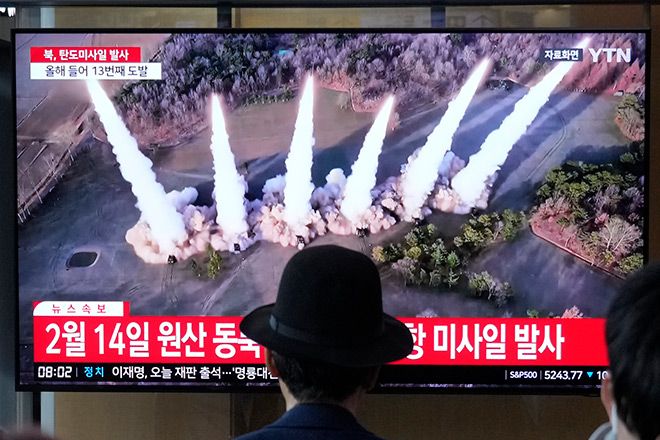
Deterrence could heighten risk of nuclear warfare, study suggests
April 5, 2024







A peek through the music industry’s curtain at the producers who harnessed social media to help their idols go global.

A series based on diplomatic documents declassified by Japan’s Foreign Ministry

Here is a collection of first-hand accounts by “hibakusha” atomic bomb survivors.

Cooking experts, chefs and others involved in the field of food introduce their special recipes intertwined with their paths in life.

A series about Japanese-Americans and their memories of World War II



