By SHOTA TOMONAGA/ Staff Writer
December 9, 2025 at 07:00 JST
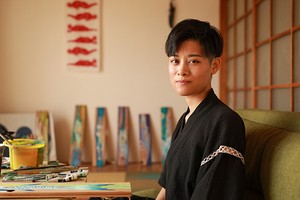
 The artist Ekaki Ninja Sen (Drawing Ninja Sen) found out she was born through a surrogate pregnancy about three years ago. This photo was taken in the Kanto region on Aug. 22. (Shota Tomonaga)


About three years ago after returning home from a new employee orientation, Sen was given a color photo by her mother.
In it, her Japanese parents held a baby Sen in their arms. Standing next to them was a Filipina who looked just like her.
That woman was her surrogate mother, and, in that moment, Sen felt her world upend.
Along with the photo came her mother’s explanation that she and Sen’s father had a strong desire for a child of their own and turned to a surrogate abroad when fertility treatments did not pan out; domestic bans made surrogacy in Japan largely infeasible.
Their daughter was now in her 20s and things were suddenly making more sense.
Sen was severely bullied for her appearance “to the extent of wanting to die” from fourth grade through her junior high school years. Classmates were verbally cruel, calling Sen the name of a character from an English textbook instead of using her own and threw a rag at her face.
She couldn't find convincing reasons why she looked different from others even though she was supposed to be ethnically Japanese.
These deep wounds eventually made her believe that she was ugly.
"If I had known my own roots when I was a grade schooler, I could have endured the baseless smears," Sen recalled.
As an adult, she still harbors conflicted feelings about the fact that her surrogate mother was paid for a service.
"Buying a newborn life and making them a family member is not different from buying pets," she said. "I wonder how much I was."
These are musings that are at war with more positive ones.
"I wonder if my parents had me not because I was an affordable choice but because they wanted to wait for me," she added, saying their affection for her has always been clear.
Both went straight to her junior high school’s officials to ask them to take action when they found out their daughter was being bullied.
"The bond with my parents will never change," she said. "My only parents are the ones in Japan."
Sen learned the name of her surrogate mother earlier this year.
Now that she knows her face, name and how she delivered her, the artist can envision this figure as a real person.
For now, Sen thinks this is enough.
Another form of her parents’ love is their support as she pursues her art dreams.
After jobs at a design company and elsewhere, she started working as an artist about two and a half years ago, calling herself "Ekaki Ninja Sen" (Drawing Ninja Sen).
Her colorful works depict animals and goddesses. Her canvases of choice are discarded floorboards.
Sen sees the worm-eaten boards that can't be commercially sold as relatable to her experience of being excluded for her differences.
"I feel like I'm saved by turning my feelings into art pieces," Sen said.
The artist has shared that she is a child of a surrogate pregnancy on social media while talking about her experiences and thoughts on surrogacy.
"I want to create an environment where people wrestling with different things can feel it is OK to talk about their troubles," she said.
DON’T LEAVE THE KIDS OUT
Although there are no legal restrictions on surrogacy in Japan, it is banned under the rules of the Japan Society of Obstetrics and Gynecology; this makes approving artificial insemination, in vitro fertilization and other medical options for surrogate pregnancies practically infeasible.
The reasoning for the ban is the physical and mental effects on surrogate mothers and potential for complicated family relationships concerning children and their legal parents.
Sen feels that while discussions tend to focus on parents who want children and the human rights of those carrying them, surrogate children are left out of these accounts.
"I hope that by making this issue (of surrogate mothers, children and parents) widely known, it will encourage dialogue to decide when a child’s origins should be disclosed and address the ethical aspect," Sen said. "I also hope we can discuss what to expect after having children through surrogacy."

Manga shows sexism through the eyes of girls around world
November 12, 2022
Japanese teen makes debut as Chinese opera ‘face-changer’
July 14, 2025

S. Korean mother finds ‘oasis’ in Japan away from cram school life
February 29, 2024
Fearing future issues, parents rethink posting pictures of kids
January 15, 2025












A peek through the music industry’s curtain at the producers who harnessed social media to help their idols go global.

A series based on diplomatic documents declassified by Japan’s Foreign Ministry

Here is a collection of first-hand accounts by “hibakusha” atomic bomb survivors.

Cooking experts, chefs and others involved in the field of food introduce their special recipes intertwined with their paths in life.

A series about Japanese-Americans and their memories of World War II



