THE ASAHI SHIMBUN
December 9, 2025 at 15:41 JST
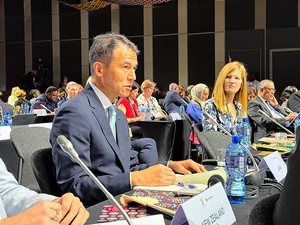
 Yuichi Oba, deputy director-general of the International Cooperation Bureau in the Foreign Ministry, attends the replenishment session of the Global Fund held in Johannesburg, South Africa, on Nov. 21. (Captured from the Foreign Ministry’s X account)
The Japanese government has come under criticism for silently slashing its funding to about half of what it pledged in 2022 to an organization that plays a central role in global infectious disease control.
In 2022, Japan pledged up to $1 billion (155.8 billion yen) over the next three years to the Global Fund to Fight AIDS, Tuberculosis and Malaria, which is a public-private international partnership.
The contribution is part of the government’s official development assistance (ODA).
However, regarding the latest pledge, the Foreign Ministry merely posted on its website on Nov. 25 that Japan would “contribute up to 81 billion yen over the next three years” to the Global Fund.
Converted to U.S. dollars, this amounts to about $520 million, which is about half of the previous pledge of up to $1.08 billion in 2022.
Amid growing criticism within the country against providing aid to foreign countries, the government’s increasingly passive stance toward contributions and communications related to ODA and other support for developing countries is apparent.
The Japan Center for International Exchange (JCIE), which operates the Global Fund’s Japan committee, issued a statement on Nov. 28, criticizing Japan's major reduction in its contribution.
“Suddenly announcing the contribution amount whose reduction rate was significantly larger than other countries undermines Japan’s long-standing credibility in international cooperation,” it said.
The statement emphasized that amid a global decline in aid funding, “It is essential for Japan to maintain its role as a major donor and shoulder its fair share in order to lead global health discussions at this crucial moment.”
According to the Friends of the Global Fund, Japan, the Global Fund’s Japan committee, the reduction rate compared to the previous pledge in U.S. dollars is 5.2 percent for the United States, 10.6 percent for Germany and 5.4 percent for Britain. Japan’s 52.2 percent reduction is startlingly high compared to other countries.
The Global Fund was established in 2002 following the Group of Eight Kyushu-Okinawa Summit in 2000, where Japan, as chair, made infectious disease control a key agenda item.
The fund, which Japan has long served as a major donor, provides financial support to developing countries for the prevention and treatment of the three major infectious diseases—AIDS, tuberculosis and malaria.
In 2022, then Prime Minister Fumio Kishida announced Japan’s pledge twice: at the 8th Tokyo International Conference on African Development (TICAD8) in August; and at the Global Fund replenishment session held in New York in September, committing “up to $1.08 billion over the next three years.”
Sources close to the Foreign Ministry pointed to a major reason behind the recent sharp reduction, saying, “We cannot ignore the increasingly critical perspective that opposes foreign aid, including ODA, from the Japanese public.”
According to preliminary results of the Cabinet Office’s public survey on diplomacy released on Nov. 28, only 22.6 percent of respondents said the Japanese government “should actively promote” aid for developing countries, which was the lowest rate over the past 10 years.
Meanwhile, the combined percentage of those who responded that the aid “should be minimized” or “should be stopped” reached 22.6 percent, the highest in the same period.
(This article was written by Yuka Takeshita and Azusa Kato.)

Japan aims to refocus its foreign aid on maritime, economic security
June 9, 2023
Rich world aims to end vaccine inequities, China pledges $3 billion in aid
May 23, 2021
Japan ranks 3rd in foreign aid spending but still below U.N. target
April 14, 2023
EDITORIAL: Japan best served sticking to original principles in ODA
June 20, 2023
4.1 billion yen in taxpayer funds wasted on failed foreign aid plans
October 24, 2024
IMF upgrades forecast for 2021 global growth to a record 6%
April 7, 2021










A peek through the music industry’s curtain at the producers who harnessed social media to help their idols go global.

A series based on diplomatic documents declassified by Japan’s Foreign Ministry

Here is a collection of first-hand accounts by “hibakusha” atomic bomb survivors.

Cooking experts, chefs and others involved in the field of food introduce their special recipes intertwined with their paths in life.

A series about Japanese-Americans and their memories of World War II



