Vox Populi, Vox Dei is a daily column that runs on Page 1 of The Asahi Shimbun.
December 10, 2025 at 13:16 JST
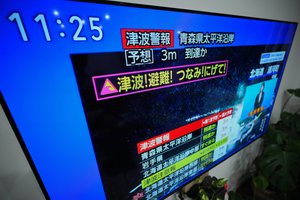
 An electronic signboard displays a "subsequent earthquake advisory" in Sendai's Miyagino Ward in Miyagi Prefecture on Dec. 9. (Megumi Kishi)
Earthquake prediction is fiendishly difficult, a science fraught with profound uncertainty.
Two days before the catastrophic 2011 Great East Japan Earthquake, which registered the maximum intensity of 7 on the Japan Meteorological Agency’s scale, there was a tremor with an intensity of “Lower 5” originating from roughly the same area off the coast of the northeastern Tohoku region.
At the time, many experts did not anticipate that a much larger earthquake would soon occur in the same area. Even the agency merely urged the public to “be cautious about aftershocks with a maximum intensity of around 4.”
On the basis of such hard-learned lessons, a new quake warning system was introduced. Dubbed the “subsequent earthquake advisory,” it is designed to alert people to the possibility of a massive earthquake occurring after an initial large one.
This alert was issued for the first time following the magnitude 7.5 earthquake that struck the Tohoku region late at night on Dec. 8 off the eastern coast of Aomori Prefecture.
Frankly, I suspect many people now feel more confused than properly informed about the danger.
The advisory states that the probability of a large-scale earthquake has “relatively increased,” yet in the same breath concedes that this is “information with an extremely high uncertainty.”
It is hard to know what to do with these two statements. On top of that, we are told that schools and public transportation should operate as usual.
The probability theory behind the advisory is even more perplexing.
We are told that the likelihood of a magnitude 8 class earthquake occurring within a week is about one in 100.
That “one time” could be now; conversely, there is also a non-zero possibility that nothing will happen even if the same conditions recur 100 or 200 times and the advisory is issued on each occasion.
In the Japanese archipelago, everyone lives with a seismic Sword of Damocles hanging over their head, never knowing when it might fall. I have no wish to stoke anxiety, but a devastating earthquake could strike anywhere in this country at any moment.
Perhaps this cautionary information serves mainly to force us to confront that grim and inescapable reality.
We must accept what we do not know simply as something we do not know. Humanity has always lived this way, holding nature in awe.
My thoughts are with those in the disaster-stricken areas, where a biting, snow-laden wind is blowing. I look up at the ceiling of my own home, in silence.
—The Asahi Shimbun, Dec. 10
* * *
Vox Populi, Vox Dei is a popular daily column that takes up a wide range of topics, including culture, arts and social trends and developments. Written by veteran Asahi Shimbun writers, the column provides useful perspectives on and insights into contemporary Japan and its culture.

Quake off Aomori hurts 30; special advisory issued for first time
December 9, 2025

Emergency guidelines for Nankai Trough quake revised
August 8, 2025
Quakes now shaking island in Kagoshima Prefecture
December 7, 2021
Despite social media posts, scientists say no rise in quakes
May 6, 2024
JMA: Quake did not raise risk of Nankai Trough mega-temblor
January 14, 2025
Stronger Nankai Trough alert likely to cause more confusion
August 16, 2024










A peek through the music industry’s curtain at the producers who harnessed social media to help their idols go global.

A series based on diplomatic documents declassified by Japan’s Foreign Ministry

Here is a collection of first-hand accounts by “hibakusha” atomic bomb survivors.

Cooking experts, chefs and others involved in the field of food introduce their special recipes intertwined with their paths in life.

A series about Japanese-Americans and their memories of World War II



