December 10, 2025 at 17:44 JST
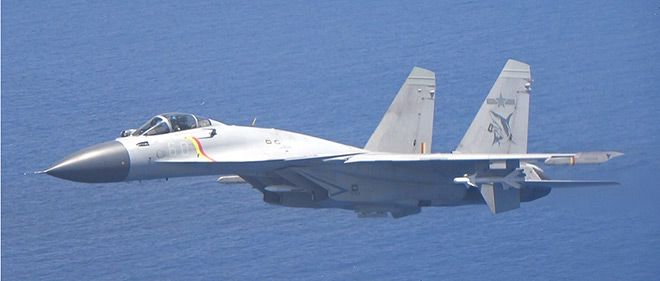 A Chinese J-15 fighter jet similar to the one which had a radar lock-on against a Self-Defense Force jet (Provided by Defense Ministry)
A Chinese fighter jet locked its radar on a Self-Defense Forces aircraft over international waters southeast of the main Okinawa island on Dec. 6.
We can never accept this extremely dangerous and provocative act, which might have led to a clash because the act could be deemed preparation for firing.
The Chinese navy and air force are now regularly moving into the western Pacific and tensions continue with the SDF, which conducts surveillance and patrol.
There is a need to create a framework for a calm response that can prevent an unintentional incident.
According to government officials, the radar lock-on came from a J-15 fighter jet that took off from the Liaoning aircraft carrier, which was on a training exercise.
The radar lock-on occurred intermittently on two occasions against an Air Self-Defense Force F-15 fighter jet that had scrambled to guard against an airspace violation.
Officials said there was a high possibility that the Chinese jet was in the fire-control mode that designates a target for shooting.
Because that is a sign that an attack was possible, an ASDF source described it as facing a firearm with the holder having his finger on the trigger.
It is only natural that the government lodged a protest against China, saying the act was dangerous because it exceeded the limit needed for safe flights by aircraft and asked that a recurrence be prevented.
While China said the SDF aircraft was approaching the training area and threatening safety, that is not a legitimate justification for initiating a radar lock-on.
The Chinese military has been in lockstep with the stronger criticism by the Chinese government of Prime Minister Sanae Takaichi for her comment about a military contingency involving Taiwan as well as various retaliatory measures taken.
But there is likely a need to carefully determine whether the latest act is directly linked to such past moves.
In recent years, China has strengthened its naval capability and has rapidly advanced into the western Pacific because Chinese President Xi Jinping is taking steps to prevent the U.S. military from approaching as China strives to achieve its top priority of unifying Taiwan.
Beijing in November launched the Fujian, its third aircraft carrier, and there are reports that it is constructing a fourth.
If the opportunities for contact with the SDF on surveillance duties should increase, that would correspondingly heighten the possibility of an unexpected incident.
In June, aircraft from the Shandong aircraft carrier on two occasions came unusually close to a Maritime SDF patrol aircraft.
In March 2023, Japan and China established a hotline between military officers of the two nations, but it has not been functioning properly.
The hotline was not used in the latest incident because of a difference in understanding about how it should be utilized.
A misunderstanding of the other nation’s intentions could cause an accidental clash that might further escalate.
The two nations should become much more serious about installing an effective hotline.
Takaichi said her administration would respond “calmly yet resolutely.”
To encourage communications between the defense officials of the two nations, dialogue between the top leaders as well as defense ministers will be important.
Such officials should take the lead in fulfilling their political responsibility.
--The Asahi Shimbun, Dec. 9
Japan counters Chinese radar lock-on claims amid tensions
December 8, 2025
Japan and Australia urge calm after Chinese radar locks on Japanese jets
December 8, 2025
Japan-China defense hotline used 1 time for ceremonial call
August 18, 2025
Japan threatening us militarily, China foreign minister tells German counterpart
December 9, 2025
Seoul drafted radar guidelines in 2019 targeting only SDF aircraft
August 19, 2022
Chinese violation of airspace in Kyushu shocks, confuses Japan
August 27, 2024











A peek through the music industry’s curtain at the producers who harnessed social media to help their idols go global.

A series based on diplomatic documents declassified by Japan’s Foreign Ministry

Here is a collection of first-hand accounts by “hibakusha” atomic bomb survivors.

Cooking experts, chefs and others involved in the field of food introduce their special recipes intertwined with their paths in life.

A series about Japanese-Americans and their memories of World War II



