November 26, 2025 at 15:42 JST
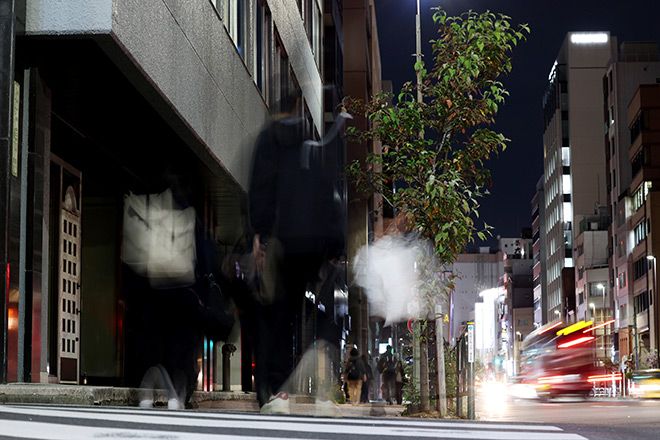
 A 12-year-old Thai girl was found working at a massage parlor located in this building in Tokyo's Bunkyo Ward. (Wataru Sekita)
A review of the legal regulations as well as efforts by all the relevant government ministries are needed to eradicate the damages like those caused by the trafficking of a 12-year-old girl at a massage parlor in Tokyo.
The owner of the establishment was arrested on suspicion of violating the Labor Standards Law for having the girl work there.
The girl came to Japan with her mother and serviced about 60 customers over a 33-day period.
After her mother left Japan, the girl sought help from the Tokyo Regional Immigration Services Bureau and was taken into protective custody as a victim of human trafficking.
A number of other Thai women also worked at the same massage parlor and there are suspicions that a mediation agency was involved.
The U.N. Protocol to Prevent, Suppress and Punish Trafficking in Persons, adopted in 2000, defined human trafficking as acts of acquiring people through violence or threats for the purpose of sexual exploitation or forced labor.
Japan signed the protocol in 2017 and efforts are being made to grasp what business activities are involved based on the action plans compiled by the applicable government agencies.
But the international community continues to cast a stern eye on Japan.
In 2022, the U.N. Human Rights Committee expressed concerns because those found guilty of human trafficking were given suspended sentences or only a fine.
A U.S. State Department report described efforts against child sexual exploitation as insufficient.
One major problem is the lack of a comprehensive law on human trafficking.
There is major significance in defining what constitutes a crime, recognizing victims and establishing protective custody procedures.
Diet members should formulate proposals while referring to what other nations have done.
The agency in charge should be clearly stated and an office to provide assistance should be set up.
In 2005, the Criminal Law was revised to establish a new crime of human trafficking. Under that law, those who sell humans can face prison terms of between one to 10 years.
But as the grounds for finding suspects guilty are severe, there have been many cases of those hiring the trafficked individuals to only be indicted on other legal violations.
Under such a situation, the actual scope of human trafficking cannot be ascertained.
The opposition Constitutional Democratic Party of Japan is planning to submit to the Diet legislation that would increase the maximum penalty for human trafficking, noting that in some nations life sentences are handed down.
While we can understand what the party is seeking, there is also a need for a wide-ranging assessment of why it is difficult to apply the provisions of the law on human trafficking.
The actual situation faced by the Thai girl has not been made clear because her customers were not detained.
She has said that she was taught by her mother how to touch the customers’ bodies.
In general, the massage parlor could face violations of the anti-prostitution law if there is sexual intercourse.
But that law has no provision to penalize the customer.
As a result, some have called for a legal revision to address that situation.
Prime Minister Sanae Takaichi has directed that consideration begin for a possible revision, but there is a need for discussions that place maximum consideration on the human rights of those working in the sex industry.
It will be important to change a society in which customers have a weak understanding about the problematic acts they are engaging in due, in part, to the simple use of terms such as “enjo kosai,” a euphemism for prostitution or young girls dating older men for money.
In 2024, the government confirmed 66 victims of human trafficking, but there is a need for a study about the latent damage.
Poverty and military conflicts are some of the factors behind human trafficking.
The heavy human rights toll inflicted by human trafficking must be eliminated by strengthening cooperation with the international community.
--The Asahi Shimbun, Nov. 25
Tokyo police suspect human trafficking of Thai girl, 12
November 6, 2025
Thai girl, 12, left in sex parlor waited in vain for mother’s help
November 7, 2025
Taiwan detains mom of Thai girl forced to work in Tokyo sex parlor
November 8, 2025
Grandmother of Thai girl left in Japan ‘does not believe reports’
November 11, 2025
EDITORIAL: Strong doubts remain on letting TEPCO operate a nuclear plant
November 24, 2025
EDITORIAL: It’s time to stop this needless confrontation with China
November 19, 2025











A peek through the music industry’s curtain at the producers who harnessed social media to help their idols go global.

A series based on diplomatic documents declassified by Japan’s Foreign Ministry

Here is a collection of first-hand accounts by “hibakusha” atomic bomb survivors.

Cooking experts, chefs and others involved in the field of food introduce their special recipes intertwined with their paths in life.

A series about Japanese-Americans and their memories of World War II



