By YUKI EDAMATSU/ Staff Writer
December 22, 2025 at 18:36 JST
Japan’s space agency failed in its latest attempt to launch its flagship rocket, leaving it unable to place a key component of the country’s satellite positioning system into orbit.
The eighth unit of the H3 rocket blasted off from the Tanegashima Space Center in Kagoshima Prefecture on Dec. 22, according to the Japan Aerospace Exploration Agency.
It carried the Michibiki No. 5 satellite, which is designed to improve the accuracy of location information for smartphones and car navigation systems.
JAXA said the second‑stage engine stopped burning prematurely. Pressure in the fuel tank dropped, resulting in lower‑than‑expected thrust.
The agency has not yet confirmed whether the satellite successfully separated from the rocket.
JAXA apologized for failing to meet public expectations, while the science ministry pledged a full investigation into the cause of the failure.
The launch had already faced multiple delays. It was initially scheduled for Dec. 7 but was postponed due to equipment issues.
A second attempt 10 days later was automatically aborted moments before liftoff when a water‑cooling system for the engine failed to supply sufficient water.
The H3 was developed by JAXA and Mitsubishi Heavy Industries Ltd. as a lower‑cost successor to the H2A, which flew its final mission in June.
While the H3’s first flight ended in failure, subsequent launches had been successful. Had the latest launch proceeded as planned, JAXA intended to send up the H3 No. 9 with Michibiki No. 7 as early as February.
Yasunori Matogawa, a space engineering specialist and professor emeritus at JAXA, said the rocket appeared to lack the necessary velocity required to reach orbit.
“This time, the velocity seemed slightly insufficient, and the altitude began to drop midway,” he said, noting that some missions can still succeed despite an early engine shutdown.
Michibiki spacecraft operate within the Quasi‑Zenith Satellite System, a multi‑orbit network, which is designed to ensure that at least one satellite remains near the zenith over Japan at all times.
By transmitting signals from almost directly overhead, the system reduces interference caused by buildings and mountains.
The failed launch was expected to increase the number of quasi‑zenith satellites in the system from three to four, improving signal stability and accuracy.
Including two satellites already in geostationary orbit, the system currently operates with five spacecraft.
In a successful scenario, Japan would have placed seven satellites in the system by February, enabling the country to maintain domestic positioning services even if the U.S. GPS became unavailable.

Japan launches navigation satellite into orbit aboard H3
February 3, 2025

New flagship H-3 rocket buoys Japan’s hope in global space race
February 18, 2024
JAXA’s launch of its Epsilon-6 rocket ends in failure
October 12, 2022

Japan hopes to forge profitable launch business with new H3 rocket
March 22, 2024
H-3 failure could deal setback for Japan’s entire space policy
March 8, 2023
Japan aborts launch of new rocket after abnormality detected
February 18, 2023















A peek through the music industry’s curtain at the producers who harnessed social media to help their idols go global.

A series based on diplomatic documents declassified by Japan’s Foreign Ministry

Here is a collection of first-hand accounts by “hibakusha” atomic bomb survivors.

Cooking experts, chefs and others involved in the field of food introduce their special recipes intertwined with their paths in life.

A series about Japanese-Americans and their memories of World War II

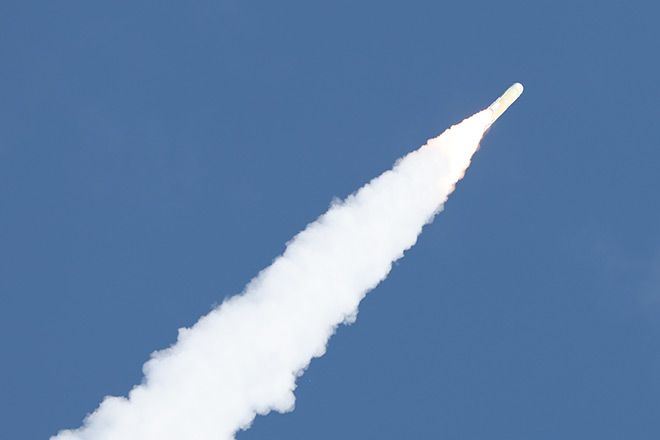 The eighth H3 rocket lifts off from the Tanegashima Space Center in Kagoshima Prefecture on Dec. 22. (Kazushige Kobayashi)


