By YUKI NIKAIDO/ Staff Writer
December 22, 2025 at 17:44 JST
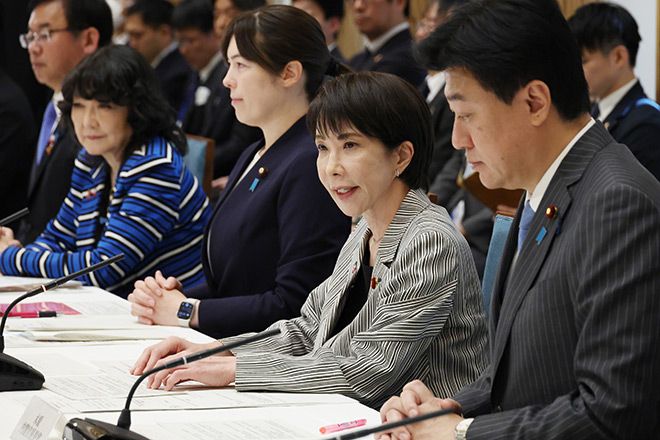 Prime Minister Sanae Takaichi speaks at a ministerial meeting on foreign nationals at the Prime Minister’s Office on Nov. 4. (Takeshi Iwashita)
Japan is moving to double the required length of stay in the country for foreign nationals to acquire Japanese citizenship while adding a Japanese language proficiency condition for permanent residency.
The changes, expected as early as next year, are being compiled by the government and the ruling coalition parties.
They were initiated after coalition partner Nippon Ishin (Japan Innovation Party) criticized the current requirements as too lenient, prompting Prime Minister Sanae Takaichi to order a review.
NEW CITIZENSHIP REQUIREMENTS
For citizenship, the policy on length of time in Japan will be changed from the current “five years or more” to “in principle, 10 years or more.”
However, the Nationality Law itself, which specifies the “five years” minimum, will not be amended. Instead, the stricter rules will be implemented through changes in how the law is applied.
“The Nationality Law only sets the minimum conditions,” a senior Justice Ministry official said. “It is not as if we have always granted citizenship with just five years of residence."
The official also said the ministry will provide sufficient public notice before the new operational rules are implemented.
The Nationality Law lists several conditions for justice minister to grant citizenship, including the “five year” minimum, being 18 or older, being of good conduct, and having financial independence.
Japanese language ability sufficient for daily life is also required, in principle.
According to a Justice Ministry summary, 12,248 citizenship applications were filed in 2024. Of these, 8,863, or 70 percent, were approved.
EXCEPTIONS FOR ‘CONTRIBUTORS’
Multiple government sources confirmed that exceptions will be made for the “10 years” rule.
For example, individuals deemed to have “contributed” to Japan, such as athletes who have long been active in the country, may have their citizenship applications approved even if they fall short of the 10-year residency requirement.
The move directly addresses what Nippon Ishin has called a “paradoxical situation.”
In a policy proposal last September, the party, then in the opposition camp, argued that the five-year residency requirement for citizenship--a weightier legal status--was inexplicably shorter than the 10 years required for permanent residency.
PERMANENT RESIDENCY CHANGES
The government and ruling parties also plan to tighten requirements for permanent residence permits.
This follows a 2023 amendment to the Immigration Control and Refugee Recognition Law, allowing the government to revoke permanent residency for offenses like deliberate nonpayment of taxes.
As of June this year, Japan was home to about 930,000 permanent residents, who account for 20 percent of the foreign population.
To be granted permanent residence, applicants must be of good conduct, be financially independent, and have their residence align with Japan’s national interests.
According to government sources, the guidelines will be revised to formally require Japanese language ability. The specific proficiency level is still under consideration.
Officials are also weighing the creation of a program for foreign nationals to learn the Japanese language and civic rules. Completion of this program could become a factor in residency screenings or even a mandatory requirement for permanent residency.
Current guidelines explicitly require applicants to have lived in Japan for at least 10 years, in principle, to have no record of paying fines or imprisonment, and to have fulfilled public obligations, such as paying taxes and social insurance premiums.
They also require applicants to have resided in Japan for the “maximum period” under their current residence status.
While current practice allows this to be “three years,” the officials plan to require “five years” instead.
PUSH FOR STRICTER POLICY
These stricter measures were outlined in an interim report by the ruling Liberal Democratic Party’s project team on the proper management of immigration and acceptance of foreign nationals.
The report also included a proposal to set upper limits on the number of foreign nationals accepted under certain visa categories, such as “Engineer/Specialist in Humanities/International Services,” as part of a “quantitative management” strategy.
The LDP, which set up three project teams in November to review its foreign national policies, is expected to submit its recommendations to Takaichi in January. The government will then likely revise its comprehensive immigration plan by the end of that month.

Policy talks on foreigners start; land deals, visas high on agenda
November 28, 2025
Japan to require language skills for entrepreneur visa holders
September 11, 2025
Foreigners with permanent residency could face stricter rules
February 5, 2024
Japanese-born professor loses legal bid for dual citizenship
September 30, 2025














A peek through the music industry’s curtain at the producers who harnessed social media to help their idols go global.

A series based on diplomatic documents declassified by Japan’s Foreign Ministry

Here is a collection of first-hand accounts by “hibakusha” atomic bomb survivors.

Cooking experts, chefs and others involved in the field of food introduce their special recipes intertwined with their paths in life.

A series about Japanese-Americans and their memories of World War II



