November 17, 2025 at 15:20 JST
 Measures are being planned to fight the spread of misinformation. (Akihito Ogawa)
Fake and mistaken information is an increasing threat to society by causing confusion and distorting voters’ judgments.
Miyagi Governor Yoshihiro Murai recently announced his intention to create a prefectural “fact-check” mechanism from a third-party standpoint for national and local elections. It would provide support for those thinking about submitting criminal complaints to police about misinformation.
Misinformation was rife during the October gubernatorial election in which Murai won his sixth term.
A number of political parties have also come up with plans to fact check information related to each party.
It has become increasingly difficult to determine the veracity of information in an age when generative artificial intelligence can produce deep-fake videos and images as well as data that appears accurate.
Individuals exposed to misinformation may become disillusioned into thinking they themselves have confirmed accurate information, making it more difficult for them to accept a different interpretation.
That, in turn, would create further distrust and division.
For that reason, the central and local governments have a large role to play since they are in a position to collect and investigate primary information.
For example, if baseless information, such as the flooding of a river or crimes committed by foreigners, should spread, an expedient transmission of confirmed facts is needed.
Aggressive denials should also be issued when the effects of misinformation are large, such as unscientific predictions for major natural disasters.
But public authority must be cautious about deciding on the veracity of information under the name of fact checking.
If comments critical of government policy and programs are simply deemed incorrect or fake, it might weaken the function of society to monitor mistakes or wrongdoings on the part of those in power.
The starting point of the fact-checking trend was in the United States in the 2000s, when specialized media and newspapers increasingly assessed the statements of politicians and others in public positions by providing evidence on whether they were truthful or not.
Public authority is primarily on the side of having its statements monitored because of the strong powers it holds.
The side effects would be huge if it entered the realm of deciding on veracity that went beyond a simple counterargument, and it might only lead to greater distrust among the public.
In Singapore, India and other places, governments determine whether information is factual.
But an Indian human rights organization has criticized the move because the government becomes the sole arbiter of the truth.
The International Fact-Checking Network lays out several principles, such as nonpartisanship and fairness, as well as transparency of funding and organization.
The administrative branch must persistently explain misinformation related to policy by presenting statistical documents and legal basis.
The media must check facts after collecting information that does not come from the government or administrative branch.
One steady way to prevent the spread of misinformation is to have government and the media each fulfill their role to allow individuals to increase their information literacy.
--The Asahi Shimbun, Nov. 16

Asahi guidelines to check veracity of social media posts in elections
June 16, 2025
Miyagi governor’s fact-check plan sparks debate
November 6, 2025
In Taiwan, a group is battling fake news one conversation at a time--with a focus on seniors
April 1, 2024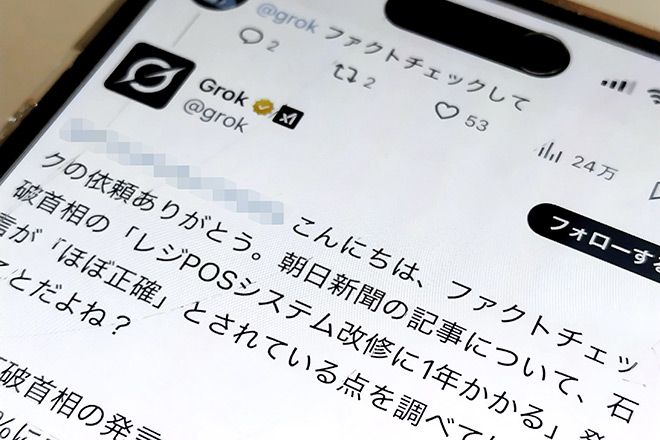
Asahi reporter assesses Grok’s ability as a fact-checker of stories
October 6, 2025










A peek through the music industry’s curtain at the producers who harnessed social media to help their idols go global.

A series based on diplomatic documents declassified by Japan’s Foreign Ministry

Here is a collection of first-hand accounts by “hibakusha” atomic bomb survivors.

Cooking experts, chefs and others involved in the field of food introduce their special recipes intertwined with their paths in life.

A series about Japanese-Americans and their memories of World War II



