November 5, 2025 at 15:39 JST
 Prime Minister Sanae Takaichi responds to an opposition question in the Lower House plenary session on Nov. 4. (Takeshi Iwashita)
Representatives of the various parties in the Diet have begun questioning Prime Minister Sanae Takaichi about her first policy speech.
One point of contention was how she would explain parts of her speech that were not specific and why she did not mention items that were contained in the coalition agreement with Nippon Ishin (Japan Innovation Party).
But Takaichi's responses often did not try to address those questions head-on.
She must present as soon as possible the overall picture of the policies she wants to implement, including the stable revenue source to pay for such programs and any possible side effects.
A typical example was trying to define what a “responsible aggressive fiscal policy” that the Takaichi administration has come out with means.
Takaichi was asked about the revenue source, whether she expected an increase in tax revenues and if she planned to increase issuance of government bonds.
But Takaichi only replied, “We will come up with specific measures in the process of dealing with that issue in the future.”
She also said continued consideration would be given for a stable revenue source to cover the abolishment by year-end of the provisional gasoline tax rate that the ruling and opposition parties have agreed to.
While Takaichi has said she wants to push forward a comprehensive strengthening of defense capabilities, she only said in her Diet response that continued consideration would be given to raising taxes as a stable revenue source to pay for that move.
Those responses lacked specifics and if future generations are made to eventually pay for what will be spent now, that cannot be called responsible politics.
In her policy speech, Takaichi did not touch upon the money scandal involving the former factions of her Liberal Democratic Party or about revising a law on donations from companies and organizations.
She only said she would make every effort to restore trust in politicians.
Yoshihiko Noda, the head of the main opposition Constitutional Democratic Party of Japan, first raised the topic of money in politics and asked Takaichi to agree to limiting the entities that can accept donations from companies and organizations.
But she did not take an aggressive stance, only saying that such a proposal was closely tied to the freedom to engage in political activities of companies and organizations.
Is she perhaps thinking that the public will soon forget the matter if nothing is done?
Noda said the coalition between the LDP and Nippon Ishin meant the administration now had two accelerators and he declared that his party, firmly rooted as a middle-of-the-road one, would serve as a brake.
For his part, Fumitake Fujita, the Nippon Ishin co-head, started off by boasting that a genuine reformist conservative coalition government had been established.
He described the 12 items in the coalition agreement his party reached with the LDP as “12 arrows” and asked Takaichi how serious she was about implementing them.
She responded by saying consideration and implementation of the various policies would be made according to the agreed-upon schedule.
She emphasized her intent to aggressively tackle issues that have long been pushed by Nippon Ishin, such as creating a secondary capital, making senior high school education free and revising the Constitution.
Nippon Ishin has also called for reducing the number of Lower House seats, a reform that could cut into public will.
While Takaichi said her party would make every effort to realize that goal, she added that a broad consensus covering the ruling and opposition parties would have to be reached.
She added that her administration would also hold thorough discussions with the various parties regarding a proposed people’s conference to discuss the future of social security.
In concluding her policy speech, Takaichi quoted from the 17-article Constitution written up by Prince Shotoku in the seventh century and said she would stress discussions by many people that the prince called for in the document.
She will now face the test of putting those words into practice by striving carefully to strike agreements amid the political landscape of a multi-party Diet.
--The Asahi Shimbun, Nov. 5

Takaichi draws jeers in Diet over fund scandal, Trump ‘flattery’
November 4, 2025
Takaichi eager to outline policies on foreigners in January
November 4, 2025
Takaichi calls for summit with Kim Jong Un to solve abduction issue
November 3, 2025
EDITORIAL: Takaichi must balance security, economics for a strong Japan
October 29, 2025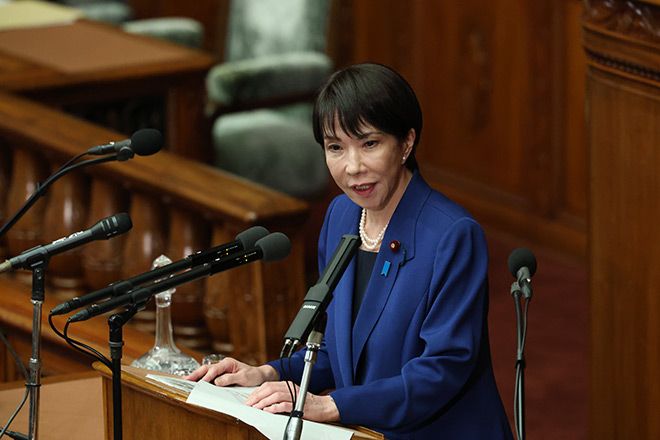
VOX POPULI: On fiscal reality, Sanae Takaichi is no Margaret Thatcher
October 25, 2025
Takaichi pledges to build strong economy with fiscal stimulus
October 24, 2025











A peek through the music industry’s curtain at the producers who harnessed social media to help their idols go global.

A series based on diplomatic documents declassified by Japan’s Foreign Ministry

Here is a collection of first-hand accounts by “hibakusha” atomic bomb survivors.

Cooking experts, chefs and others involved in the field of food introduce their special recipes intertwined with their paths in life.

A series about Japanese-Americans and their memories of World War II



