October 29, 2025 at 16:39 JST
 Prime Minister Sanae Takaichi meets with U.S. President Donald Trump in Tokyo. (Wataru Sekita)
One week after taking office, Prime Minister Sanae Takaichi met for the first time with U.S. President Donald Trump.
She handled the meeting successfully by confirming the importance of the Japan-U.S. alliance with Trump, who is often unpredictable.
In her opening policy speech in the Diet, Takaichi said she would push forward the comprehensive strengthening of Japan’s defense capability.
However, the current plan has Japan mostly serving as a supplementary role in relation to the U.S. military's might.
But with Washington moving toward not fulfilling its role to maintain the world order, what will be required of Japan is an autonomous strategy that does not depend excessively on military force, but is based on multilateral diplomacy and economic power.
PRIORITY ON UNITY BEFORE U.S.-CHINA MEETING
In his first term, Trump developed a close personal relationship with then Prime Minister Shinzo Abe to such an extent that Abe described it as a “honeymoon.”
That legacy connected the two leaders in their latest meeting.
Takaichi, who considers herself the successor to Abe, started off the meeting with Trump by bringing up Abe.
Trump told her that Abe spoke highly of Takaichi.
She said she wanted to work together to create a new golden age for the bilateral alliance and Trump said Japan was the most important ally.
Takaichi has said that she wants to push forward by two years the goal of raising defense spending to 2 percent of gross domestic product and achieve that objective in the current fiscal year.
She has also expressed her intent to begin revising the three documents related to national security to allow for even further increases in defense spending.
Takaichi reportedly told Trump that Japan would take the initiative in that field.
The two leaders signed two documents.
One confirmed implementing the agreement reached through bilateral negotiations on tariffs, while the other called for cooperation in securing important ores, such as rare-earth metals, to reduce dependence on China.
Differences did not arise over a large increase in defense spending and investment in the United States that Trump has called for.
With a U.S.-China summit scheduled soon in South Korea, Trump and Takaichi may have placed priority on giving the impression that their bilateral relationship was a strong one.
GOING BEYOND ABE'S LEGACY
At the start of the meeting, Takaichi highly praised the contributions made by Trump for the cease-fire between Thailand and Cambodia as well as the cease-fire agreement reached for Gaza.
According to U.S. sources, Takaichi indicated she would nominate Trump for the Nobel Peace Prize.
While she likely placed priority on establishing a relationship in their first meeting, Takaichi could be seen as being excessively subservient.
Although Abe developed close ties with Trump, he was unable to fulfill the role of bringing the United States back to the global order after it left the Paris Agreement to prevent global warming, among other issues.
The important point is what is to be achieved after developing a close relationship.
Trump is calling on allies to join sanctions against Russia in the energy field.
As such, the Sakhalin-2 project, in which Japanese companies have contributed capital to produce natural gas and petroleum in the Russian Far East, could become a thorn in the side of Japan-U.S. relations.
Trump will also likely not alter his stance of calling on Japan to further increase its defense spending.
The trend for the United States to reduce its international engagement is a reflection of U.S. public opinion, so there is no guarantee that stance will revert back after Trump leaves office.
For the time being, it will be difficult to achieve stability in the Indo-Pacific region without the overwhelming economic and military power of the United States.
The key will be whether Japan can undertake multilateral diplomacy centered on Asia while trying to maintain U.S. engagement in the region.
In her first overseas trip as prime minister, Takaichi met with ASEAN leaders and proposed cooperation in national security, economics and personnel exchanges.
In addition to ASEAN, efforts should be made to deepen cooperation with nations that share value systems, such as South Korea, Australia, India and nations in Europe.
Japan must also contribute to creating a regional order based mainly on maintaining the rule of law and a free trading system.
The accumulation of such efforts will benefit Japan and will also be effective in constructing the relationship with Washington.
Building a stable relationship with China is another must.
Although Takaichi was unable to meet with Chinese leaders at the ASEAN summit, she must utilize the opportunity of the Asia-Pacific Economic Cooperation summit to be held in South Korea this week.
CONCERNS ABOUT TILTING TOWARD FORCE
The Takaichi administration has moved further toward relying on force as seen by the plan to accelerate comprehensive strengthening of defense capabilities.
But the plan assembled under then Prime Minister Fumio Kishida was not an accumulation of requests from those actually handling defense matters, but agreed upon by first establishing the total amount to be spent.
No formal decision has yet been made on when to implement income tax increases to pay for some of the increased defense spending as a stable revenue source.
The configuration of defense and fiscal policy could become distorted if another decision is made to increase spending that is more than Japan needs to respond to requests from the United States.
We also hold strong concerns about the move to further relax restrictions on weapons exports.
At a time when Japan is called on for multilateral diplomacy, if it becomes a major weapons exporter, that could affect the effort to create positive ties.
The Trump administration has dismantled the U.S. Agency for International Development so Japan should make greater efforts in economic and humanitarian relief programs to respond to the requests of the so-called Global South group of newly emerging and developing nations.
An alliance is a means to protect the safety and daily lives of the people and should not become an end in itself.
Having pledged to create a strong Japan, Takaichi in her opening policy speech repeatedly said she wanted to build a strong economy.
Centered on a perspective of protecting the daily lives of the people, we hope she lays out a course that is balanced between national security and economics.
--The Asahi Shimbun, Oct. 29

Takaichi faces diplomatic gauntlet with Trump, China
October 25, 2025
Takaichi acts as ‘Abe’s successor’ in summit with Trump in Tokyo
October 28, 2025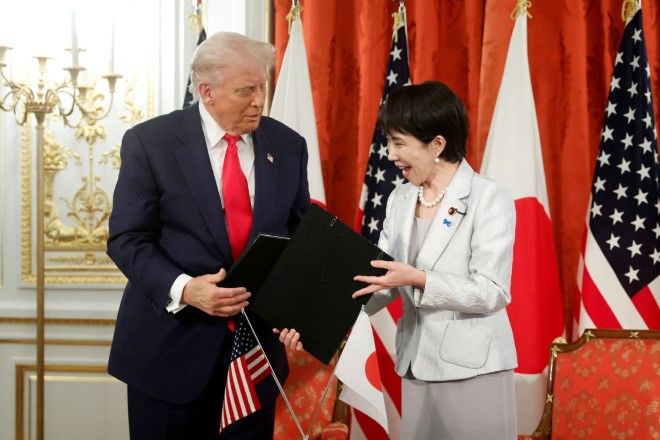
Trump meets with newly elected Japanese Prime Minister Sanae Takaichi in Tokyo
October 28, 2025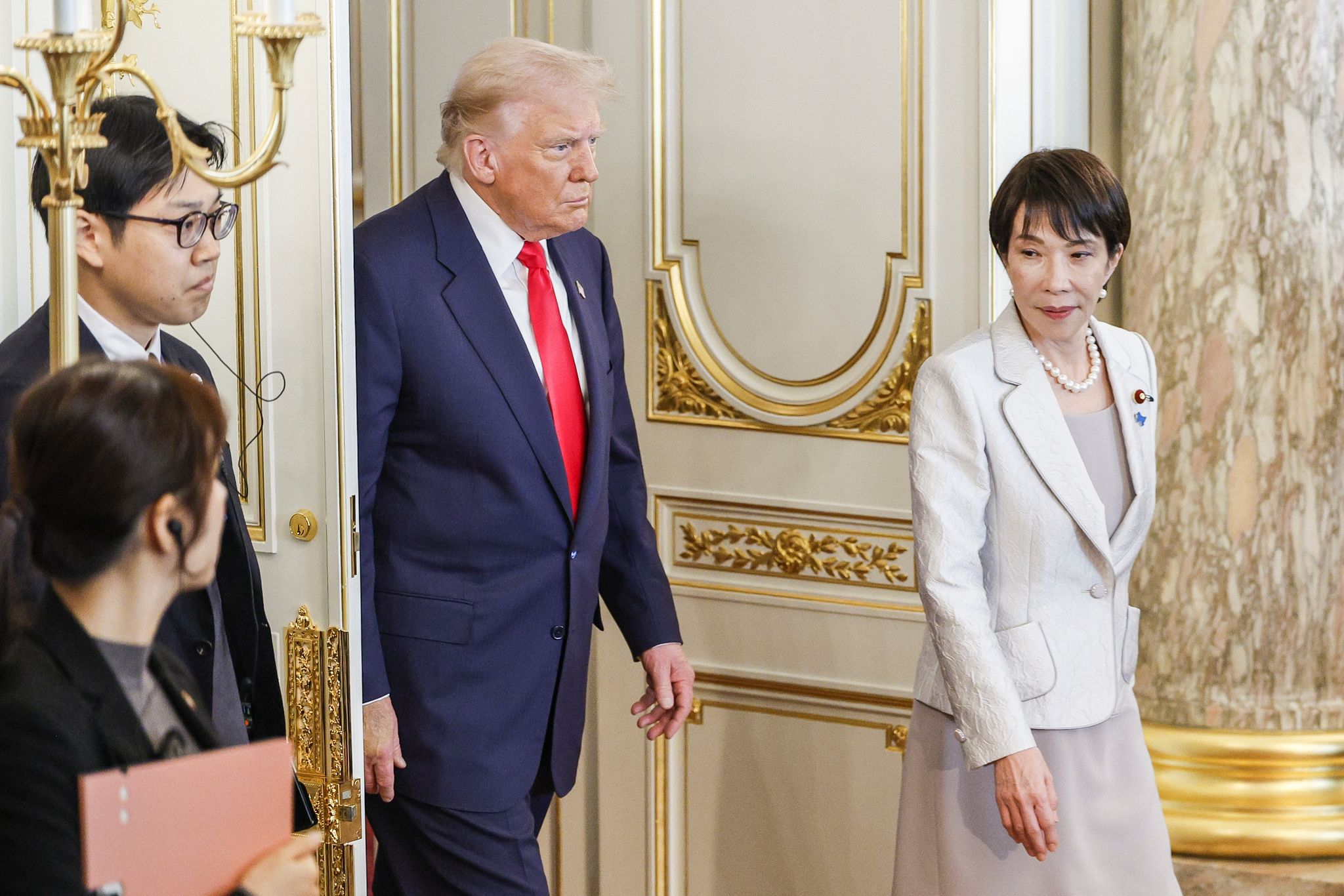
Trump meets with newly elected Japanese Prime Minister Sanae Takaichi in Tokyo
October 28, 2025
Trump praises Japan’s new prime minister, saying U.S. is an ‘ally at the strongest level’
October 28, 2025
With golfing gifts, Japan PM invokes Abe’s legacy to forge Trump bond
October 28, 2025











A peek through the music industry’s curtain at the producers who harnessed social media to help their idols go global.

A series based on diplomatic documents declassified by Japan’s Foreign Ministry

Here is a collection of first-hand accounts by “hibakusha” atomic bomb survivors.

Cooking experts, chefs and others involved in the field of food introduce their special recipes intertwined with their paths in life.

A series about Japanese-Americans and their memories of World War II



