By KOHEI MORIOKA/ Staff Writer
May 27, 2025 at 15:05 JST
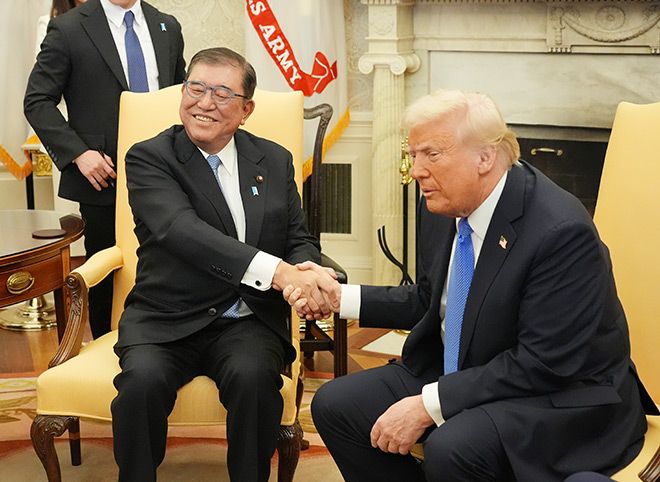 Prime Minister Shigeru Ishiba with President Donald Trump at the White House on Feb. 7 (Asahi Shimbun file photo)
Japanese government officials are trying to determine the purpose behind U.S. President Donald Trump’s sudden phone call to Prime Minister Shigeru Ishiba.
Was Trump setting the stage for demands that Japan buy U.S. fighter jets? Was he trying to get closer to someone he believes is a like-minded leader?
Or was the U.S. president just seeking someone to stroke his ego?
According to Ishiba administration officials, the U.S. side, via the National Security Secretariat, approached Ishiba on the morning of May 23 and said, “U.S. President Trump has asked, ‘Can we talk in a few hours?’”
That exchange occurred just before Japan’s top trade negotiator, Ryosei Akazawa, left for the United States for talks on Trump’s tariffs.
Several senior Japanese government officials said they feared Trump would strengthen his demands that Japan import more U.S. agricultural products or would flat out reject Japanese requests to lower the tariffs.
However, when the phone call began at 11 a.m., Trump’s tone was so relaxed that the Japanese side was taken aback.
“It was as if (Trump) was lying down and talking,” a senior official at the prime minister’s office said.
Trump gave a rundown of his recent trip to the Middle East and praised himself for his “great accomplishments.”
Ishiba chimed in, saying Trump is committed to peace.
Trump then said he would like to further strengthen the military to achieve peace, to which Ishiba agreed was a very good idea.
The topic in this friendly and casual conversation then shifted from the Middle East to U.S.-made fighter jets, officials said.
Trump mentioned the F-47, the sixth-generation fighter jet manufactured by Boeing that was announced in March.
He said the “47” in “F-47” is a good number, and asked Ishiba to agree with him.
The F-47, which will replace the F-22, and is believed to be named in honor of Trump, the 47th president of the United States.
Trump also praised the F-22, which the United States has never tried to sell to Japan, and the F-55, which is considered an upgraded version of the F-35 fighter.
He said the United States has such great fighter jets and asked Ishiba if he would like to take a look at them.
Trump added that he will get “the best” for Japan, the officials said.
Sources said Trump is aware of Japan’s joint development of a fighter jet with Britain and Italy.
However, Trump only causally asked Ishiba if Japan was interested in buying U.S.-made fighter jets, officials said. He never urged Japan to purchase them in conjunction with the tariff negotiations.
The topic of fighter jets may have come up because during the Japan-U.S. summit in February, Ishiba showed interest in the C-17, a large U.S.-made transport aircraft, officials said.
“Trump must have thought, ‘Well, (Ishiba) would understand (aircraft),’ so he went into the in-depth exchange,” one official surmised.
However, Japan would have to overcome a number of obstacles to change its fighter aircraft models, such as pilot training and maintenance.
For this reason, the Japanese government is taking a cautious approach to Trump’s comments about fighter jets. At this point, there are no plans for Ishiba to inspect military aircraft in the United States, sources said.
Although the main purpose of Trump’s trip to the Middle East was to secure business deals, the key issue in the region is peace, something that Trump has failed to secure so far.
“When Trump returns from the Middle East, he will be criticized by his opponents. That’s probably why he said, ‘Let’s call (Ishiba) who will listen to me,’” a Japanese government official said.
Ishiba himself is becoming increasingly confident that he and Trump have chemistry, the official said.
During the 45-minute phone call, Trump and Ishiba agreed to hold a summit in conjunction with the G-7 conference to be held in Canada in mid-June.

Failed Trump meeting deals blow to Ishiba’s diplomatic hopes
November 18, 2024
Ishiba curried Trump’s favor by seeking U.S. C-17 military aircraft
March 13, 2025
'Investment, not tariffs,' Ishiba says after phone talks with Trump
May 23, 2025
Trump says Japan's prime minister will visit him next week
February 1, 2025
Ishiba to ‘ensure’ Trump grasps importance of Japan-U.S. ties
November 20, 2024
Sources: Ishiba seeks agreement with Trump on tariffs in July
May 12, 2025












A peek through the music industry’s curtain at the producers who harnessed social media to help their idols go global.

A series based on diplomatic documents declassified by Japan’s Foreign Ministry

Here is a collection of first-hand accounts by “hibakusha” atomic bomb survivors.

Cooking experts, chefs and others involved in the field of food introduce their special recipes intertwined with their paths in life.

A series about Japanese-Americans and their memories of World War II



