By YUKI EDAMATSU/ Staff Writer
December 23, 2025 at 17:40 JST
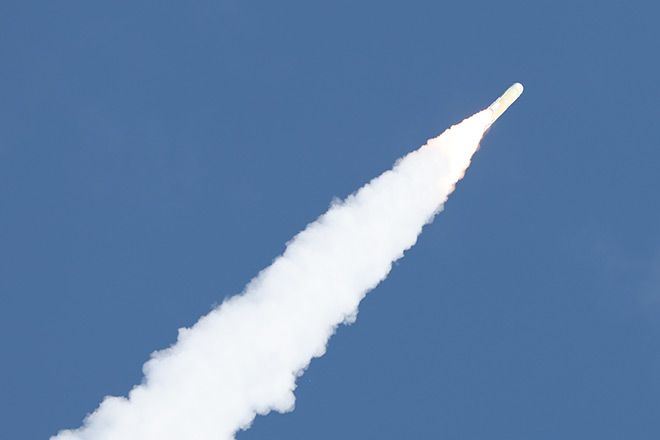
 The payload fairing of the eighth H3 rocket (Provided by Japan Aerospace Exploration Agency)
A satellite's protective cover may have doomed Japan's latest H3 rocket mission, with the space agency now investigating if the shield separated abnormally and crippled the vehicle in flight.
Japan Aerospace Exploration Agency officials told a science ministry panel on Dec. 23 they suspect an abnormal separation of the rocket’s payload fairing—a protective nose cone shield—caused a critical drop in pressure in the second-stage engine’s hydrogen tank.
The eighth launch of the H3 rocket, Japan's flagship launch vehicle, lifted off from the Tanegashima Space Center in Kagoshima Prefecture on Dec. 22 seemingly without incident to the assembled spectators below.
However, the second-stage engine shut down prematurely, failing to deliver the Michibiki No. 5 satellite—part of Japan’s GPS-like Quasi-Zenith Satellite System—to its designated orbit.
According to JAXA, pressure in the second-stage engine’s hydrogen tank began to drop during the first burn, causing thrust to fall by about 20 percent below expectations.
The agency noted the pressure drop began precisely at the moment the payload fairing separated.
The fairing is a shield that protects a satellite from atmospheric pressure and heat during ascent. It is jettisoned once the rocket reaches space.
Data showed a "larger-than-usual impact" during the separation event, leading JAXA to suspect the fairing may have struck the rocket's body as it detached.
The agency added that it has not yet confirmed if the second-stage engine and the Michibiki No. 5 satellite ever separated, nor has it determined their current status.
Japan’s H3 rocket fails to reach orbit after engine shutdown
December 22, 2025

Japan hopes to forge profitable launch business with new H3 rocket
March 22, 2024
H-3 failure could deal setback for Japan’s entire space policy
March 8, 2023
JAXA’s H-3 rocket launch fails again, key satellite lost
March 7, 2023

Japan announces plans to launch upgraded observation satellites on new flagship rocket’s 3rd flight
April 26, 2024
Japan aborts launch of new rocket after abnormality detected
February 18, 2023













A peek through the music industry’s curtain at the producers who harnessed social media to help their idols go global.

A series based on diplomatic documents declassified by Japan’s Foreign Ministry

Here is a collection of first-hand accounts by “hibakusha” atomic bomb survivors.

Cooking experts, chefs and others involved in the field of food introduce their special recipes intertwined with their paths in life.

A series about Japanese-Americans and their memories of World War II



