By SHINTARO KIKO/ Staff Writer
December 20, 2025 at 07:00 JST
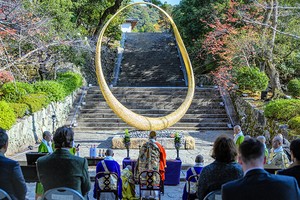
 Priests chant a Buddhist sutra to pray for safety in front of the Magnus RINN in Kyoto’s Higashiyama Ward on Nov. 21. (Shintaro Kiko)


KYOTO—Following the wishes of its Irish creator, a prominent sculpture at the Osaka Kansai Expo is now on public display at Chion-in temple in Kyoto’s Higashiyama Ward.
Titled “Magnus RINN,” the ring-shaped monument measures 6 meters tall, weighs 2 tons and stands between Chion-in’s Sanmon main gate and a flight of stone steps.
It will remain on public exhibit there through September 2026.
It had been featured at the Ireland Pavilion during the world expo, which closed Oct. 13.
Joseph Walsh, the Irish-born artist who created the sculpture, was impressed by the atmosphere and architecture of Chion-in, the head temple of Japan’s Jodo Shu (Pure Land Sect), during a visit shortly after the expo opened on April 13.
Walsh, 46, expressed his wish that his artwork be displayed at the temple.
The monument’s lower section is made of bronze, while its upper section consists of oak wood gilded with gold leaf. Walsh finger-pressed the surface to make patterns.
The artwork is themed on the relationship between humans and nature throughout time and nature’s cycles, and also on cultural exchanges between Ireland and Japan.
The word “rinn” means a place or meeting point in Irish Gaelic and rhymes with “rin,” which means a circle in Japanese, temple officials said.
The relocation came about after Tsujii Landscape Co., which administers Chion-in’s Hojo Garden and is based in Otsu, capital of Shiga Prefecture, undertook the landscaping for the Ireland Pavilion.
A decision was made to have the sculpture displayed at Chion-in following arrangements with the Irish government, the officials said.
A commemorative ceremony took place on Nov. 21.
Walsh said it is his greatest honor that the temple accepted his creation, adding that he hopes his artwork will serve as a bridge between cultures.
“A new relationship has emerged between Ireland and this swath of terrain, where the teaching of ‘nenbutsu’ (prayer to Amitabha Buddha) has been handed down,” said Zencho Tokida, head of Chion-in’s administrative affairs. “I hope the landscape will stand in harmony with history.”

All-night chant held in Kyoto to honor founder of Buddhist sect
April 19, 2025
Kyoto exhibition offers public rare glimpse of cultural artifacts
October 28, 2024
Monks at Kyoto temple test their hanging bell for New Year’s Eve
December 28, 2022
Monument honors victims of deadly Kyoani arson attack
July 16, 2024
Car crashes through ‘Japan’s oldest toilet’ in ancient capital
October 18, 2022













A peek through the music industry’s curtain at the producers who harnessed social media to help their idols go global.

A series based on diplomatic documents declassified by Japan’s Foreign Ministry

Here is a collection of first-hand accounts by “hibakusha” atomic bomb survivors.

Cooking experts, chefs and others involved in the field of food introduce their special recipes intertwined with their paths in life.

A series about Japanese-Americans and their memories of World War II



