THE ASAHI SHIMBUN
December 12, 2025 at 17:49 JST
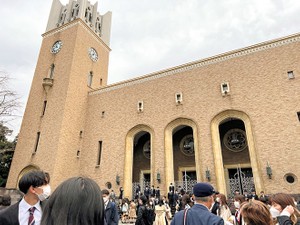
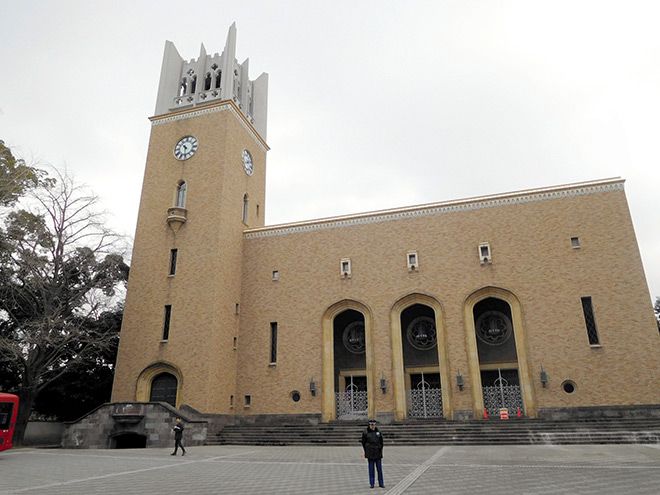 Waseda University in Tokyo’s Shinjuku Ward (Asahi Shimbun file photo)
With caps on tuition for international students lifted, some leading universities in Japan are hiking the fees to boost revenue while others are worried about fairness and hurting campus diversity.
While raising international student tuition aligns Japan with many universities in Western nations, the issue has divided the academic community.
The division in the debate is clear.
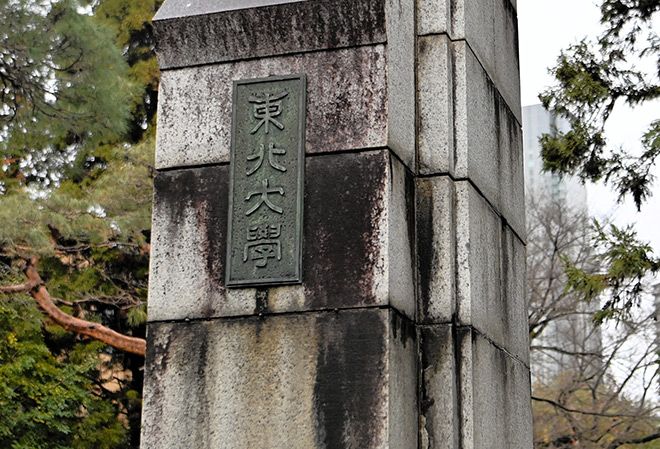
Tohoku University in Sendai and Hiroshima University have committed to raising international student tuition, while Waseda University in Tokyo has announced it is exploring the possibility.
Yet, many of their peers remain cautious or opposed to such a hike.
When contacted by The Asahi Shimbun recently, a significant number of institutions—including top-ranked universities in Tokyo and Kyoto—described the matter as “undecided,” signaling widespread deliberation across the sector.
DEREGULATION OPENS THE DOOR
Tuition fees for national universities are set by an education ministry ordinance at a standard 535,800 yen ($3,500) per year. Universities are free to set their own fees up to a ceiling of 1.2 times that amount, or 642,960 yen.
However, the ministry removed this cap for international students only in March 2024.
In response, Tohoku University announced on Dec. 1 that from the 2027 academic year, it will raise tuition to 900,000 yen—1.7 times the current rate—for incoming undergraduate and master's program students.
Hiroshima University has also decided on a policy to raise fees for undergraduate students and is currently considering the amount and timing of the increase.
Waseda University also announced this month that it is considering a hike for students who have not yet mastered the Japanese language.
When The Asahi Shimbun surveyed universities that accept a large number of international students, Osaka University, Hokkaido University and Keio University in Tokyo responded that they are "not considering it."
On the other hand, the University of Tokyo, Kyoto University, Nagoya University, Kyushu University in Fukuoka, the University of Tsukuba in Ibaraki Prefecture, and the Institute of Science Tokyo stated that the matter is "undecided."
CONTENTIOUS DEBATE
The president of a national university that is "not considering" hiking tuition for international students said, "A tuition increase would have a significant impact on applicants from developing countries. It could narrow the diversity of our students' home regions."
The president of a private university that is "currently considering what to do" said, "We need to carefully examine and consider the difference in the cost required for Japanese students versus international students. We shouldn't make a simplistic decision just because universities in the United States and Britain charge international students two or three times more."
International students often require special attention from universities due to differences in language and lifestyle, which tends to increase personnel and other university costs.
For this reason, prominent national universities hoping to increase their enrollment of international students had requested deregulation, leading to the ministry to revise its ordinance on student tuition in 2024.
INCENTIVES AND CONDITIONS
However, national universities willing to raise their tuition were slow to take action.
An education ministry official said, "I suspect that while multiple universities were considering it, none wanted to be the 'first penguin.'"
A penalty related to student enrollment caps also posed an obstacle for universities wanting to accept more international students.
For large faculties, if the number of students reaches 105 percent of the enrollment capacity, the university is barred from establishing new faculties.
Since it is difficult to predict the number of international students, universities wanting to avoid the penalty were reluctant to increase their intake.
In response, the ministry introduced a special exemption in July to ease this regulation.
If universities meet certain conditions, such as creating a plan to increase their international student ratio by 10 percent or more over 15 years, the penalty threshold is raised to "110 percent of the enrollment capacity."
At that time, the ministry requested that universities implement financial measures such as raising tuition for international students.
A senior ministry official said, "Without covering the costs, you cannot guarantee an improved quality of education."
While not mandatory, the universities are strongly urged to take such measures.
A national university president criticized this requirement, saying, "To achieve a multicultural society, it is necessary to treat everyone equally, regardless of their origin or cultural background. Tuition should not differ based on one's place of origin or nationality."
Conversely, another national university president, mindful of political opposition to increasing international student numbers, said, "When you consider the balance, it can't be helped."
GLOBAL CONTEXT
At prominent universities in the United States and Britain, international students often pay much higher tuition than domestic students.
For example, at the University of Cambridge in Britain, tuition from 2025 to 2026 is 9,535 pounds (1.9 million yen) per year for domestic students. For international students, it ranges from 27,024 to 70,554 pounds, depending on the faculty.
In the United States, private universities such as Harvard University charge the same tuition for both international and domestic students.
On the other hand, at state universities, it is common for out-of-state students, including international ones, to pay higher tuition than in-state students.
For example, the University of Maryland charges in-state students more than $10,000 (1.5 million yen) and out-of-state students more than $40,000.
However, the United States offers a robust system of various scholarships and financial aid, allowing many international students to attend universities with a smaller financial burden.
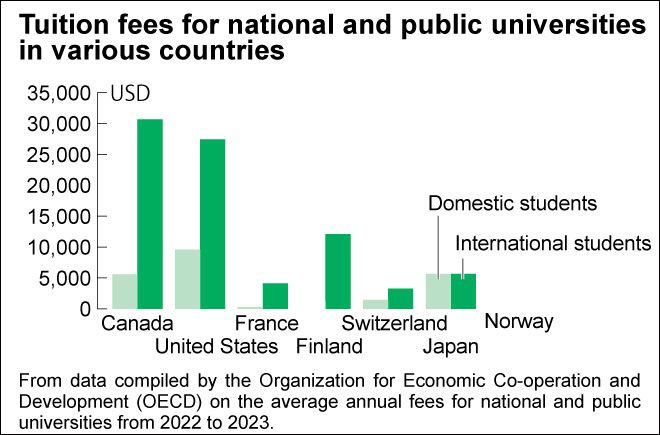
According to data from the Organization for Economic Co-operation and Development (OECD), looking at tuition fees at national and public universities in 18 comparable countries from 2022 to 2023, only five countries had no difference between the two groups: Japan, Italy, Germany, Norway and Spain.
In Norway, tuition was free for both international and domestic students.
In other countries, tuition for international students was 2 to 16 times higher.
When looking at the amount converted to U.S. dollars to account for price levels, France had the largest ratio at 16 times.
The price difference in Canada was as high as 5.5 times.
Some countries also had different tuition fees depending on whether a student was from within or outside the EU.
Among these, Finland's tuition was free for students from within the EU, while international students were charged $12,084.
(This article was written by Fumio Masutani, Amane Shimazaki and Kayoko Sekiguchi.)

Tohoku Univ. to hike foreign student tuition 70% in 2027
December 1, 2025
Waseda mulling tuition hike for non-fluent foreign students
December 6, 2025
University of Tokyo to raise tuition fee by 20% next year
September 11, 2024
Four national universities to hike tuition from next April
November 4, 2025
EDITORIAL: Universities need more funding for tuition to remain affordable for all
June 26, 2024
EDITORIAL: Todai’s planned tuition hike could pose issues for needy students
September 14, 2024















A peek through the music industry’s curtain at the producers who harnessed social media to help their idols go global.

A series based on diplomatic documents declassified by Japan’s Foreign Ministry

Here is a collection of first-hand accounts by “hibakusha” atomic bomb survivors.

Cooking experts, chefs and others involved in the field of food introduce their special recipes intertwined with their paths in life.

A series about Japanese-Americans and their memories of World War II



