REUTERS
November 12, 2025 at 18:19 JST
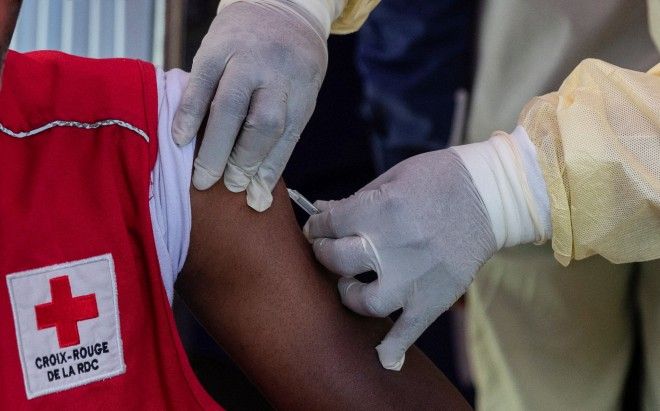 A Congolese health official administers a mpox vaccination to a Congolese Red Cross worker, a key step in efforts to contain an outbreak that has spread from its epicentre, at a hospital in Goma, North Kivu province of the Democratic Republic of Congo on Oct. 5, 2024. (REUTERS)
LONDON--Around a third of mpox vaccines donated by Japan to the Democratic Republic of Congo are being wasted because they cannot be stored once prepared for use, the head of Congo’s mpox response told Reuters.
Japan has donated three million doses of its LC16 vaccine to Congo to help fight a new form of mpox known as clade Ib, which spread internationally and sparked a global health emergency last year. The second tranche of 1.5 million doses arrived in Congo in September, around two years after the outbreak began.
Congo began vaccinating with LC16 in Kinshasa in August and more than half a million people have now been vaccinated with either LC16 or Bavarian Nordic’s vaccine, Cris Kacita, Congo’s mpox lead, said, although some data is outstanding.
“But ... the loss rate (for LC16) is enormous,” he added. “It’s around 32-35%. But we’re really doing everything we can to prevent loss.”
STORAGE CHALLENGE
Each LC16 vial contains 250 powder doses that must be mixed before use and cannot be stored for more than a few hours once opened, Kacita said, meaning leftover vaccine goes to waste if turnout is low.
The World Health Organization guides countries to expect that between 5% and 50% of vaccines are wasted, with vaccines made like LC16 usually on the higher end due to the storage challenge.
Mpox is a viral infection that spreads through close contact and typically causes flu-like symptoms and pus-filled lesions. It is usually mild but can be fatal, particularly for children, pregnant women and people with weakened immune systems.
LC16, made by KM Biologics, is the only vaccine approved for children and is being given to children aged one and above as well as adults, but it is technically complex, requiring a specific needle and technique.
There are also challenges delivering the vaccine in some of the worst-affected provinces, which are remote or politically unstable, Kacita said. But the vaccine has still helped tackle mpox, particularly in Kinshasa, he said.
The Japanese government said by email that it had not been informed about the wastage issue but trusted the Congo government to use the doses well.
This year, there have been 53,657 recorded mpox cases in Congo, Kacita said, down from 67,247 last year.
Mpox transmission is ongoing in 17 countries across Africa, the WHO said this month, but it downgraded the outbreak from a global health emergency in September due to declining infection rates in hot spots, including Congo.

Congo asked Japan for 2 million mpox vaccine doses, health officials say
August 28, 2024
Japan will ship mpox vaccines four months after request made
December 20, 2024
China’s children may be next in line for COVID-19 vaccines
June 11, 2021
WHO panel OKs emergency use of China’s Sinopharm vaccine
May 8, 2021
More COVID-19 vaccines coming to Taiwan as cases spike
May 18, 2021











A peek through the music industry’s curtain at the producers who harnessed social media to help their idols go global.

A series based on diplomatic documents declassified by Japan’s Foreign Ministry

Here is a collection of first-hand accounts by “hibakusha” atomic bomb survivors.

Cooking experts, chefs and others involved in the field of food introduce their special recipes intertwined with their paths in life.

A series about Japanese-Americans and their memories of World War II



