September 17, 2025 at 16:36 JST
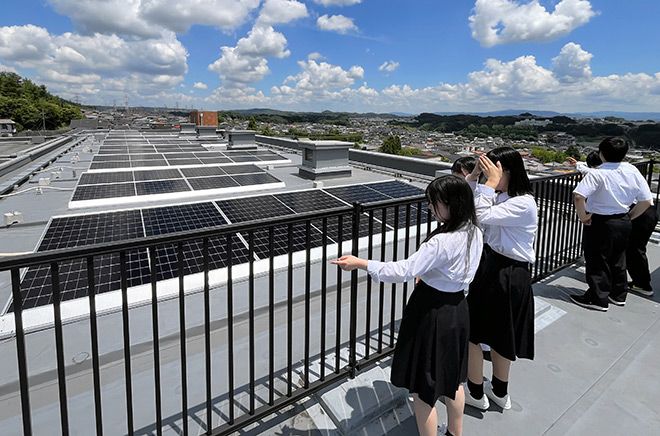 Solar panels on the roof of a Nara elementary school (Makoto Ito)
Solar panels supported the expansion of renewable energy in the wake of the 2011 Great East Japan Earthquake.
These panels are said to have life spans of between 20 and 30 years, meaning a large volume will be discarded from the late 2030s.
One estimate is that as much as 500,000 tons would be disposed of in a year.
That is a volume similar to discarded cars and is also equivalent to the total volume of the four major home appliances being discarded.
After the Central Environment Council compiled its view in March, the Environment Ministry and economy ministry began considering making the recycling of solar panels mandatory and setting up a system in which producers and importers of panels would shoulder the expense.
But the ministries abandoned that plan and are now considering an alternative.
Establishing a structure that will ensure recycling is urgently needed.
Discussions until now have been based on expanded producer responsibility in which manufacturers of solar panels would bear a certain responsibility for disposing or reusing the materials once the solar panels were no longer used
But the Cabinet Legislation Bureau pointed out that the proposal would contradict the existing legal framework regarding recycling.
A major point is that users of home appliances and cars now bear the recycling cost.
In fiscal 2023, solar energy generation increased by about twentyfold over fiscal 2011 and now accounts for about 10 percent of total power generation.
The government is striving to convert renewable energy into a major energy source so expansion of solar power is a must.
Because of that, progress has to be made in promoting reuse and developing recycling technology so that a system is established to ensure proper disposal and reuse of the materials found in solar panels.
The bad example of nuclear power, which has failed to resolve the issue of disposal of radioactive waste, should not be repeated.
Japan is said to have the largest solar panel installation capacity per land area among the major nations.
But there is still room to further expand installation, by utilizing the roofs of homes and buildings, the sides of roads and railway tracks as well as unused farm land.
There are expectations for further spread of installation locations with progress being made to develop solar cells in sheet form.
But concerns have been raised about the effect on the ecosystem and scenery as well as possible landslides, particularly in Hokkaido with its mega solar farms.
It will be necessary to proceed with installation while conducting thorough discussions with local communities.
The need to expand natural energy is unmistakable given that it would be an entirely domestic energy source as well as a measure to deal with climate change.
We cannot depend forever on nuclear energy, which comes with the risk of tremendous damage should an accident occur and also faces major issues of economic feasibility and waste.
The government is said to be considering making mandatory reporting on the actual state of recycling.
But can a truly effective system be implemented only through requiring reports and requesting that efforts be made to recycle?
While solar panels contain materials such as aluminum, silver and copper with a high value, it is much more difficult to reuse the glass now found in such panels.
Other issues that will have to be dealt with are the higher cost of recycling compared to simply burying the discarded solar panels as well as the fact that many of the panels are made abroad.
If recycling is made obligatory, it would promote further technology development and lead to a reduction of expenses if the recycling volume expands.
Establishing an effective system will be indispensable.
--The Asahi Shimbun, Sept. 17











A peek through the music industry’s curtain at the producers who harnessed social media to help their idols go global.

A series based on diplomatic documents declassified by Japan’s Foreign Ministry

Here is a collection of first-hand accounts by “hibakusha” atomic bomb survivors.

Cooking experts, chefs and others involved in the field of food introduce their special recipes intertwined with their paths in life.

A series about Japanese-Americans and their memories of World War II



