By YUJI MASUYAMA/ Staff Writer
July 4, 2025 at 14:54 JST
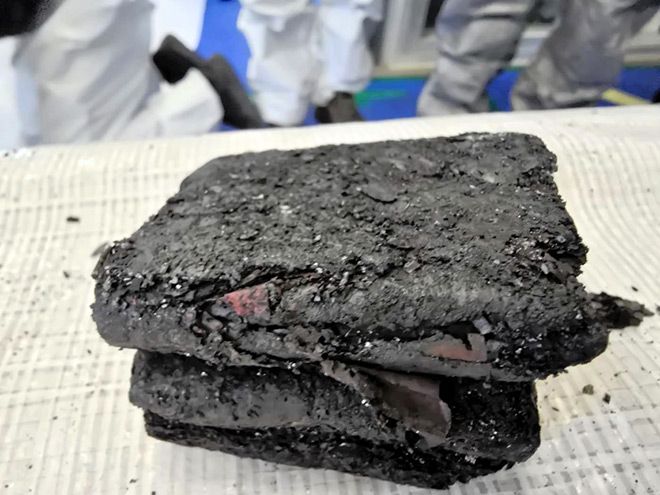 A charred power bank found in the wreckage of an Air Busan aircraft (Provided by Aviation and Railway Accident Investigation Board of South Korea)
Japan’s transport ministry announced new air safety regulations that require passengers to keep power banks in plain sight and not in overhead bins to mitigate fire risks on board.
The policy move follows a series of incidents in which lithium ion battery packs overheated or caught fire.
From July 8, passengers on 23 Japan-based airlines will be required to keep their battery packs where cabin staff can monitor the devices during flight.
In January, a power bank triggered a fire that destroyed an aircraft operated by budget carrier Air Busan at South Korea’s Gimhae International Airport.
All 176 passengers and crew members managed to evacuate but 27 were injured.
The fire is believed to have started near the rear luggage compartment. The charred remains of a power bank were found nearby.
Following the incident, South Korean airlines banned passengers from storing power banks in overhead compartments, requiring them to keep the devices close at hand at all times.
On April 28, a power bank was blamed for a fire that forced a Hawaiian Airlines’ flight from Honolulu to make an emergency landing at Tokyo’s Haneda Airport.
Most of the incidents were quickly dealt with by cabin attendants, according to Japan’s transport ministry and other authorities.
International aviation rules prohibit passengers from storing power banks in checked baggage. Batteries exceeding 160 watt-hours are banned due to the potential fire risk. Passengers may only carry two battery packs rated between 100 W and 160 W.
Although the new request is not legally binding, airlines, in coordination with the transport ministry, are seeking maximum passenger cooperation.
Huge fire closes U.K.’s Heathrow Airport, global flight schedules disrupted
March 21, 2025
A jet‘s carbon-composite fiber fuselage burned on a Tokyo runway. Is the material safe?
January 5, 2024
Korean Air plane bumps another aircraft when towing tractor slips at a Japanese airport
January 17, 2024
JAL plane catches fire at Haneda; all aboard safe
January 2, 2024










A peek through the music industry’s curtain at the producers who harnessed social media to help their idols go global.

A series based on diplomatic documents declassified by Japan’s Foreign Ministry

Here is a collection of first-hand accounts by “hibakusha” atomic bomb survivors.

Cooking experts, chefs and others involved in the field of food introduce their special recipes intertwined with their paths in life.

A series about Japanese-Americans and their memories of World War II



