By RYO KIYOMIYA / Correspondent
June 2, 2025 at 16:10 JST
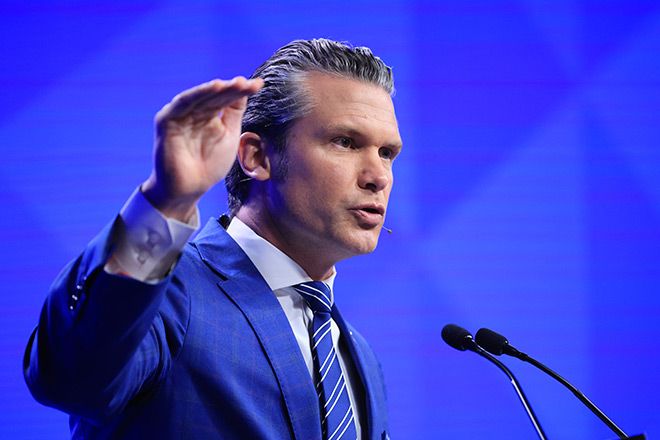 U.S. Secretary of Defense Pete Hegseth speaks at the Shangri-La Dialogue conference on May 31 in Singapore. (Kazuhiro Nagashima)
U.S. Secretary of Defense Pete Hegseth said Japan must immediately bolster its defense spending to help counter China’s “unprecedented” military buildup and aggressive posture.
“Deterrence does not come cheap and every single one of our allies and partners must do more now, including Japan,” Hegseth said in written interview with The Asahi Shimbun on May 31. “I cannot overstate the urgency of this challenge, of confronting the hard truth about the threat the United States and Japan face.”
Hegseth described China as a “pacing threat” and “top priority” for the United States.
“Communist China is building up its military at an unprecedented pace and has a growing willingness to use force to dominate the Indo-Pacific region,” he wrote.
Hegseth said he has shown clear support for European allies to heighten defense of their continent by increasing defense spending to 5 percent of their GDP.
“Our Asian allies and partners should look to European countries as an example in defense spending to meet the far more formidable threat from Communist China, not to mention North Korea,” he said.
Hegseth visited Singapore for the Shangri-La Dialogue, an Asian defense conference organized by the International Institute for Strategic Studies and supported by The Asahi Shimbun and others.
In a May 31 speech there, Hegseth called on allies in the Indo-Pacific region to increase defense spending, although he did not name the countries.
In the written interview, Hegseth said: “I am supportive of the work Japan is doing to strengthen the Japan Self-Defense Forces and improve its indigenous capabilities, but more must be done, and it starts with ensuring our defense spending reflects the danger of the threats we face today.”
He added, “The United States and Japan must act with a sense of urgency to modernize our Alliance to deter those threats and respond to potential contingencies.”
In March, Hegseth visited Japan and the Philippines on his first overseas trip to the Indo-Pacific region as U.S. defense chief.
He met with Defense Minister Gen Nakatani and announced that the United States had started the first phase of upgrading U.S. military command in Japan.
“The old command and control structure in Japan did not meet our modern threat environment,” he said in the written interview.
He said the upgrade is about “warfighting and deterrence, and common sense.”
“Developing joint warfighting capabilities and enhancing interoperability with Japan will greatly strengthen our deterrence posture in the Indo-Pacific region and ultimately allow the Alliance to effectively deter and, if necessary, prevail in conflict.”
When asked how the United States plans to balance its deterrence against China with the ongoing wars in Ukraine and the Middle East, Hegseth said Washington is not abandoning other theaters.
“We are using common sense by allocating resources more prudently and asking our allies and partners to do their fair share,” he said.
He indicated the United States will seek an expanded security role for Japan and other countries in the region.
“Prioritizing deterring China requires us to make hard choices alongside our allies and partners,” Hegseth said. “We are asking, and indeed insisting, that our allies do their part to be real force multipliers, so America can concentrate where it counts most.”
Regarding the situation in the Middle East, he said the United States fully supports Israel’s defense.
“We will continue to support the President (Donald Trump) and Special Envoy (Steve) Witkoff’s efforts to achieve peace through strength in the region,” he said.
He added, “There will be no forever wars in the Middle East in this Administration.”

Hegseth says U.S. will stand by Indo-Pacific allies against ‘imminent’ threat of China
May 31, 2025
Hegseth says Japan on 'front lines' in western Pacific
March 31, 2025
Japan and U.S. confirm security treaty covers Senkakus
January 31, 2025
INTERVIEW/ Yoshihide Yoshida: Top SDF officer vows to deter aggression in Indo-Pacific
September 2, 2024
Pentagon releases footage of hundreds of ‘highly concerning’ aircraft intercepts by Chinese planes
October 18, 2023
Japan-U.S. security talks focus on bolstering military cooperation, underscores threat from China
July 29, 2024











A peek through the music industry’s curtain at the producers who harnessed social media to help their idols go global.

A series based on diplomatic documents declassified by Japan’s Foreign Ministry

Here is a collection of first-hand accounts by “hibakusha” atomic bomb survivors.

Cooking experts, chefs and others involved in the field of food introduce their special recipes intertwined with their paths in life.

A series about Japanese-Americans and their memories of World War II



