Vox Populi, Vox Dei is a daily column that runs on Page 1 of The Asahi Shimbun.
February 10, 2025 at 13:46 JST
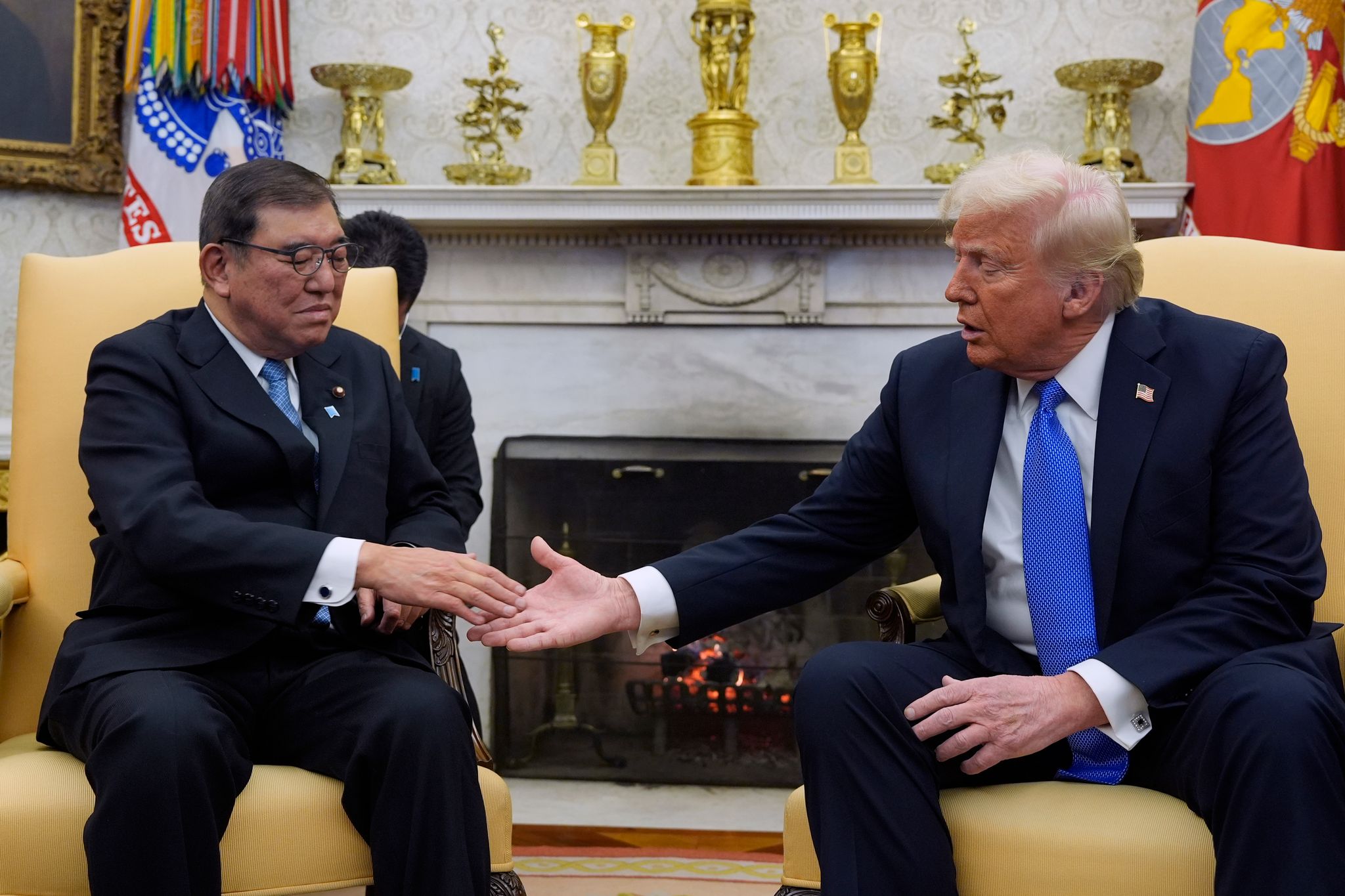
 U.S. President Donald Trump with Japanese Prime Minister Shigeru Ishiba in the Oval Office of the White House on Feb. 7 in Washington (AP Photo)
Would this analogy be considered rude?
The president of a subcontracting company visits a client. He greets the new, eccentric president of the client company.
In a position where his livelihood depends on this person, he offers a couple of compliments to the new boss of the crucial business partner and politely requests the continuation of their usual contract.
For now, he gets an OK, but the future remains uncertain.
This is how the first meeting between Prime Minister Shigeru Ishiba and U.S. President Donald Trump looked. Ishiba, with great reverence, addressed Trump as “Your Excellency, the President” and praised him as a leader who seemed to have been re-elected with the belief that he was "chosen by God.”
Trump, for his part, mistakenly referred to Nippon Steel Corp. as “Nissan” and repeatedly mentioned the name of former Prime Minister Shinzo Abe.
I have no intention of sneering at Ishiba’s behavior. His flattery reflects Japan’s pathetic diplomatic portrait itself. Even if one stages it beautifully as entering a “golden age,” the Japan-U.S. relationship has never been truly equal.
During the past 100 and dozens of meetings with U.S. presidents, successive Japanese prime ministers have strived to manage this relationship well.
One managed to ensure that he and the U.S. president were on a first-name basis, calling each other Ron and Yasu, and another took the trouble of spending a day playing 27 holes of golf with the president.
Were all these desperate sales efforts to forge a "relationship of trust" and somehow make an inroad with the vital trading partner through direct talks?
Historian E.H. Carr points out in his renowned book, “The Twenty Years' Crisis,” that what matters in international politics are military power, economic power and “power over opinion.”
The political leader of a smaller country is always required to master “the art of persuasion.”
Eighty years after the end of World War II, the United States is moving in a dangerously uncertain direction. Japan cannot afford to loudly correct this course, nor can it afford to simply be swept along with it.
We must face the harsh reality of our situation as it is.
—The Asahi Shimbun, Feb. 9
* * *
Vox Populi, Vox Dei is a popular daily column that takes up a wide range of topics, including culture, arts and social trends and developments. Written by veteran Asahi Shimbun writers, the column provides useful perspectives on and insights into contemporary Japan and its culture.
Trump tells Ishiba at the White House that he wants to slash the US trade deficit with Japan
February 8, 2025
Trump says Japan's prime minister will visit him next week
February 1, 2025
Ishiba holds first meeting with Xi; ties with U.S. and S. Korea affirmed
November 16, 2024
Failed Trump meeting deals blow to Ishiba’s diplomatic hopes
November 18, 2024
President-elect Trump hosts Akie Abe at Mar-a-Lago estate
December 16, 2024
Ishiba coached on making good case to forestall Trump demands
February 4, 2025











A peek through the music industry’s curtain at the producers who harnessed social media to help their idols go global.

A series based on diplomatic documents declassified by Japan’s Foreign Ministry

Here is a collection of first-hand accounts by “hibakusha” atomic bomb survivors.

Cooking experts, chefs and others involved in the field of food introduce their special recipes intertwined with their paths in life.

A series about Japanese-Americans and their memories of World War II



