By JIN HIRAKAWA/ Staff Writer
July 18, 2024 at 17:30 JST
 This street adjacent to Kadena Air Base in Okinawa Prefecture is lined with bars and clubs. (Jin Hirakawa)
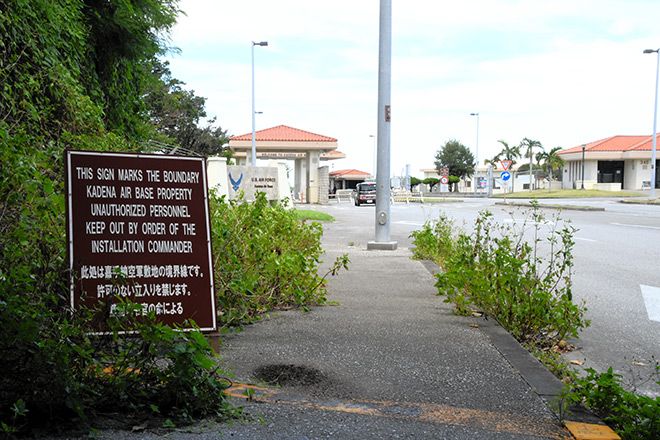

OKINAWA, Okinawa Prefecture—The apparent hush-up of another suspected sex crime by a U.S. serviceman in Okinawa Prefecture has stoked furor in Japan.
It appears that while the incident went unreported for months, the U.S. military was doing little to prevent a recurrence.
None of the five U.S. military personnel contacted by The Asahi Shimbun over three days in late June around Kadena Air Base, where the suspect was stationed, said they had heard about the case or known of a curfew or any other steps imposed.
Brennon Washington, 25, a U.S. airman, was indicted in March on suspicion of abducting and sexually assaulting a girl under the age of 16 in Okinawa Prefecture in December.
The case was not disclosed to the media and was unknown even to the Okinawa prefectural government until a local broadcaster broke the news on June 25.
A U.S. airman was asked about the case on a neon-lit street lined with bars and clubs in the city of Okinawa late on June 26.
“A sexual assault case? No, I didn’t know,” said the man, who is also in his 20s. He was transferred to Kadena from the United States a few months ago.
When a reporter showed the man an article about the case, he replied, “This is like going into someone else’s house and spitting on their doormat. He should be in jail.”
The government has said it called on the U.S. side to strengthen discipline and prevent a recurrence when Washington was indicted, although it did not publicize this at the time.
But when asked whether superior officers informed service members of preventive measures or even alerted them to the incident, the airman said, “I didn’t hear about any of them. No curfews, no restrictions or collective punishment.”
A Navy crew member in his 20s said, “It has been a few years since I came to Okinawa, but as far as I can remember, there haven’t been any restrictions.”
In the past, the U.S. military responded to sexual assaults, murders and other serious crimes by service personnel in Okinawa Prefecture with curfews or an alcohol ban, for example.
Many of the people contacted said this crime was the responsibility of an individual, not an organization.
A former soldier in his 30s, who was walking along a beach in the town of Chatan, said, “Children are the most vulnerable people. It is crazy. He should be punished and go to jail.”
But he continued, “It is not just the military. Doctors and teachers have sex with children, too.”
Critics say the Japan-U.S. Status of Forces Agreement grants a privileged position to U.S. military personnel.
The former soldier, who worked at Kadena Air Base, acknowledged that there is an imbalance.
“Why wouldn’t there be inequality? If you are stronger, you can make any deal if you want to,” he said. “The unequal treaty came after the bombs, and you couldn’t change it for 79 years. You just have to go through it.”
A soldier in the reserves, who was deployed to Okinawa Prefecture in June, said he resents criticism of the crimes of U.S. service personnel.
“Why do people talk about the crimes committed by the Americans and not the ones committed by the Okinawans?” he said.
“Of course, if there were no U.S. bases, there would be no crimes committed by the Americans. But then, the Chinese will come and commit the same crimes. Unless Okinawa gets the power to defend itself, we should stay here.”
Nicholas Evans, commander of the U.S. 18th Wing at Kadena Air Base, who is the top U.S. Air Force officer in Okinawa Prefecture, visited the prefectural government office on June 27.
“These criminal allegations do not reflect the values of thousands of U.S. service members that serve honorably in Okinawa in support of the U.S.-Japan alliance,” he said in a meeting with Okinawa Deputy Governor Takekuni Ikeda.
But he did not offer an apology over the incident.
Kadena Air Base told The Asahi Shimbun on July 10 that the 18th Wing offers education and training to newly assigned personnel. It also said U.S. Forces Japan regularly reviews the Liberty Policy, which restricts the off-base activities of service members.
But officials did not discuss any specific measures to prevent a recurrence.
In the wake of Washington’s case, four other suspected sex crimes involving U.S. service members in Okinawa Prefecture came to light. All were previously unreported.
U.S. Ambassador Rahm Emanuel and Lt. Gen. Roger Turner, Okinawa Area Coordinator of the U.S. Forces Japan, issued a statement on July 12.
The statement said superior officers will contact every member of the U.S. military serving in Okinawa Prefecture to reinforce the Liberty Policy. Other measures will be applied, too, including a unified Liberty Policy for all branches of U.S. Forces Japan.
As of the end of March 2013, Japan hosted about 105,000 individuals related to the U.S. military such as service personnel, civilian employees and family members, according to an Okinawa prefectural document based on Defense Ministry information.
About 52,000 of the personnel were in Okinawa Prefecture and about 16,000 resided off base.
The Defense Ministry said the U.S. side stopped releasing such figures in 2014, citing international threats.

U.S. airman denies raping underage girl in Okinawa
July 12, 2024
Okinawa police mum on another sex crime tied to U.S. military
June 28, 2024
Okinawa angry over lack of info about suspected assault of minor
June 27, 2024
Okinawa ire at being left in dark on sex crimes by U.S. servicemen
June 29, 2024
U.S. airman charged over sex crime with minor in Okinawa
June 25, 2024
Japan protests sex assault cases involving U.S. military on Okinawa
June 29, 2024














A peek through the music industry’s curtain at the producers who harnessed social media to help their idols go global.

A series based on diplomatic documents declassified by Japan’s Foreign Ministry

Here is a collection of first-hand accounts by “hibakusha” atomic bomb survivors.

Cooking experts, chefs and others involved in the field of food introduce their special recipes intertwined with their paths in life.

A series about Japanese-Americans and their memories of World War II



