Vox Populi, Vox Dei is a daily column that runs on Page 1 of The Asahi Shimbun.
December 29, 2025 at 13:10 JST
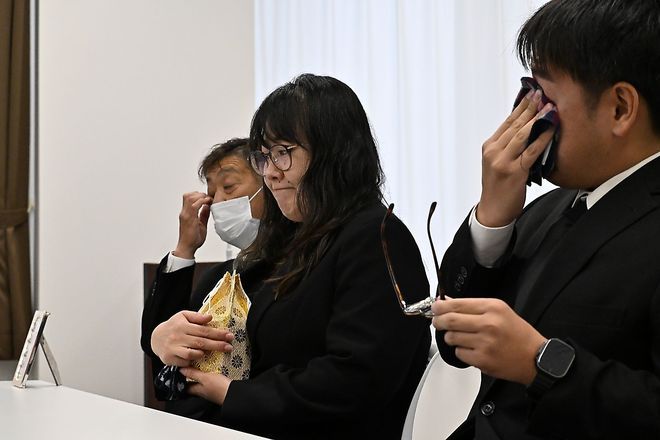 Chiyumi Yamane holds an urn containing the remains of her daughter, Natsuse, who was swept away in the 2011 tsunami, on Oct. 16 in Minami-Sanriku, Miyagi Prefecture. Her husband, Tomonori, left, and her son, Daiya, wipe away tears. (Asahi Shimbun file photo)
We live through words. At times our hearts leap with joy; at others we tremble with anger or sink into sorrow. Yet it is always through words that we make our way through the day, navigating the shifting landscapes of thought, emotion and meaning.
As this year draws to a close, it feels only fitting to look back through the words that left a lasting impression.
In January, Ichiro Suzuki was elected to the U.S. National Baseball Hall of Fame, finishing one vote shy of unanimity. With a soft smile and a trace of reflection, the legend murmured, “After all ... there’s something quietly good about being incomplete.”
He continued, “It’s that very incompleteness that allows us to keep moving forward.”
In a recent case, a 12-year-old Thai girl was placed under protective custody as a victim of human trafficking. Abandoned in Tokyo by her mother, the girl had been forced to provide sexual services at a massage parlor.
“I hated it. I didn’t want to do it,” she said. But she was terrified of the consequences of running away. “If I didn’t work, my family wouldn’t be able to survive.”
One can only imagine the excruciating pain of being left alone and trapped in the sex industry in a foreign land where she did not even speak the language.
Eighty years after the end of World War II, Japan’s identity as a “peaceful nation” feels lonelier than ever. Its once-proud banner is now shadowed by uncertainty.
In the July Upper House election, a candidate who claimed that “nuclear armament is the most cost-efficient option” was elected.
A high-ranking official at the prime minister’s office even remarked, “Japan should possess nuclear weapons.” Where, then, is this country headed?
During Japan-U.S. tariff negotiations, then Prime Minister Shigeru Ishiba blustered, “I won’t let them look down on us.”
Meanwhile, his successor and the incumbent prime minister, Sanae Takaichi, was asked in the Diet about the political slush fund scandal involving the ruling Liberal Democratic Party. Her response began with a dismissive pivot: “More importantly than such a thing ... .”
It is a shallow brand of politics, one that recalls former Prime Minister Shinzo Abe’s derogatory reference to hecklers as “people like them.”
The remains of Natsuse Yamane, who went missing in the 2011 Great East Japan Earthquake at the age of 6, were finally returned to her family, a reunion 14 years in the making.
“Welcome home. Thank you for coming back,” said her mother, Chiyumi. “The clock that had stopped has finally started ticking again.”
Soon, a new year will arrive.
--The Asahi Shimbun, Dec. 29
* * *
Vox Populi, Vox Dei is a popular daily column that takes up a wide range of topics, including culture, arts and social trends and developments. Written by veteran Asahi Shimbun writers, the column provides useful perspectives on and insights into contemporary Japan and its culture.

Human remains identified as girl who disappeared in 2011 tsunami
October 10, 2025
VOX POPULI: I'm making my new year wish in an old-fashioned paper planner
December 27, 2025
VOX POPULI: Jumbo Ozaki and his ‘limitless power’ redefined golf in Japan
December 26, 2025
VOX POPULI: As ‘100th year of Showa’ nears, how does Japan treat history?
December 25, 2025
VOX POPULI: Children’s words are gifts of perspective during holidays
December 24, 2025
VOX POPULI: Niigata nuclear plant’s return an ugly paradox for big city residents
December 23, 2025





A peek through the music industry’s curtain at the producers who harnessed social media to help their idols go global.

A series based on diplomatic documents declassified by Japan’s Foreign Ministry

Here is a collection of first-hand accounts by “hibakusha” atomic bomb survivors.

Cooking experts, chefs and others involved in the field of food introduce their special recipes intertwined with their paths in life.

A series about Japanese-Americans and their memories of World War II



