By JUNJI MURAKAMI/ Staff Writer
December 29, 2025 at 07:00 JST
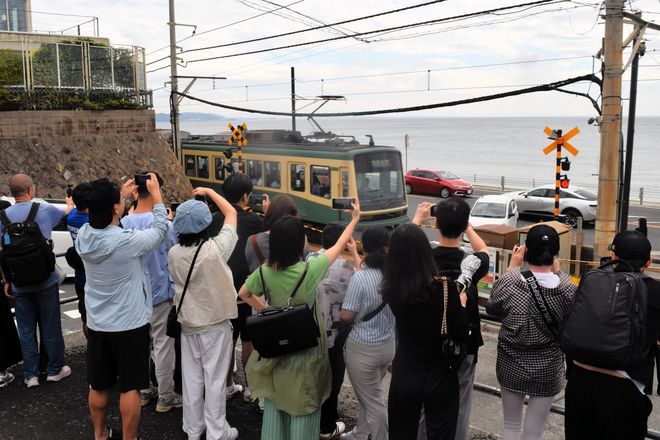 Tourists photograph the Enoden train, the railway crossing and the sea on Oct. 1 in Kamakura, Kanagawa Prefecture. (Junji Murakami)


Some 750 years after the Kamakura Shogunate fended off foreign invasions of the Kyushu region, the ancient capital of Kamakura in Kanagawa Prefecture is under siege.
This time, officials are turning to artificial intelligence to fight the influx of tourists fueled by a pop-culture phenomenon known as “anime pilgrimage.”
The coastal city just south of Yokohama—renowned as the seat of Japan’s first shogunate—has installed 12 AI-driven cameras near a railway crossing in a residential area.
The cameras are designed to address growing problems at the site, which has become a magnet for fans of the iconic basketball anime “Slam Dunk,” sparking a spate of overtourism complaints.
Officials say the system tracks visitor numbers and congestion, and also collects information on vans believed to be transporting inbound tourists, which pass through nearby neighborhoods or park along residential streets.
PILGRIMAGE FRENZY
According to the city, 12 AI cameras were installed in mid-December at locations associated with the anime—including five railway crossings, a park and nearby residential areas—that have become popular photo spots near Kamakura-Koko-mae Station on the Enoden Line.
The line is a roughly 10-kilometer single-track electric railway operated by Enoshima Electric Railway Co.
The installation is part of a Japan Tourism Agency pilot project. In response to the surge of visitors, Kamakura has set up a designated photography area at Koshigoe Rakko Park, next to the Kamakura Koko-mae No. 1 railroad crossing.
The crossing has gained international attention as a “Slam Dunk” pilgrimage site because it is widely seen as the model for a scene in the anime’s opening. Camera images are streamed to show congestion in the park, with faces blurred to protect privacy.
To address frequent complaints from residents about vehicles dropping off tourists near the crossing and then circulating through surrounding streets, the system reads license plates to better understand traffic patterns, including how often vehicles loop through the area.
The agency will place signs in four languages near the cameras to notify visitors that recording is under way and to urge proper manners. The project will run through February, with a budget of up to 6 million yen ($38,000). Recording will not take place at night.
Although the railway crossing near Kamakura Senior High School does not appear in the “Slam Dunk” manga, the TV anime’s opening shows the protagonist standing in a strikingly similar spot—prompting fans to flock there to film and take photos.
The release of a film based on the series in December 2022, which became a major hit across Asia, further intensified the phenomenon known as “seichi junrei”—literally “pilgrimage to sacred sites”—among inbound tourists.
The term refers to fans visiting real-world locations featured in, or associated with, scenes from their favorite anime, manga or other works.
Local residents and officials have raised concerns about a range of problems, including illegal parking by vans—both unlicensed “shiro-taku” (white taxis) and vehicles operated by licensed transport providers with green license plates—as well as reports of public defecation on private property.
CHINESE VISITOR NUMBERS NEARLY HALVED
Meanwhile, the city disclosed on Dec. 9 that the number of Chinese nationals who visited the tourist information center at the east exit of JR Kamakura Station in November totaled 688, down 46.8 percent from 1,292 in November 2024.
City officials believe the decline may be linked to a Nov. 14 call by the Chinese government urging its citizens to exercise restraint in traveling to Japan.
That advisory followed remarks made by Prime Minister Sanae Takaichi in a Diet session concerning a Taiwan-related security contingency that angered China. The figures were released in the city’s response at the municipal assembly.
While Kamakura does not track the total number of foreign visitors to the city, the information center records the nationalities of overseas visitors who stop by to pick up maps or ask for directions.
In 2024, Chinese nationals were the largest group of foreign visitors to the center, at 23,604, followed by the United States, 10,605, South Korea, 6,600, and Taiwan, 5,794. The number of Chinese visitors recorded at the center in November 2023 was 768.

Kamakura tackles ‘Slam Dunk’ chaos with photo zone
September 12, 2025
Kamakura steps up guards as tourists to anime site increase
September 19, 2023
Kamakura ends ‘Slam Dunk’ license plates due to overtourism
December 4, 2025
Kamakura starts fund-raiser to manage ‘Slam Dunk’ crowds
October 20, 2025
Parking fees planned to ease tourist crowds for Mount Fuji
February 20, 2025







A peek through the music industry’s curtain at the producers who harnessed social media to help their idols go global.

A series based on diplomatic documents declassified by Japan’s Foreign Ministry

Here is a collection of first-hand accounts by “hibakusha” atomic bomb survivors.

Cooking experts, chefs and others involved in the field of food introduce their special recipes intertwined with their paths in life.

A series about Japanese-Americans and their memories of World War II



