Vox Populi, Vox Dei is a daily column that runs on Page 1 of The Asahi Shimbun.
December 19, 2025 at 12:45 JST
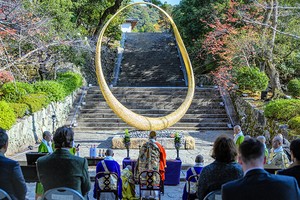
 Seihan Mori, the chief priest of Kiyomizudera temple in Kyoto, draws the kanji for “kuma” (bear) on Dec. 12. (Asahi Shimbun file photo)
Who invented kanji? The truth remains a mystery. Yet a legend from a neighboring land tells of an ancient sage named Cangjie as the creator of the first Chinese characters.
According to the tale, Cangjie observed natural patterns such as the footprints of birds and beasts.
He realized that distinct marks could be used to distinguish one thing from another, and he devised written symbols to represent objects and ideas.
What is truly striking is how later generations portrayed this culture hero: Cangjie is often depicted with four eyes.
The point was likely not that Chinese characters are square-shaped, but that such a breakthrough could only have been achieved through an exceptionally sharp, almost transcendent power of observation.
At Kiyomizudera temple in Kyoto on Dec. 12, the “kanji of the year” was unveiled in bold calligraphy. The top choice by public vote was the character for “kuma” (bear).
Many will no doubt nod in agreement, as the number of people attacked by bears in Japan reached a record high this year. The character’s “onyomi” reading, derived from its original Chinese pronunciation, is “yu.” From this comes the term “yukyo,” meaning to occupy the land like a crouching bear.
The character for “kome” (rice), which I had predicted, came in a close second. Third was the kanji read “taka” or “ko” meaning high—reflecting both the name of Japan’s new prime minister, Sanae Takaichi, and “bukka-daka,” or the high cost of living.
Following these were “myaku” (pulse or network), inspired by the popularity of Myaku-Myaku, the official mascot of Expo 2025 in Osaka; “man” (10,000), used in the word “banpaku,” which is the common Japanese abbreviation for a World Expo; “hen” (change); and “haku,” the other character used in the Japanese word for an expo.
Perhaps because it was a notable year for Japanese women, the character for “onna” (woman) ranked eighth.
Kanji is a philosophy. In the Western biblical myth of the Tower of Babel, humans once spoke a single language, only to be scattered and divided by divine wrath.
In the East, by comparison, there is the story, handed down from antiquity: creating a unified writing system based on kanji characters enabled people of different spoken languages to understand one another through a shared script.
Perhaps this reflects a fundamental difference in perspective between cultures that possess kanji and those that do not.
With a single character, we can share the same reflections. Even with a stranger, we can share the feeling, “Ah, so that is the kind of year it was,” as we take in the year’s symbolic kanji.
There is a mysterious power in the invention attributed to that four-eyed sage.
—The Asahi Shimbun, Dec. 13
* * *
Vox Populi, Vox Dei is a popular daily column that takes up a wide range of topics, including culture, arts and social trends and developments. Written by veteran Asahi Shimbun writers, the column provides useful perspectives on and insights into contemporary Japan and its culture.

‘Bear’ chosen as kanji of 2025 after spike in recorded attacks
December 12, 2025

VOX POPULI: Where are the brakes in the Takaichi-Nippon Ishin combo?
December 18, 2025
VOX POPULI: Democratic process skipped in last-minute policy draft edit
December 17, 2025
VOX POPULI: Untangling church and state in French art via a Japanese lens
December 16, 2025
VOX POPULI: Widow’s daily routine honors husband’s belief in her recovery
December 15, 2025
VOX POPULI: ‘Rage bait’ is apropos as word of the year, given our ‘age of anger’
December 13, 2025













A peek through the music industry’s curtain at the producers who harnessed social media to help their idols go global.

A series based on diplomatic documents declassified by Japan’s Foreign Ministry

Here is a collection of first-hand accounts by “hibakusha” atomic bomb survivors.

Cooking experts, chefs and others involved in the field of food introduce their special recipes intertwined with their paths in life.

A series about Japanese-Americans and their memories of World War II



