THE ASAHI SHIMBUN
December 5, 2025 at 20:25 JST
 Prime Minister Sanae Takaichi shakes hands with President Xi Jinping on Oct. 31 in Gyeongju, South Korea. (Pool)


Two global experts suggest that Japan should not bow to pressure from China and should clarify its position on a global stage as tensions simmer over Prime Minister Sanae Takaichi's remarks on a Taiwan contingency.
The Asahi Shimbun spoke with two experts from Japan and the United States about the flap that has erupted since Takaichi made the comments in response to questions in the Diet on Nov. 7.
Masayuki Masuda, head of the China Division at the National Institute for Defense Studies, sees no alternative for Japan but “a long test of endurance with China.”
“China is using economic measures to try to turn Japanese public opinion against the Takaichi administration," he said. "I think China is watching to see how the pressure works.”
Masuda pointed out a fundamental disconnect, saying, “Japan and China have different definitions of a ‘constructive relationship.’”
On Oct. 24, Takaichi mentioned in her policy speech about promoting a comprehensive strategic reciprocal relationship and building a constructive and stable relationship with China.
This led to the Oct. 31 summit in Gyeongju, South Korea, with Chinese President Xi Jinping.
In that meeting, Takaichi stressed the importance of peace and stability in the Taiwan Strait and listed issues such as the safety of Japanese nationals and problems in the East China Sea.
Masuda explained, “Japan believes that frankly conveying concerns and pending issues is the premise of a constructive relationship, while China thinks respecting its core interests, such as Taiwan, is what makes a relationship constructive.”
China had hoped for improved ties with Japan under former Prime Minister Shigeru Ishiba, but Ishiba, too, conveyed similar concerns to Beijing as Takaichi did.
In his first meeting with Premier Li Qiang last October, Ishiba cited former Prime Minister Kakuei Tanaka’s remark from the 1972 normalization of diplomatic ties, saying, “It is important for leaders of both countries to talk for the sake of tomorrow.”
Masuda explained, “Ishiba showed respect for the historical background between Japan and China while conveying pending issues and concerns. China was watching closely how the Takaichi administration would articulate its basic stance. From China’s perspective, the Taiwan contingency remarks came amid uncertainty about that stance.”
Regarding the current situation, U.S. President Donald Trump spoke with Xi by phone and then with Takaichi on Nov. 25.
According to Japanese government sources, Trump expressed his view to Takaichi that calming tensions is necessary.
Bonnie S. Glaser, managing director of the German Marshall Fund’s Indo-Pacific program, a U.S. think tank, believes Trump wants to avoid jeopardizing prospects for a U.S.-China trade deal.
“I think that Trump is very careful when he talks about Taiwan, because he knows it is an incendiary issue in China,” she said.
The Trump administration imposed “reciprocal tariffs” on China and faced Chinese restrictions on rare earth exports in retaliation.
Glaser said, “I think that the biggest lesson that Trump has learned this year is that the United States is quite vulnerable to China when it comes to rare earths and critical minerals.”
That vulnerability, she said, is a factor “leading Trump to try and reduce tensions with China and to find a way to a deal that will include keeping the delivery of rare earths, magnets, critical minerals, as essentially as smooth as possible.”
She added that U.S. allies are increasingly worried about America keeping its commitments.
“I have that concern about our European allies, about Japan and South Korea and Australia, and certainly in Taiwan, where there are doubts about U.S. willingness to come to Taiwan's defense,” she said.
However, she stressed, “Trump very much values the alliance with Japan, and it would not make sense to me that he was trying to take a position that would in any way weaken the alliance.”
Looking ahead, Masuda emphasized Japan’s need to communicate and clarify its position to shape global opinion.
The Chinese U.N. envoy, in a letter to U.N. Secretary-General Antonio Guterres, stated that if Japan intervenes militarily in the Taiwan Strait, China would exercise its right of self-defense.
Masuda said, “A narrative is being created that Japan has declared an intention to intervene militarily. There is concern that China will shape international opinion.”
Glaser, meanwhile, said, “While Japan should not seek to make the situation worse, it should not cave into Chinese pressure when the Chinese sense that a country is weak and easily giving in to China because of fear.”
She cited Australia’s experience of normalizing relations with China after import restrictions during the COVID-19 pandemic.
“It did take quite a long time, but both countries finally found the political will to very gradually return the relationship to normal,” Glaser said.
Japan, she said, can learn from that case.
“At some point, while demonstrating resolve, I think Japan should signal it is willing and hopefully desires to have a good relationship with China, just not on Beijing's terms,” Glaser said.
(This article was written by Narumi Ota and Ryo Kiyomiya.)

Japan sends envoy to China to prevent friction from worsening
November 17, 2025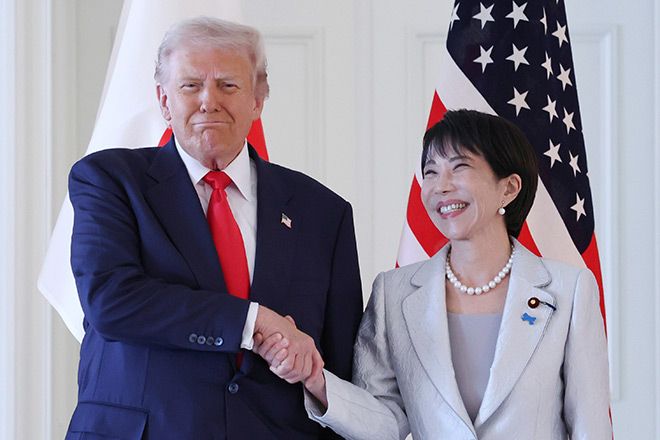
Trump urged Takaichi not to rise to China’s provocation
November 28, 2025
Amid fight with China, Japan wary of where Trump stands
November 26, 2025
Blinken signals possible resumption of U.S.-Taiwan trade, investment talks
June 8, 2021
Japan PM candidate Koizumi talks of change, but rivals could alter U.S. diplomacy
September 26, 2024
Pompeo lifts restrictions on U.S.-Taiwan relationship as clock runs out on Trump administration
January 10, 2021





A peek through the music industry’s curtain at the producers who harnessed social media to help their idols go global.

A series based on diplomatic documents declassified by Japan’s Foreign Ministry

Here is a collection of first-hand accounts by “hibakusha” atomic bomb survivors.

Cooking experts, chefs and others involved in the field of food introduce their special recipes intertwined with their paths in life.

A series about Japanese-Americans and their memories of World War II



