THE ASAHI SHIMBUN
November 21, 2025 at 14:39 JST
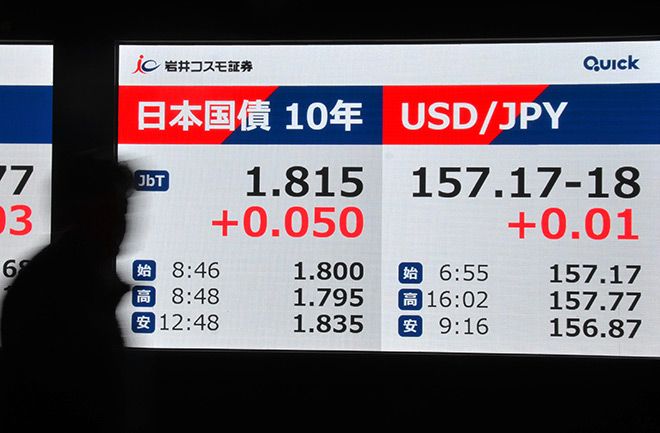 An electronic sign in Tokyo shows the benchmark Japanese government bond yield and the yen-dollar exchange rate on Nov. 20. (Chihaya Inagaki)
The finance minister signaled possible government and Bank of Japan intervention in the foreign exchange market to stem the yen’s plummet against the dollar, a day after the Japanese currency weakened to its lowest level in 10 months.
“We are deeply concerned that (the yen’s depreciation) is extremely one-sided and rapid,” Satsuki Katayama told a news conference after the Cabinet meeting on Nov. 21.
Asked about currency intervention, Katayama said, “Naturally, it is something we can consider,” warning against market movements with stronger language than previously.
The administration of Prime Minister Sanae Takaichi, which advocates “responsible proactive fiscal policy,” approved a comprehensive package of economic measures totaling 17.7 trillion yen ($112 billion) in general account expenditures on Nov. 21.
Amid concerns over worsening fiscal health, the yen hit the upper 157-yen range against the dollar at one point during Tokyo trading on Nov. 20, a level not seen since January.
The Japanese currency has fallen by more than 10 yen against the greenback, compared with the evening of Oct. 3, a day before Takaichi was elected president of the Liberal Democratic Party.
Against the euro, the yen fell to the upper 181-yen range on Nov. 20, an all-time low.
As of the morning of Nov. 21, the yen was trading in the mid 157-yen range in Tokyo.
“It is important that exchange rates move in a stable manner that reflects economic fundamentals,” Katayama said at the news conference.
She added: “Regarding excess volatility and disorderly movements in the foreign exchange market, including speculative developments, we will take appropriate action as needed, based on the principles outlined in the joint statement issued by the Japanese and U.S. finance ministers in September.”
Worries about deteriorating public finances also triggered a sell-off of Japanese government bonds in Tokyo on Nov. 20, sending yields sharply higher.
The yield on the newly issued 10-year Japanese government bond, a benchmark for long-term interest rates, rose to 1.835 percent at one point, the highest level since June 2008.
Takaichi, who styles herself as the political heir of former Prime Minister Shinzo Abe, has pledged to carry forward his “Abenomics” economic policies centered on aggressive public spending and monetary easing.
Interest rates did not surge immediately after she took office as LDP president, partly because former Finance Minister Taro Aso was appointed vice president and Nippon Ishin (Japan Innovation Party), the LDP’s coalition partner, was seen as a moderating force.
But concerns over fiscal deterioration intensified in financial markets once plans for a massive economic stimulus package emerged.
On Nov. 19, Katayama said “no concrete discussions took place” about currency movements during a meeting with Kazuo Ueda, governor of the Bank of Japan.
Her remarks eased market wariness over currency intervention and contributed to a further yen sell-off on Nov. 20.
At a news conference on Nov. 20, Chief Cabinet Secretary Minoru Kihara said, “We are concerned as we observe one-sided and rapid (currency) movements. We are monitoring excess volatility and disorderly movements with a high sense of vigilance.”
Ayako Sera of Sumitomo Mitsui Trust Bank said a “sell Japan trend” is emerging in the foreign exchange market.
“The government needs to demonstrate its commitment to fiscal discipline, including with concrete figures,” Sera said. “It is crucial to show the ‘responsible’ part of Takaichi’s ‘responsible proactive fiscal policy.’”
(This article was compiled from reports by Takao Shinkai and Chihaya Inagaki.)

Japan’s next finance minister could unsettle yen bears
October 22, 2025
Yen on back foot as Japan PM touts slow rate hikes, Aussie rises after jobs data
November 13, 2025
BOJ maintains interest rates, sends yen to new 34-year low
April 26, 2024
Yen faces worst monthly drop since July as BOJ disappoints
November 1, 2025
Traders on alert amid signs Japan may be about to prop up yen
October 19, 2022
Yen falls to one-week low after Takaichi elected as Japan PM, dollar firms
October 22, 2025





A peek through the music industry’s curtain at the producers who harnessed social media to help their idols go global.

A series based on diplomatic documents declassified by Japan’s Foreign Ministry

Here is a collection of first-hand accounts by “hibakusha” atomic bomb survivors.

Cooking experts, chefs and others involved in the field of food introduce their special recipes intertwined with their paths in life.

A series about Japanese-Americans and their memories of World War II



