THE ASAHI SHIMBUN
October 27, 2025 at 17:49 JST
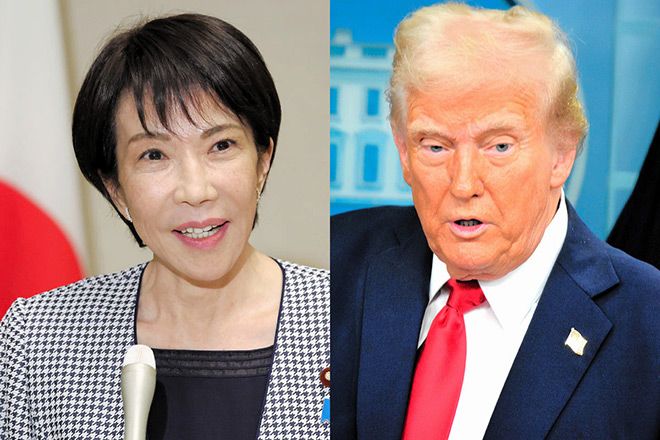 Prime Minister Sanae Takaichi will meet with U.S. President Donald Trump in Tokyo on Oct. 28. (Asahi Shimbun file photos)

During her first summit with U.S. President Donald Trump on Oct. 28, newly minted Prime Minister Sanae Takaichi is expected to pledge Japan’s commitment to proactively bolstering its defense capabilities.
Japanese officials are on edge ahead of the talks, which are likely to be dominated by national security issues, such as an increase in Japan’s defense spending.
Trump, who attended meetings with members of the Association of Southeast Asian Nations in Malaysia over the weekend, arrived in Tokyo on Oct. 27 and will have an audience with Emperor Naruhito.
The visiting U.S. president will be greeted by a massive police deployment in the capital.
The three-day trip through Oct. 29 marks Trump’s first visit to Japan after he returned to the White House in January. He last traveled to Japan in June 2019 to attend the Group of 20 summit in Osaka during his first term.
In her policy speech to the Diet on Oct. 24, Takaichi announced plans to advance the target of raising the defense budget to 2 percent of gross domestic product in fiscal 2027, pledging to achieve it within the current fiscal year.
She also expressed her intention to revise three key national security documents ahead of schedule in 2026, signaling the possibility of further increases in defense outlays.
Takaichi plans to communicate these plans to Trump during the summit.
However, the prime minister will not commit to a specific new target for the defense budget as a share of GDP, according to a government source.
For now, Japan aims to secure Washington’s understanding by demonstrating its commitment to accelerating its defense buildup.
Trump has long criticized what he calls “free-riding” by U.S. allies.
In April, he voiced frustration with the Japan-U.S. Security Treaty, saying that although the United States has to defend Japan, the Asian ally does not have defend his nation.
The U.S. administration has also informally called on Japan to increase its defense budget to 3.5 percent of GDP.
Some observers said Washington may press Tokyo to increase defense spending, shoulder more of the cost of hosting U.S. forces in Japan and purchase additional U.S.-made defense equipment during the summit.
For Takaichi, who was elected prime minister just last week, the summit represents an early, critical test for the future of Japan-U.S. relations.
“If we fail to convince the U.S. side on our defense buildup, confidence in the Takaichi administration could be shaken,” a government source said.
Takaichi and Trump talked over the phone for the first time on Oct. 25, affirming their commitment to strengthening the bilateral alliance.
Observers are closely watching how the two leaders, who are both known to admire former Prime Minister Shinzo Abe, will build a personal rapport.
For Japan, coordinating China policy with Trump is another major objective of the summit.
Trump, who will travel to South Korea for the Asia Pacific Economic Cooperation forum summit after his visit to Japan, is expected to meet with Chinese President Xi Jinping on Oct. 30.
Tokyo has long been wary of Trump striking a “deal” with Beijing over its head.
A senior government official said, “It is important to convey the message: ‘Don’t do anything ill-considered with China’” on security and economic matters.
The summit will also address the terms of the Japan-U.S. tariff negotiations.
Tokyo and Washington are working on a document committing them to the steady implementation of the agreement for the two leaders to sign, according to a government source.
Under the deal, Japan has pledged $550 billion (80 trillion yen) in investments in the United States, and Washington may urge Tokyo for its swift fulfillment during the summit.
During Trump’s three-day stay, Tokyo’s Metropolitan Police Department will deploy about 18,000 officers, placing the capital under high alert.
The MPD has set up a special security headquarters headed by the deputy superintendent general and assembled a special mobile unit composed of riot police and officers from local police stations.
Police presence will be heavy at Trump’s destinations, government facilities and major train stations, conducting vehicle inspections and questioning individuals.
Temporary traffic restrictions are planned on the Metropolitan Expressway and general roads in central Tokyo over three days through Oct. 29.
(This article was written by Sotaro Hata in Kuala Lumpur and Ryo Kiyomiya.)

Japan signals defense budget surge ahead of Trump visit
October 22, 2025
Takaichi pledges to build strong economy with fiscal stimulus
October 24, 2025
Japan’s Takaichi faces early test of defense ambitions with Trump visit
October 24, 2025
LDP swallows Nippon Ishin’s demands to push hardline policies
October 21, 2025
Takaichi to pick Motegi as foreign minister for U.S. trade talks
October 6, 2025










A peek through the music industry’s curtain at the producers who harnessed social media to help their idols go global.

A series based on diplomatic documents declassified by Japan’s Foreign Ministry

Here is a collection of first-hand accounts by “hibakusha” atomic bomb survivors.

Cooking experts, chefs and others involved in the field of food introduce their special recipes intertwined with their paths in life.

A series about Japanese-Americans and their memories of World War II



