THE ASAHI SHIMBUN
September 29, 2025 at 18:36 JST
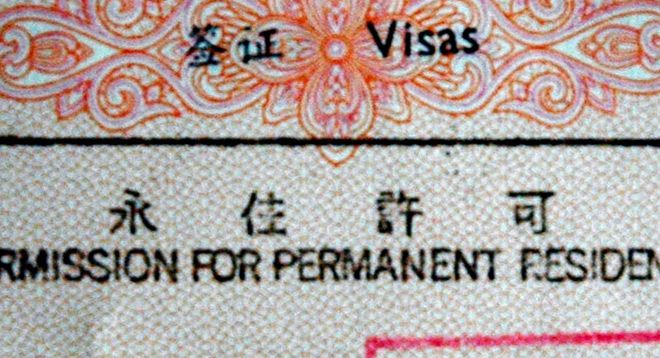 A passport indicating permanent residency status (Takuro Yagi)

The Immigration Services Agency has unveiled guidelines for enforcing a revised immigration law's provision that allows to rescind a foreign national's permanent residency status if they dodge taxes or social insurance contributions.
The details, released on Sept. 29, clarify the scenarios where these strict measures will apply after the law takes effect in April 2027.
The ability to revoke permanent residency was introduced in last year’s revision of the Immigration Control and Refugee Recognition Law.
Permanent residency is typically granted to individuals who have lived in Japan for more than 10 years, complied with laws and fulfilled civic duties; this includes paying taxes.
As of the end of last year, 918,000 people held this visa status. Unlike other visas, it does not require periodic renewal.
Because of that, authorities have noted cases where foreign nationals stopped paying taxes once obtaining permanent residency.
The revised law aims to address this disparity, and its enforcement criteria have not been defined until now.
CRITERIA FOR REVOCATION
At a Sept. 29 expert panel meeting, the Immigration Services Agency proposed a two-part test for determining “deliberate nonpayment.”
First, the individual fails to pay despite a lack of unavoidable circumstances.
Secondly, the individual is aware of the obligation, but still does not pay.
Revocation will apply only if both criteria are met, but there are exceptions.
The agency said, for the first criterion, individuals unable to pay due to illness, natural disasters or unemployment would not be subject to status revocation.
For the second, those who did not receive payment notices and were unaware of their obligations would also be exempted.
TARGETING MALICIOUS INTENT
Further exceptions are possible even if someone meets both criteria points for immediate loss of their visa.
The agency emphasized that it will only apply in "malicious cases." This covers instances such as repeated delinquency involving large sums or clear evidence that the individual does not intend to pay in the future.
An individual may be deemed "not malicious" if, for example, payment of any outstanding taxes is made after being interviewed by authorities. This could then lead to the individual's reclassification to another visa status, such as one for long-term residents that requires regular renewal.
The agency may also opt to change someone's visa status over revoking it in cases involving serious illness or other humanitarian considerations.
PAST DEBTS MAY APPLY
Because the revised law does not include any “transitional provisions,” any instances of a resident not making payments before the law’s implementation may also be subject to status revocation.
However, the agency said an individual's status will be safe if the debt is settled before the law takes effect and the case is not deemed malicious.
FINAL RULES EXPECTED IN 2026
The agency plans to gather opinions from stakeholder organizations and draft operational guidelines by summer 2026 and finalize them in the fall.
Taxes are not the only issue the new law covers. Permanent residency may be revoked if a resident violates other immigration requirements. This covers failing to renew residence cards, among related issues, or being convicted of crimes such as theft or assault.
These procedures will also be specified in the new guidelines, the agency said.
COMMUNITY CONCERNS PERSIST
Katsunori Ryu, 79, who heads a group of Chinese in Okayama Prefecture, expressed his qualms about the update.
“This does not ease our worries, because we know firsthand how strict immigration authorities can be toward foreigners,” he said.
Ryu has been holding study sessions to explain the new system to foreign residents.
“Highly skilled professionals working in Japan and hoping to obtain permanent residency for their children and grandchildren are especially anxious,” he said.
CALLS FOR LEGAL SAFEGUARDS
Eriko Suzuki, a professor at Kokushikan University and expert on immigration policy, warned, “Permanent residents are people who have built their lives in Japan. Revoking what should be the most stable legal status is a serious issue and must be handled with great caution.”
She criticized that the law should have explicitly stated that exceptions are permitted in unavoidable circumstances rather than relying on guidelines with broad administrative discretion.
Suzuki also urged that the agency to consider personal attributes—such as being born in Japan—alongside behavior such as tax delinquency.
“Each person has unique and complex circumstances. I hope (the agency) listens to as many diverse voices as possible,” she said.
(This article was written by Yuki Nikaido and Takuya Asakura.)

Foreigners with permanent residency could face stricter rules
February 5, 2024
Migrant labor law revised to allow longer, flexible stays
June 14, 2024
Japan grants special residency status to 212 foreign children
September 28, 2024
Child’s interests a ‘positive’ for foreigners eyeing stay permits
March 6, 2024
Concerns rise as tighter rules on refugee status, deportation near
June 7, 2024
EDITORIAL: Issue of foreign workers rests on key principle of integration
May 10, 2024








A peek through the music industry’s curtain at the producers who harnessed social media to help their idols go global.

A series based on diplomatic documents declassified by Japan’s Foreign Ministry

Here is a collection of first-hand accounts by “hibakusha” atomic bomb survivors.

Cooking experts, chefs and others involved in the field of food introduce their special recipes intertwined with their paths in life.

A series about Japanese-Americans and their memories of World War II



