THE ASAHI SHIMBUN
April 17, 2025 at 16:08 JST
 Ryosei Akazawa, the minister of economic revitalization, and U.S. President Donald Trump hold talks at the White House on April 16. (The Asahi Shimbun)
Prime Minister Shigeru Ishiba said talks on tariffs between his close ally and U.S. President Donald Trump were “frank and constructive,” but he declined to comment on security issues raised by the U.S. leader.
“I recognize and appreciate that talks (on tariffs) leading to the next step were held,” Ishiba told reporters at the prime minister’s office on April 17. “I am considering visiting the United States at the most appropriate time and meeting directly with President Trump.”
Ryosei Akazawa, the minister of economic revitalization, met with Trump for 50 minutes at the White House on April 16, followed by a 75-minute discussion with U.S. Treasury Secretary Scott Bessent and others.
“I have received reports that considerable time was spent in a frank and constructive discussion,” Ishiba said.
He also said he was told that Trump mentioned to Akazawa that he would like to place the highest priority on talks with Japan.
Although both Akazawa and Ishiba would not comment on whether Japan-U.S. security arrangements were discussed in Washington, several Japanese government officials told The Asahi Shimbun that Trump did indeed raise the issue.
In the meeting, Trump reiterated his view that the Japan-U.S. Security Treaty is “unfair” because it obliges only the United States to defend Japan, the sources said.
Trump also repeated his familiar argument that the cost of stationing U.S. forces in Japan should be borne by both Japan and the United States, the sources said.
Akazawa told Trump that the Japanese side has paid an average of about 211 billion yen ($1.5 billion) annually from fiscal 2022 to fiscal 2026 for U.S. forces stationed in the country, the sources said.
JAPAN TALKS A ‘PRIORITY’
Bessent, who is in charge of negotiations with Japan over the U.S. tariffs, also attended the meeting between Akazawa and Trump. Akazawa later met with other U.S. Cabinet members at the White House.
After the meetings, Akazawa told reporters he strongly urged the U.S. officials to review the 10-percent tariffs on automobiles, steel and aluminum, and that both sides agreed to try to arrange the next round of talks within the month.
He also said he told Trump that Ishiba desires “a win-win situation in which both the Japanese and U.S. economies would be strengthened.”
Noting that Trump said talks with Japan are a top priority, Akazawa said, “I think he is telling us to hurry up (negotiations).”
He said he believes the U.S. side aims to conclude a “deal” within the 90-day pause of Trump’s “reciprocal tariffs.”
Akazawa also said he was grateful that Trump “spoke directly with (me), a lower-ranking official.”
SURPRISE TRUMP ANNOUNCEMENT
The Japanese negotiator was originally scheduled to hold talks at the U.S. Treasury Department with Bessent and U.S. Trade Representative Jamieson Greer mainly to explore the intentions of the U.S. side.
However, early on April 16, Trump announced on social media that he would attend the meeting. He also expressed his determination to bring up security issues in the talks.
The announcement about security sent shock waves through the Japanese government.
Late on April 16, Chief Cabinet Secretary Yoshimasa Hayashi and senior Foreign Ministry officials quickly gathered at the prime minister’s official residence to discuss how to respond to the situation.
Akazawa would not clearly say if security-related topics were raised during the meeting.
Ishiba also declined to say whether Trump brought up security issues with Akazawa.
“I refrain from mentioning specific details,” Ishiba said.
MIXED REVIEWS
Itsunori Onodera, policy chief of the ruling Liberal Democratic Party, told reporters at LDP headquarters on April 17 that he received a report from Akazawa via telephone after the Trump meeting.
“As a first round of negotiations, I rate it as a very successful one,” Onodera said. “These are not negotiations that will be easy. It will take a certain amount of time.”
The main opposition Constitutional Democratic Party of Japan, however, questioned whether Akazawa is the right person for the job, given his apparently ingratiating “lower-ranking official” comment.
“I saw that the negotiations were being conducted with a humble attitude,” Hiroshi Ogushi, acting president of the CDP, said at a news conference. Akazawa should “take a resolute attitude toward the negotiations, considering Japan’s national interests are at stake.”
Ogushi added: “I am concerned about whether the negotiations will function well with Akazawa as our main negotiator. What kind of negotiating position is desirable now that the issue of security has come up? The Japanese government needs to reconsider.”

Ishiba ally to negotiate tariff exemptions from U.S. counterparts
April 11, 2025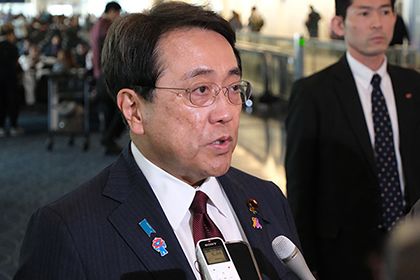
Trump reports 'big progress' in tariff talks with Japanese officials
April 17, 2025
Ishiba ally heads to U.S. for negotiations on Trump’s tariffs
April 16, 2025
Trump jumps in on tariff talks with Japanese officials
April 17, 2025
PM Ishiba warns U.S. tariffs have potential to disrupt global economic order
April 14, 2025
Japan says no plan for big concessions in talks on US tariffs
April 15, 2025








A peek through the music industry’s curtain at the producers who harnessed social media to help their idols go global.

A series based on diplomatic documents declassified by Japan’s Foreign Ministry

Here is a collection of first-hand accounts by “hibakusha” atomic bomb survivors.

Cooking experts, chefs and others involved in the field of food introduce their special recipes intertwined with their paths in life.

A series about Japanese-Americans and their memories of World War II



