THE ASAHI SHIMBUN
February 5, 2025 at 07:00 JST
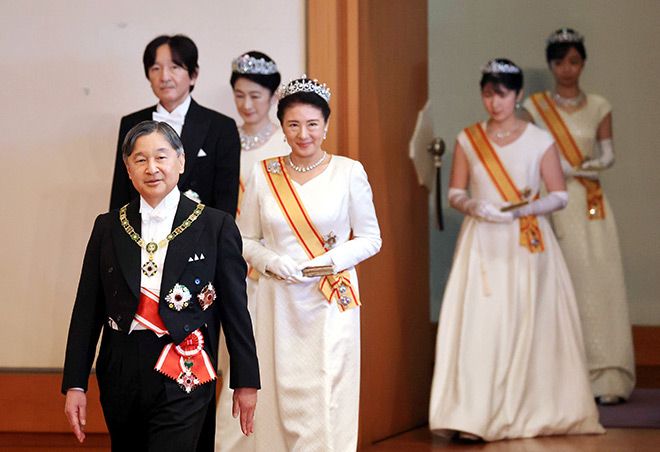 Emperor Naruhito, Empress Masako and their daughter, Princess Aiko, attend the New Year reception at the Matsu-no-Ma hall in the Imperial Palace on Jan. 1 with Crown Prince Fumihito, Crown Princess Kiko and their second daughter, Princess Kako. (Pool)

The imperial family, like so many families, has its fair share of problems. But in this case, its very survival in its current form is under threat.
Drastic change would appear to be the answer.
Uncertainty about the future of the Chrysanthemum Throne lies in the dwindling number of female members due to marriages to commoners and the advancing age of other royals.
As matters stand, Prince Hisahito is the sole heir to the throne.
Two options proposed by an expert panel in 2021 are being discussed in earnest by the Diet: allowing female members to retain their imperial status following marriage; and enabling male and patrilineal former members to formally rejoin the royal family via adoption.
It remains unclear when Japan’s royal house system will be revamped.
MARRIED FEMALE MEMBERS
Five unmarried female imperial members, including Princess Aiko, the daughter of Emperor Naruhito and Empress Masako, and Princess Kako, the second daughter of Crown Prince Fumihito and Crown Princess Kiko, are expected to lose their royal status if they marry commoners.
As a result, Hisahito, the emperor’s nephew, could end up emerging as the sole next-generation successor in the imperial family.
The proposal for female royals to keep their imperial status despite marriage requires an amendment to Article 12 of the Imperial House Law, which states: “In case a female of the imperial family marries a person other than the emperor or the members of the imperial family, she shall lose the status of the imperial family member.”
Among other things, the Imperial House Law specifies procedures for succession to the Chrysanthemum Throne as well as the status of imperial family members under the postwar Constitution.
In September, a midterm report drawn up by the speakers and vice speakers of the Lower and Upper houses said that a “general consensus has been reached with an eye on approving” the reform plan at some point.
But there is still a wide divergence of opinion on the issue among the political parties, in particular over whether to give royal status to the spouses of female members and any children of the couple.
The Imperial House Law stipulates that the line of succession is through patrilineal male members, thereby excluding the descendants of female royals. The reasoning is that the descendants of female royals are considered matrilineal unless they tie the knot with emperors or other male imperial members.
Released toward the end of 2021, the government expert panel’s report did not support including the spouses and offspring of female members in the imperial family.
This reflected concerns that allowing royal women to remain in the household following marriage could eventually lead to “expanding the right to the throne for matrilineal members, too.”
Other issues revolve around whether it is appropriate for outsiders to live in the Imperial Palace and other facilities designated for royals and the extent to which officials from the Imperial Household Agency should extend support to non-royal members, seeing as they are public servants.
Concerns have also been voiced about the possibility of spouses of formal imperial members trying to exploit the royal family’s name recognition for political activities and other purposes.
“There are many topics that must be examined meticulously,” said an Imperial Household Agency insider.
ADOPTION OF PATRILINEAL LINE
The other major option under debate concerns the return to court of patrilineal males from 11 disbanded imperial family lines through adoption. These families lost their royal status at the end of World War II.
This suggestion aligns closely with the government’s position. Tokyo has called for “careful and thorough discussions,” stressing the “significance of maintaining patrilineal succession without exception since olden times.”
The 11 former royal family lines all trace their origins to Prince Fushimi-no-miya Sadafusa in the Muromachi Period (1336-1573).
Members of these Fushimi-no-miya family branches, with a history spanning 600 years, were compelled to relinquish their royal status in October 1947, in part owing to directives issued by the General Headquarters of the Allied Powers.
The government expert panel emphasizes that they “had the right to the imperial throne” under the contemporary legal framework because the current Constitution and Imperial House Law were already in effect.
Although the report by the speakers and vice speakers of the Lower and Upper chambers highlights many positive reactions to the proposal, it acknowledges opposing arguments as well.
Some members in the former imperial houses married princesses linked to Emperor Meiji and Emperor Showa, but they are generally distantly related to the current imperial family from a patrilineal standpoint.
The complexity of the envisioned adoption mechanism bothers officials because they feel the public may not understand what it entails precisely.
Children of newly adopted members would be eligible to succeed to the imperial throne under the ruling bloc’s plan. However, the offspring of female royals born to emperors or other imperial fathers, strangely, could not be counted as members of the household.
This, in the words of one Imperial Household Agency official, is an “overly complicated” framework.
An agency representative described the planned mechanism as “far more difficult to gain public understanding compared to the current imperial family system, which consists of those closely related to the emperor.”
What is not known is whether any former imperial members want to live as royals again after so long in the wilderness.
The head of one of the imperial family branches wrote in a book that he “would have no choice but to comply” with the emperor and government’s request to return.
Another family head, in a past publication, showed his “unwillingness to use taxpayers’ money upon rejoining the royal family.”
FEMALE, MATRILINEAL EMPERORS
After establishing a monogamous framework within the imperial household, Emperor Taisho had four sons, among them Emperor Showa, known as Hirohito in his lifetime, with Empress Teimei.
Of these sons’ lines, the Chichibu-no-miya and Takamatsu-no-miya families ceased to exist when they had no male heirs to continue their clans.
The imperial family is currently comprised of the descendants of the remaining Mikasa-no-miya line and Emperor Showa.
Following the birth of Crown Prince Fumihito, nine consecutive girls were born into the royal household.
With that circumstance in mind, an expert committee in 2005 recommended accepting female and matrilineal emperors in its report, which was compiled when Junichiro Koizumi was prime minister.
Taking social changes into account, such as a tendency to wait longer to marry and have fewer children, the report said it would be “extremely difficult to secure patrilineal male heirs in each generation to make sure of a stable succession to the imperial throne.”
As the current Imperial House Law, promulgated in 1947, restricts the right to the throne to males who have imperial members on their father’s side, the legislation must be revised through Diet talks for female and matrilineal members to become emperors.
The momentum toward reform, however, waned when Prince Hisahito was born in 2006.
For now, the ruling and opposition blocs are moving toward stable succession to the Chrysanthemum Throne.
The speaker and vice speaker of the Lower House have reportedly agreed to proceed along the lines of forming a “comprehensive consensus of the legislative body” in the ordinary session this year.
A request from the opposition camp to “squarely consider embracing female and matrilineal emperors,” coupled with the complexities of the two major proposals, renders it increasingly uncertain whether the relevant parties will be able to reach an acceptable compromise.
How the debate progresses will be worth noting because of a recommendation in October by the U.N. Committee on the Elimination of Discrimination Against Women that the Imperial House Law be amended to guarantee gender equality in the succession issue.





A peek through the music industry’s curtain at the producers who harnessed social media to help their idols go global.

A series based on diplomatic documents declassified by Japan’s Foreign Ministry

Here is a collection of first-hand accounts by “hibakusha” atomic bomb survivors.

Cooking experts, chefs and others involved in the field of food introduce their special recipes intertwined with their paths in life.

A series about Japanese-Americans and their memories of World War II



