By KAZUMICHI KUBOTA/ Staff Writer
December 20, 2024 at 15:11 JST
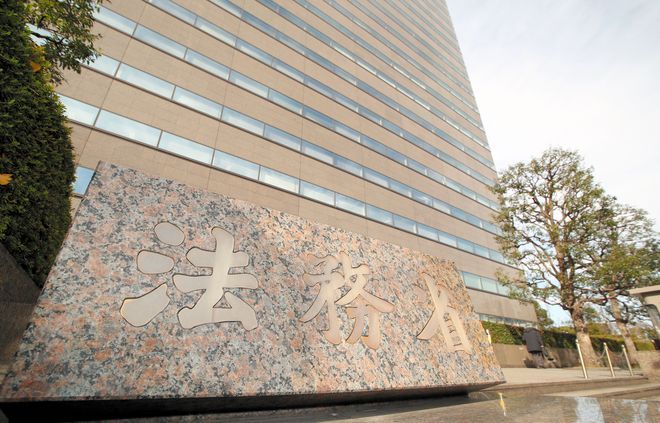 The Justice Ministry (Asahi Shimbun file photo)
Amid increasing calls for reform, the Justice Ministry will review Japan’s retrial system, which allows for the reopening of criminal cases after a conviction has been finalized, government sources said.
The decision comes following the recent high-profile acquittal of an inmate who spent decades on death row and the granting of a retrial in Fukui to a man who served seven years in prison.
The ministry intends to consult its Legislative Council as early as next spring to explore possible revisions to the retrial system.
Retrials were established under the Code of Criminal Procedure to address wrongful convictions. However, the system has been coming under increasing criticism for its high barriers to relief.
NO CHANGES IN 76 YEARS
The retrial provisions have remained unchanged since the current Code of Criminal Procedure was enacted in 1948. Any revisions would mark a major turning point in Japan’s criminal justice system.
In September, Iwao Hakamada, who had been sentenced to death for the murder of a family of four in Shizuoka Prefecture, was acquitted in a retrial 44 years after his sentence was finalized.
The case highlighted issues with the retrial system, including the handling of evidence disclosure by prosecutors―crucial in securing the acquittal―and the prolonged nature of retrial proceedings.
In October, a retrial was approved for a man who served time in prison for the murder of a junior high school girl in Fukui Prefecture 38 years ago.
While there remains strong opposition within the ministry to amending the law, officials have decided that the growing public demand necessitates holding discussions specifically focused on retrials, the sources said.
The Legislative Council, composed of experts and legal practitioners, serves as an advisory body to the justice minister. Debate over the specifics of the system is expected to draw differing opinions, with some predicting that reaching a consensus could take several years.
LACK OF RULES LEADS TO DELAYS
Retrials follow a two-step process: a court first decides whether to grant a retrial during the retrial request hearing, and if approved, the case moves to a retrial hearing.
Granting a retrial requires “clear new evidence that warrants an acquittal.” Once a retrial is approved, an acquittal becomes extremely likely.
The focus of debates surrounding the system has been the lack of procedural regulations, often cited as a key factor behind prolonged retrial cases.
Of the 516 articles in the Code of Criminal Procedure, only 19 address retrials.
Critics argue that the lack of clear procedural rules leaves much to the discretion of judges, leading to inconsistences in how cases are handled.
One of the key issues for the Legislative Council is whether to establish rules for evidence disclosure in retrials.
While standard criminal trials have regulations on evidence disclosure, retrials do not.
In fact, the evidence that led to Hakamada’s acquittal in his retrial was held by the prosecutors for around three decades before being disclosed following a court recommendation.
The Japan Federation of Bar Associations has long called for the establishment of rules on evidence disclosure in retrials.
However, many within the Justice Ministry and prosecution have raised concerns, arguing that a uniform rule could force evidence disclosure even in retrial requests that are deemed to have little justification for overturning finalized verdicts.
They say that it is more appropriate to leave the decision to the judges’ discretion.
The bar associations have also called for banning prosecutors from appealing court decisions to grant retrials during the retrial request hearings. They say that prolonged delays before retrial hearings hinder the prompt redress of those wrongfully convicted.
But the Justice Ministry said that banning such appeals “would eliminate any means to correct erroneous decisions to grant retrials.”

Ex-judge urges reform, says retrial system an arbitrary affair
October 25, 2024
Execution timing for condemned inmates remains a mystery
September 26, 2024
EDITORIAL: Hakamada case underscores folly of maintaining death penalty
March 14, 2023
EDITORIAL: Revising judicial system starts with an apology to Hakamada
October 9, 2024
Prosecutors seek to prove guilt of Hakamada in 1966 killings
July 10, 2023
EDITORIAL: Swift retrial only way to ensure Hakamada receives justice
January 4, 2021





A peek through the music industry’s curtain at the producers who harnessed social media to help their idols go global.

A series based on diplomatic documents declassified by Japan’s Foreign Ministry

Here is a collection of first-hand accounts by “hibakusha” atomic bomb survivors.

Cooking experts, chefs and others involved in the field of food introduce their special recipes intertwined with their paths in life.

A series about Japanese-Americans and their memories of World War II



