THE ASAHI SHIMBUN
December 27, 2023 at 17:26 JST
 The widow of Shizuo Aishima offers a prayer before the home altar. (Hiraku Higa)
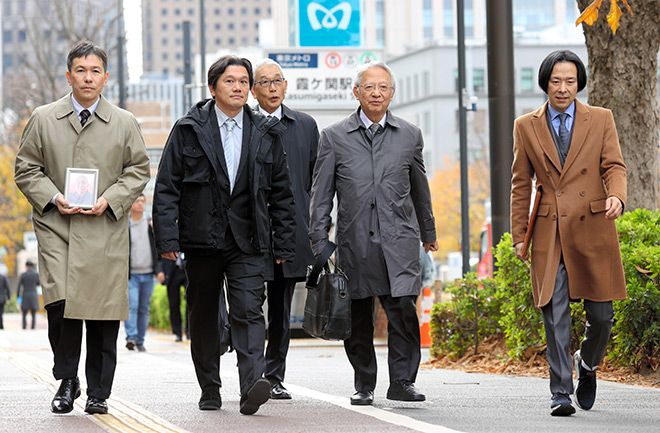
The Tokyo District Court on Dec. 27 awarded compensation to three company officials who were wrongly arrested in a “fabricated” case that tied them to exports of biological weapons parts.
The court ordered the central and Tokyo metropolitan governments to each pay about 160 million yen ($1.1 million) to the three plaintiffs, including Shizuo Aishima, an adviser at Yokohama-based Ohkawara Kakohki Co., who died before he could clear his name.
Masaaki Okawara, president of Ohkawara Kakohki, Aishima and the other senior official were arrested in March 2020 on suspicion of violating the Foreign Exchange and Foreign Trade Law.
The company manufactures and exports spray dryers.
The Metropolitan Police Department’s Public Security Bureau determined the company’s products could be converted to create biological weapons, and that exporting such equipment without permission was illegal.
The Tokyo District Public Prosecutors Office indicted the three the same month. But the indictment was retracted in July 2021 after the possibility arose that equipment in question was not subject to the export restrictions.
Before then, Aishima had died of cancer.
The lawsuit seeking about 570 million yen in compensation was filed in September 2021.
Lawyers for the company argued that the economy ministry, which oversaw such exports, did not have a clear definition of what constituted banned equipment, so the police came up with their own interpretation to arrest the three.
Tests of the equipment would have shown that it did not contain a disinfecting function, one of the conditions for the export restriction, but such tests were never conducted, the plaintiffs argued.
Police and prosecutors argued in court that they were correct in going ahead with the arrests and indictments.
However, a current assistant inspector gave stunning testimony in June that the case against the three was fabricated.
Another assistant inspector told the court that senior investigators have a tendency to understate evidence that does not align with their assumptions in a case.
Before he was arrested in March 2020, Aishima was questioned voluntarily by police 18 times.
His widow recalls him saying after those sessions that the police did not properly study details of the equipment and were utterly unable to understand what he was trying to tell them.
While he was in detention, a stomach tumor was discovered, and his lawyers asked that he be released to a hospital for more detailed analysis and proper treatment.
The court in November 2020 finally allowed Aishima to enter a hospital for two weeks, but by that time the cancer had metastasized to the liver, and there was little doctors could do to treat the illness.
Aishima died before the indictment was retracted.
His widow attended all of the court sessions.
She said the testimony by the assistant inspector that the case had been fabricated was one of the few bright spots.
But she said she can never forget the complete lack of remorse by the other officers who testified in their defense.
She said all she wanted was an apology from the police.
(This article was compiled from reports by Kazufumi Kaneko and Hiraku Higa.)

Officer testifies criminal case against company was fabricated
July 3, 2023
Diet member Akimoto to serve 4 years in prison for casino bribe case
September 7, 2021
Dentsu official admits part of bid-rigging suit, may fight the rest
July 27, 2023
Osaka police, but not prosecutors, found liable over false conviction
March 16, 2022
Police accused of racial profiling by questioning foreigners
March 16, 2022










A peek through the music industry’s curtain at the producers who harnessed social media to help their idols go global.

A series based on diplomatic documents declassified by Japan’s Foreign Ministry

Here is a collection of first-hand accounts by “hibakusha” atomic bomb survivors.

Cooking experts, chefs and others involved in the field of food introduce their special recipes intertwined with their paths in life.

A series about Japanese-Americans and their memories of World War II



