By YURI NISHIDA/ Staff Writer
December 15, 2023 at 07:00 JST
 Shoko Koshiba, chief priest of Suwajinja shrine in Kumagaya, Saitama Prefecture, looks up at the rearranged ceiling art on Nov. 1. (Yuri Nishida)
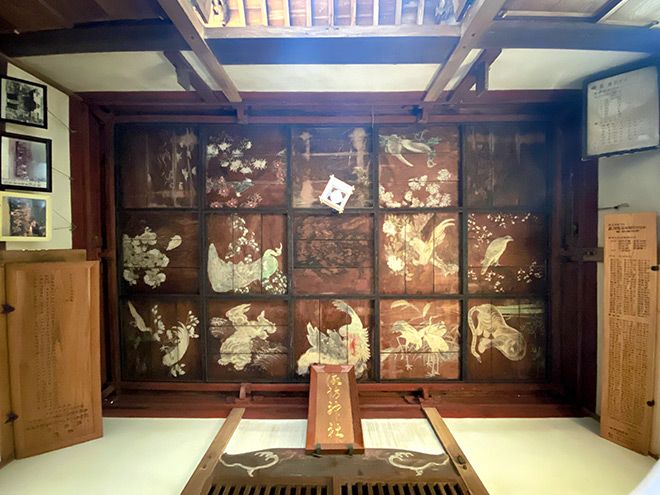
KUMAGAYA, Saitama Prefecture—Since her inauguration as chief priest of Suwajinja shrine here in the latter half of the 1980s, Shoko Koshiba had always felt there was something wrong from above.
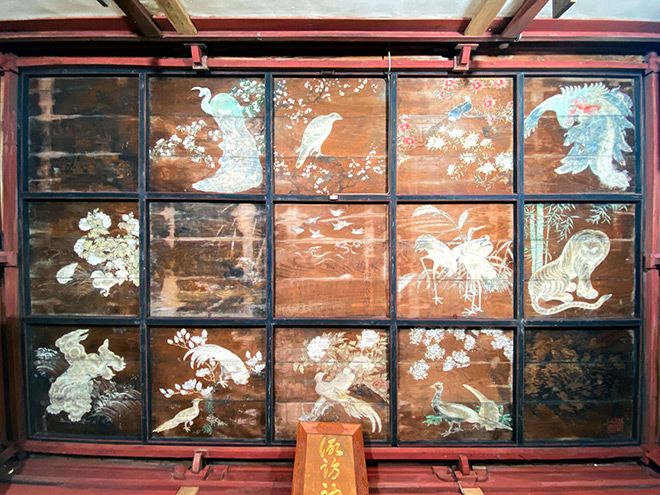
The ceiling of Suwajinja’s “haiden” worship hall features 15 paintings placed like panels in a wooden grid consisting of three rows of five pictures each. But whenever she peered up at the ceiling, the paintings seemed out of place, and the rectangular display looked somewhat like an unfinished edge-match puzzle.
The ceiling art was blown away when a typhoon obliterated the shrine’s roof in September 1966. The paintings were all recovered and reinstalled the following year.
About 20 years after that, Koshiba, now 78, became head priest of the shrine.
Koshiba’s grandfather was the shrine’s chief priest when the destructive typhoon hit. But he never told her about the original arrangement of the pictures, and no photos of it remained, either.
The paintings each measure 90 centimeters by 90 cm.
Koshiba immediately saw that some of the pictures were lined up vertically while others were arranged horizontally.
In addition to this inconsistent pattern, the painting bearing the artist’s signature was oddly located at the center of the grid.
Some of the pictures combine plants and animals, including camellia and a starling as well as bamboo and a tiger. Others portray sacred beasts, like the phoenix.
All of the paintings have faded so much that their surfaces appear whitish.
Koshiba learned that children would often play at the shrine and lie on the worship hall’s floor to rest.
However, no one in the nearby community could remember the pre-typhoon arrangement of the paintings.
CULTURAL RECOGNITION
Suwajinja shrine’s main hall was named a tangible cultural asset of Saitama Prefecture in 2016. This year, the shrine wanted its haiden worship hall listed as a designated cultural property of Kumagaya city.
A team headed by Shinichi Yokoyama, a professor of historic architecture studies at the Institute of Technologists in Gyoda, Saitama Prefecture, visited Suwajinja shrine in May to study and assess the haiden.
Thinking “it’s now or never,” Koshiba asked the team members a question: “Since I became head priest, I have always felt uncomfortable whenever I see these pictures. I desperately want to confirm if their arrangement is OK. Can you help me?”
After studying the ceiling art, Yokoyama concluded the paintings were placed in the wrong order. He agreed with Koshiba’s assessment that a picture with the artist’s signature is rarely exhibited in the middle.
The researchers removed the paintings and checked their backs for clues on how they should be arranged.
They found nothing that could help.
Starting in September, the team considered 30 possible layouts of the paintings. They reached the answer in October.
Botanical species depicted in the illustrations represent seasons. For example, the camellia-starling painting and the “ume”-bush warbler image refer to January and February, respectively, in the old calendar.
The bamboo-tiger painting was deemed as symbolizing the months of July and August. Another painting with a wave and plover, which showed no plants, was regarded as indicating October.
The pictures were reordered based on the perceived time elements. The team also placed four pictures of sacred beasts at the corners.
With the picture bearing the painter’s signature in one corner, the researchers felt the paintings were now back in their original positions.
They showed Koshiba the rearrangement on Nov. 1.
“I ended up being reunited with this ceiling,” she said. “I am so overwhelmed with joy that I’m on the brink of tears.”
UNEXPECTED FIND
When the team studied back of the center piece, they discovered the names of nine individuals and the era name for 1862, 10 years after the worship hall was built.
The nine are believed to have been Suwajinja parishioners who donated the images to express gratitude for their safe visit to renowned Ise Jingu shrine in what is now Mie Prefecture, according to Yokoyama.
The Suwajinja haiden is normally inaccessible to the public. But the shrine is now allowing tours of the hall.
“I want a wider range of people to learn about the paintings so they will be regarded as our local community’s pride,” Koshiba said.

Fall ‘flower ceiling’ a sure visitor draw to Kyoto shrine
September 26, 2021
Horyuji temple murals scorched in 1949 fire to go on special view
July 26, 2021
Dragon ceiling painting peels off at famed Sensoji temple in Tokyo
July 10, 2023
Ghost painting confirmed rare work by famous Edo Period artist
May 21, 2021











A peek through the music industry’s curtain at the producers who harnessed social media to help their idols go global.

A series based on diplomatic documents declassified by Japan’s Foreign Ministry

Here is a collection of first-hand accounts by “hibakusha” atomic bomb survivors.

Cooking experts, chefs and others involved in the field of food introduce their special recipes intertwined with their paths in life.

A series about Japanese-Americans and their memories of World War II



