By RIE KOWAKA/ Staff Writer
November 12, 2023 at 07:00 JST
 “It’s a comfortable distance for me where I can say, ‘Nice seeing you again,(Add Comma ????)’ when I see familiar faces at venues,” Nakanishi said.
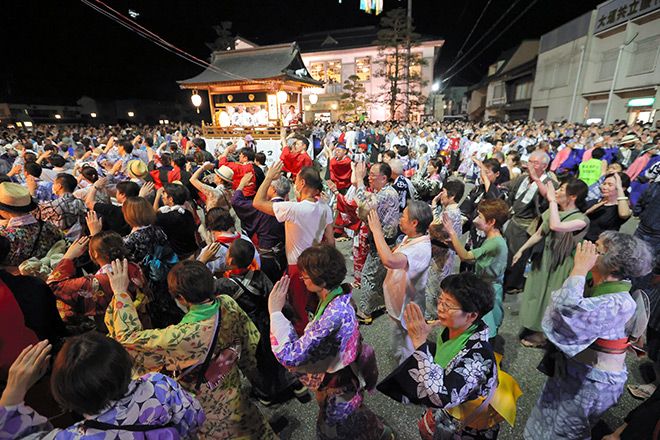
For many people, Bon odori dance festivals are an annual summer tradition where the locals get together and dance to traditional music.
But Yukiko Nakanishi has become a common fixture among the local dancers at venues across Osaka Prefecture and the vicinity.
The 35-year-old Osaka resident became so enthralled by the dance that she has been working on promotional activities on her own for five years.
With the slogan of, “A dance hall somewhere every day,” she even carries a portable “yagura” stage to play dance music on and host a dance party anywhere she goes.
“I want everyone to see the fun of Bon odori through my self-centered project,” Nakanishi said.
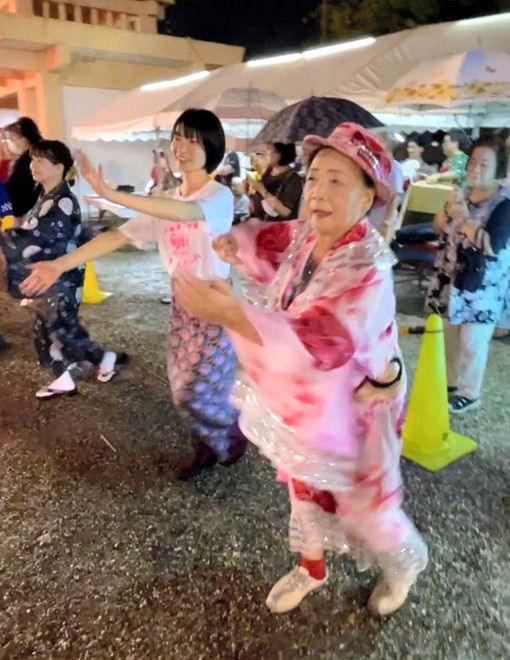
On a recent evening in mid-September, she could be seen among locals at Yao Betsuin Daishinji temple in Yao, Osaka Prefecture, dancing to the “Kawachi Ondo” Bon odori song--a local specialty--in the pouring rain.
Taking elegant steps and keeping her fingertips aligned together, she danced to the music of the guitar and drums.
She wore a white T-shirt that read, “A dance hall somewhere every day” in fluorescent pink letters, which is her typical costume when she attends Bon odori festivals.
This summer, Nakanishi attended about 10 events in Osaka alone, while also participating in a festival in Totsukawa, Nara Prefecture, as well as the Gujo Odori and Shirotori Odori festivals in Gujo, Gifu Prefecture.
“Compared to Gujo, the Shirotori Odori dance is performed at a quick pace. We danced through the night until morning,” she said. “It was exhilarating.”
If there are people who don’t know the Bon odori routines for a specific festival, others around them can show them how to do them.
“The charm of Bon odori is that anyone of all ages can do the dances,” Nakanishi said, adding that everyone can look like a natural by the end of each song while following the examples of others.
Nakanishi developed a passion for Bon odori about 10 years ago when she visited a dance festival in Osaka’s Chuo Ward with her friends.
“I could dance even though I’m not good at sports, and I was elated while I danced around the elevated yagura stage again and again,” she said.
Since then, she grew restless whenever she heard the distant sound of drums.
There was a time when she would ride her bicycle in the direction of the drums to find the festival venue.
She even started checking a website about Bon odori schedules and venues in Osaka Prefecture so she could attend the festivals alone.
FAMLIAR FACES
As Nakanishi continued attending dance festivals, she realized there were other die-hard fans at every Bon odori venue just like herself.
One is Kiyoko Nakamura, 73, who lives in Higashi-Osaka and calls herself “Tobikiyo.”
Nakanishi met her at the Kawachi Ondo venue in September.
The seasoned dancer once praised Nakanishi’s passion and encouraged the newcomer to keep it up, humbling Nakanishi.
While Nakanishi makes acquaintances through her Bon odori activities, she only regularly keeps in touch with a few of them.
“It’s a comfortable distance for me where I can say, ‘Nice seeing you again,’ when I see familiar faces at venues,” Nakanishi said.
She added: “There are people who can dance to any song. Others are passionate about going to many Bon odori festivals. I love seeing how that love can come in many different forms.”
After she launched her promotional activities five years ago, she asked her designer friend to create a T-shirt bearing her slogan, “A dance hall somewhere every day.”
She attends her friends’ housewarming parties and other events with a ready-to-assemble, portable Bon odori stage her furniture-making friend created, and she invites adults and children to dance together.
She also organizes Bon odori events at various locations upon request.
Nakanishi has an Instagram account (@nakanishidance) on which she shares her activities.

VOX POPULI: Traditional Bon odori festivals in existential crisis this summer
August 14, 2021
All-night Gujo dance festival returns to Gifu after four years
August 14, 2023
UNESCO to add folk dances to list of intangible cultural heritage
November 1, 2022

Festivals that planned to return now face tough calls as cases rise
August 2, 2022
Nagasaki Kunchi festival being held for the first time in 4 years
October 8, 2023










A peek through the music industry’s curtain at the producers who harnessed social media to help their idols go global.

A series based on diplomatic documents declassified by Japan’s Foreign Ministry

Here is a collection of first-hand accounts by “hibakusha” atomic bomb survivors.

Cooking experts, chefs and others involved in the field of food introduce their special recipes intertwined with their paths in life.

A series about Japanese-Americans and their memories of World War II



