By TETSURO NAKAJIMA/ Staff Writer
August 4, 2023 at 07:00 JST
 Toshiaki Kuramochi, director of the Meguro Parasitological Museum in Tokyo, stands by the museum's crown jewel: an 8.8-meter-long tapeworm. (Tetsuro Nakajima)

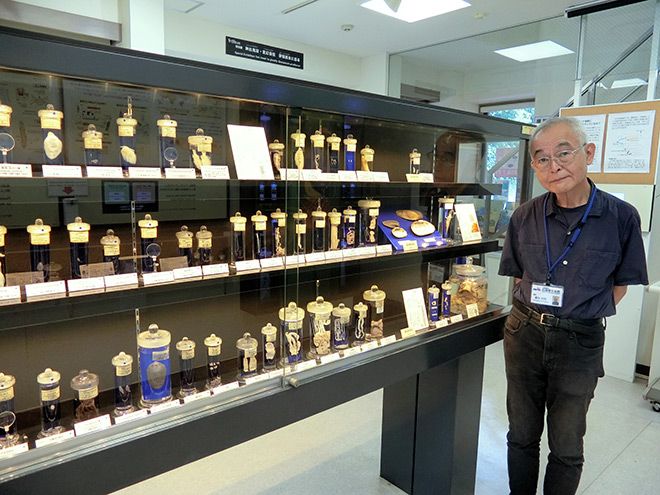
It hooks you. The Meguro Parasitological Museum in Tokyo is drawing in visitors, particularly tourists, although the institution remains little-known to the Japanese public.
The gross-out factor is strong. Among the museum's selection of parasites is an 8.8-meter-long tapeworm recovered intact from a hapless diner’s intestine.
Toshiaki Kuramochi, the museum director, explains how its main showpiece was acquired.
“In the 1980s, a man in his 40s discovered a white thread-like object in his feces,” Kuramochi said. “Dr. Satoru Kamegai, our museum’s first director, had the man take an agent that gets rid of parasites.”
And, the story goes, the giant Dibothriocephalus nihonkaiensis tapeworm was expelled from the patient’s anus.
“It measured a staggering 8.8 meters, as shown here,” Kuramochi said.
It is likely that the tapeworm was acquired orally. Suspicion fell on cherry-salmon sashimi that the man had consumed three months earlier.
The food would have contained a tiny larval form of the tapeworm, which matured and grew 10 centimeters per day in the victim's intestine.
“Patients are unaware of the parasite until its fragments are eliminated from their bodies because it generally causes no symptoms,” Kuramochi said.
Born in 1955, Kuramochi received a Ph.D. in animal medicine and specialized in parasitology. He spent time working at the National Museum of Nature and Science’s Department of Zoology. He then became the sixth director of the Meguro Parasitological Museum in April 2021.
He said tapeworms are unlikely ever again to be collected intact like the one on display because modern antiparasitic drugs cause the worms to break up within the body.
That’s not to say D. nihonkaiensis infections have disappeared. Around 50 cases are reported annually.
GATES EFFECT
The parasite found global fame when a well-known visitor posted an image of it on Twitter. Microsoft Corp. founder and billionaire Bill Gates visited the Meguro Parasitological Museum last August during a visit to Japan.
He posed for a photo with the specimen and posted it, writing that it is "believed to be the world’s longest tapeworm."
Gates’ charitable organization is assisting the fight against infectious diseases worldwide.
“He was avidly touring our museum,” Kuramochi said.
Moreover, the publicity brought immediate benefit.
“The post received a huge response," Kuramochi said. "Our website’s hits surged the following day.”
Founded in 1953, the Meguro Parasitological Museum operates using proceeds from investments, donations and gift shop sales.
It has up to 800 visitors every day, with annual foot traffic of around 50,000. But like many institutions, it suffered during the COVID-19 pandemic.
“Though the impact was not severe enough for us to shut down for good, we are grateful for supporters who solicited donations on social media shortly after Mr. Gates’ appearance here,” said Kuramochi. “At the same time, we were somewhat perplexed by (the response) because we hadn’t asked for donations.”
The result was a significant lift. Five million yen ($35,990) poured in, in the second half of last fiscal year alone.
Moreover, Japan's tourist influx is helping.
“The number of visitors from outside Japan is recovering to pre-pandemic levels, too,” Kuramochi said.
For students who go to the Meguro Parasitological Museum to study, the specimens are displayed in a way that sets them apart from the backdrop.
“Students aspiring to become clinical laboratory technologists, nurses and doctors show up,” Kuramochi said. “We are using LED lighting to display the specimens beautifully.”
The parasitologist explained why he believes it is important to collect archival records of parasites.
“It’s difficult to determine the role parasites play among living creatures in the food chain,” Kuramochi said.
“What kind of effects could their extinction bring about? High-quality records and specimens should be passed down to help answer that question.”















A peek through the music industry’s curtain at the producers who harnessed social media to help their idols go global.

A series based on diplomatic documents declassified by Japan’s Foreign Ministry

Here is a collection of first-hand accounts by “hibakusha” atomic bomb survivors.

Cooking experts, chefs and others involved in the field of food introduce their special recipes intertwined with their paths in life.

A series about Japanese-Americans and their memories of World War II



