Vox Populi, Vox Dei is a daily column that runs on Page 1 of The Asahi Shimbun.
January 2, 2026 at 12:09 JST
 Former Prime Minister Masayoshi Ohira in Kita-Kyushu, Fukuoka Prefecture, in October 1978 (Asahi Shimbun file photo)
What is time? Let me think about this at the start of this year.
One food item that is central to New Year’s culinary tradition in Japan is “omochi” (glutinous pounded rice cake).
Now, let’s pretend that omochi is also the unit of time used for measuring how long it takes a person to eat up one piece of omochi.
Obviously, not everyone eats at the same time, nor does anyone always eat at the same speed.
And that, to me, is what “time” is ultimately about.
“China and Japan are neighbors, but they are as different as New Year’s Eve and New Year’s Day,” said Masayoshi Ohira (1910-1980), who, as foreign minister in 1972, played a pivotal role in normalizing Japan-China relations that year.
Depending on one’s perspective, even the difference of just one day can be the difference of one year. Ohira’s analogy captures the odd mix of proximity and remoteness in the bilateral relationship.
In his work “Jikan to Jiko” (Time and self), psychopathologist Bin Kimura (1931-2012) delves deeply into the concepts of closeness and distance.
When the calendar turns at midnight on New Year’s Eve, bringing changes to society’s atmosphere as well as people’s feelings, what lies in that “temporal interval”?
Could it be that what can be seen there is a “fleeting dream” of being alive?
Even so, humans can’t stop breaking time into segments—seconds, minutes, months, years, eras and so forth.
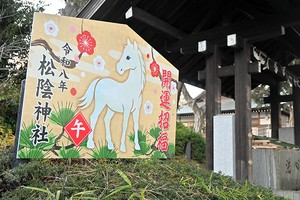
According to the traditional Japanese calendar, this year is “Hinoe-uma” (Fire Horse) that recurs every 60 years.
This is also the 101st year of the Showa Era (which in reality was from 1926 to 1989), and the 85th anniversary of Japan’s declaration of war against the United States.
What is time?
“(Time is) something you don’t know what it is until it’s in the past. When you realize what it was, it’s already long lost,” wrote poet Saburo Kuroda (1919-1980). These words hit me hard.
And Kyoshi Takahama (1874-1959) penned this verse that goes to the effect, “Last year/this year—like a stick that pierces through.”
Time, in the broad sense of the term, keeps flowing forever. And I, a small presence in it, cherish the passage of every “omochi.”
--The Asahi Shimbun, Jan. 1
* * *
Vox Populi, Vox Dei is a popular daily column that takes up a wide range of topics, including culture, arts and social trends and developments. Written by veteran Asahi Shimbun writers, the column provides useful perspectives on and insights into contemporary Japan and its culture.











A peek through the music industry’s curtain at the producers who harnessed social media to help their idols go global.

A series based on diplomatic documents declassified by Japan’s Foreign Ministry

Here is a collection of first-hand accounts by “hibakusha” atomic bomb survivors.

Cooking experts, chefs and others involved in the field of food introduce their special recipes intertwined with their paths in life.

A series about Japanese-Americans and their memories of World War II



