By MASAKI HASHIDA/ Staff Writer
December 16, 2025 at 15:51 JST
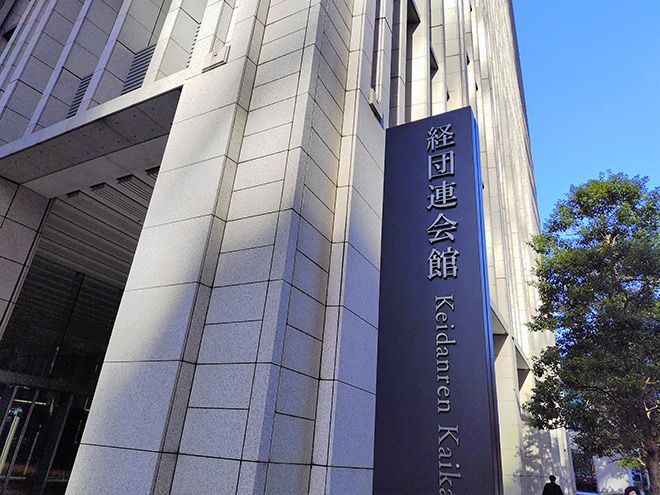 Keidanren Kaikan in Tokyo’s Chiyoda Ward on Dec. 15 (Masaki Hashida)
Keidanren (Japan Business Federation), the nation’s largest business lobby, urged the government to create a basic law that spells out a philosophy of promoting the inclusion of foreign workers into Japanese society.
In its proposal announced on Dec. 15, Keidanren said Japan’s policy on foreign nationals should shift from “acceptance” to “strategic attraction.”
After strategically attracting foreign nationals to the country, the goal would be to realize an “inclusive society” where all people support one another, the proposal said.
Keidanren also called for the establishment of a permanent, specialized department headed by the prime minister to deal with issues related to foreign workers.
The number of foreign residents in Japan has climbed to a record high of 3.95 million, or about 3 percent of the country’s total population.
But more foreign workers are expected to arrive in Japan to fill labor shortages in various industries. The foreign-born population is projected to reach 10 million in the 2040s.
However, illegal acts committed by some foreign nationals and xenophobia among the Japanese populace have become problematic.
Regarding the future of Japanese society, Keidanren aims to bring top talent from various countries to Japan to help advance technological innovation.
It said it will be necessary to adopt policies that take into account the lives and career choices of permanent residents.
Currently, the Immigration Services Agency of Japan handles the coordination function for accepting foreign nationals.
Although there is an Immigration Control Law, it does not spell out Japan’s philosophy concerning people who come into the country from overseas.
Therefore, Keidanren presented as “the ideal state” the enactment of a basic law and philosophy for policy on foreigners in Japan.
It said that a Cabinet minister with investigative powers and the permanent, specialized department could coordinate and advance policies across-the-board in areas such as employment and education.
Regarding the responsibilities of companies, Keidanren’s proposal said “improving the work environment is essential” to increase foreign workers’ sense of attachment and contribution to their employers.
In addition to reviewing their treatment and welfare benefits, including raising remuneration, companies need to develop multilingual support systems and ensure a safe and secure working environment.
Keidanren added that the business community will work to build momentum for the creation of regional networks to support foreign nationals.
“The increase in foreign nationals is occurring to supplement the decreasing Japanese workforce,” said Toshihiro Menju, a guest professor at the Kansai University of International Studies. “If this is suppressed, there is a risk that society will fall into dysfunction.”

Opponents raise voices against Musashino’s foreign vote plan
December 13, 2021
EDITORIAL: Giving foreigners referendum vote step toward inclusive society
December 18, 2021
Musashino assembly rejects proposal to let foreigners vote
December 21, 2021
Japan to punish longer-term foreign residents in arrears
June 10, 2025








A peek through the music industry’s curtain at the producers who harnessed social media to help their idols go global.

A series based on diplomatic documents declassified by Japan’s Foreign Ministry

Here is a collection of first-hand accounts by “hibakusha” atomic bomb survivors.

Cooking experts, chefs and others involved in the field of food introduce their special recipes intertwined with their paths in life.

A series about Japanese-Americans and their memories of World War II



