Vox Populi, Vox Dei is a daily column that runs on Page 1 of The Asahi Shimbun.
August 16, 2025 at 12:25 JST
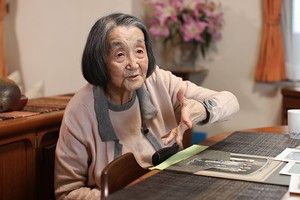
 Sen Genshitsu speaks of his experience of war in Kyoto on June 12. (Asahi Shimbun file photo)
Sen Genshitsu (1923-2025), the 15th generation “iemoto” grand master of the prestigious Urasenke school of tea ceremony, was a university student when he was drafted into the Imperial Japanese Navy air service two years before Japan’s defeat in World War II.
The day before he reported for duty, his father showed him a “wakizashi” (short samurai sword) for the first time, telling him to “take a good look.”
He had no idea at the time why his father did that, Sen recalled later.
As it happened, the sword was a famed masterpiece that was believed to have been used by Sen no Rikyu (1522-1591), the founder of the Urasenke school, when he was ordered by feudal warlord Toyotomi Hideyoshi (1537-1598) to commit “seppuku” ritualistic suicide by disembowelment.
Sen realized his father’s intent after his first training as a pilot.
In his book “Cha no Kokoro wo Sekai-e” (Imparting the spirit of tea ceremony to the world), Sen noted that his father’s message must have been, “Never choose to die.”
Sen was trained as a kamikaze pilot. But when everyone else was being sent on a suicide mission, he alone was ordered to stand by. Thus spared, he became a “survivor of the suicide attack squad” which, he often said after the war, filled him with deep shame and regret.
His feelings must have been quite complex, having always been treated, from a young age, as “the heir apparent” of an illustrious institution with a four-century history.
After preaching peace through Chado tea culture throughout the postwar period, Sen died on Aug. 14. He was 102.
Likening a round teacup to the Earth containing green matcha, Sen taught that to drink tea was to be in harmony with nature. A free thinker and speaker, his charm was never constrained by stuffy, old traditions.
In the tearoom, everyone is equal. The entrance to the tearoom is kept low and narrow, which forced samurai warriors to remove their swords to enter.
According to a theory proposed by Sen, Sen no Rikyu chose this setup because he had been inspired by the command, attributed to Jesus in the New Testament: “Enter through the narrow gate.”
Sen used to say that, for himself, World War II would never end until his death.
It ended one day before the 80th anniversary of Japan’s defeat in the conflict.
--The Asahi Shimbun, Aug. 16
* * *
Vox Populi, Vox Dei is a popular daily column that takes up a wide range of topics, including culture, arts and social trends and developments. Written by veteran Asahi Shimbun writers, the column provides useful perspectives on and insights into contemporary Japan and its culture.

Sen Soshitsu XV, tea master and peace advocate, dies at 102
August 14, 2025
VOX POPULI: A bowl of ‘suiton’ symbolizes the use of starvation as a war weapon
August 15, 2025
VOX POPULI: Memories of 'senninbari' a warning against blind allegiance
August 14, 2025
VOX POPULI: Teru Ando, the original sculptor of Hachiko who died in air raid
August 13, 2025
VOX POPULI: 40 years after JAL crash, U.S. has yet to fully explain the cause
August 12, 2025
VOX POPULI: The sorrow in the voices of 3,564 Nagasaki atomic bomb survivors
August 9, 2025







A peek through the music industry’s curtain at the producers who harnessed social media to help their idols go global.

A series based on diplomatic documents declassified by Japan’s Foreign Ministry

Here is a collection of first-hand accounts by “hibakusha” atomic bomb survivors.

Cooking experts, chefs and others involved in the field of food introduce their special recipes intertwined with their paths in life.

A series about Japanese-Americans and their memories of World War II



