Vox Populi, Vox Dei is a daily column that runs on Page 1 of The Asahi Shimbun.
August 6, 2025 at 13:13 JST
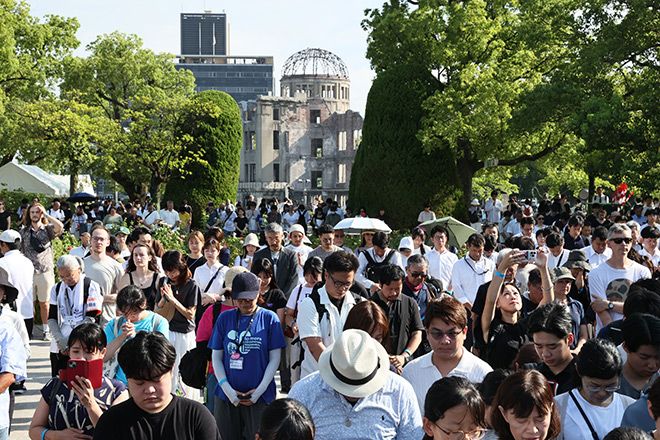 People observe a moment of silence while facing the cenotaph in Hiroshima Peace Memorial Park in Hiroshima's Naka Ward at 8:15 a.m. on Aug. 6. (Masaru Komiyaji) .
Wednesday, August 1—Cloudy “Today it suddenly struck me. ‘Summer is really here now.’ I visited Gokoku Shrine for Fallen War Heroes. After that, I was in a much better mood and felt refreshed and clear-headed.”
This entry comes from the 1945 diary of Yoko Moriwaki (1932-1945), a first-year student at Hiroshima Prefectural First Girls’ High School, written in 1945. She was 13 at the time.
Under Japan’s prewar school system, Girls’ High Schools ("koto jogakko") were the counterparts of boys’ middle schools.
“I’m so happy that my ('monpe') work trousers are finished. I’m so happy I simply can’t say the words ‘I’m happy’ enough!”
August 2—“I felt very ashamed today,” she wrote, after arriving late to school.
August 3—Together with her classmates, she went to an agricultural plot in the city to weed the fields. “It was hot, sweaty work, but I felt really good after I had finished.”
August 4—They returned to the fields. “It was just as hot as yesterday but I put up with the heat and worked as hard as I could.”
August 5—“Yesterday my uncle came, and the house was very lively. I wish every day could be like that. From tomorrow morning, we will join the home demolition groups ('kaoku sokai' work). I am going to do my best.”
"Kaoku sokai"—literally “house evacuation/clearance”—was a wartime practice of demolishing buildings in urban areas to create open spaces and was intended to prevent fires from spreading during air raids.
The next morning, Aug. 6, 1945, the U.S. bomber Enola Gay dropped the atomic bomb on Hiroshima.
Yoko was helping her classmates dismantle houses when the blast struck. She was just 700 meters from the hypocenter. Severely burned, she was carried to a relief station. Calling out “Mother!” again and again, she died late that night.
It is a story widely known, yet as Aug. 6 approaches each year, her diary inevitably comes to mind.
The atomic bomb stole her “tomorrows.” I close my eyes and think of that frustration, that sorrow, that terror.
“I am going to do my best.” We now live in the tomorrows that a 13-year-old girl longed for but could never reach.
That is why we must keep asking ourselves: Why was Yoko’s precious life lost? Whose fault was it? For what purpose?
Today marks 80 years since the atomic bombing of Hiroshima.
—The Asahi Shimbun, Aug. 6
* * *
Vox Populi, Vox Dei is a popular daily column that takes up a wide range of topics, including culture, arts and social trends and developments. Written by veteran Asahi Shimbun writers, the column provides useful perspectives on and insights into contemporary Japan and its culture.







A peek through the music industry’s curtain at the producers who harnessed social media to help their idols go global.

A series based on diplomatic documents declassified by Japan’s Foreign Ministry

Here is a collection of first-hand accounts by “hibakusha” atomic bomb survivors.

Cooking experts, chefs and others involved in the field of food introduce their special recipes intertwined with their paths in life.

A series about Japanese-Americans and their memories of World War II



