By USEN TO/ Staff Writer
May 3, 2025 at 07:00 JST
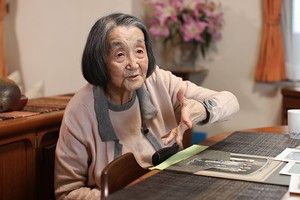
 Aki Sakuma looks out over the Kyu-Kitakamigawa river on March 8 in Ishinomaki, Miyagi Prefecture. “The river overflowed during the tsunami, and cars and debris washed ashore blocked the shoreline,” she recalled. (Usen To)

A woman’s research into the word “kizuna” (bonds) led to an extensive survey on how foreign technical intern trainees were affected by the 2011 Great East Japan Earthquake and tsunami.
Aki Sakuma, 65, was also involved in setting up an organization to help prevent a repeat of the confusion and fears of the young Chinese workers at a seafood processing plant in the town of Onagawa, Miyagi Prefecture.
Sakuma, a native of Heilongjiang province in northeastern China, came to Japan in 1993. She married a Japanese man and acquired Japanese citizenship.
In 2000, she started working as a part-time lecturer of Chinese at Tohoku Gakuin University in Sendai.
Through an acquaintance, she became a Japanese language teacher for Chinese technical intern trainees working at the seafood processing plant in Onagawa, as well as an interpreter for their supervisors.
On March 11, 2011, the Great East Japan Earthquake struck off the coast of the Tohoku region, triggering a massive tsunami.
Sakuma was in Sendai at the time. She immediately drove to her home in Ishinomaki, also in Miyagi Prefecture, and joined her family who had evacuated to a junior high school.
She called employees of the seafood processing plant to check on the technical intern trainees. They were all safe, but their workplace was swept away by the tsunami, leaving them jobless.
According to the Justice Ministry, 865 technical intern trainees were living in Miyagi Prefecture in 2010. By December 2011, the number had plummeted to 380 due to the disaster.
Some returned to Japan, and the number recovered to 749 in 2012.
Of the approximately 500 trainees whom Sakuma taught up to 2010, about 120 left Japan after the disaster.
However, more than 30 of them returned to Onagawa. Some needed to continue working to repay their debts.
Others said they had developed an attachment to Miyagi Prefecture.
After the disaster, Sakuma said she often heard the word kizuna, which was chosen as the kanji of the year in 2011.
“I wanted to write a paper on the theme of what exactly kizuna means,” Sakuma said.
In April 2013, she began interviewing the technical intern trainees who had returned to Onagawa.
As her survey progressed, she learned about the trauma and struggles that the trainees had been through.
One said, “When the earthquake hit, I didn’t know a tsunami was coming.”
Another said, “I didn’t even know what the word ‘tsunami’ meant in the first place.”
Another one said: “I often dream about tsunami. Suddenly a big wave hits, and I run and run. Then I wake up startled.”
Sakuma said she could not even imagine their fears and confusion in the sudden disaster.
Many of the trainees were unable to fully understand the evacuation information due to the language barrier, she said.
Whenever Sakuma interviewed the trainees, she also recalled her own memories of the disaster.
“The trainees did not know the word ‘tsunami’ that was broadcast on the radio,” she said. “I knew the word, but I didn’t know what it meant until I returned to Ishinomaki and lived in an evacuation shelter.”
Sakuma continued her interviews until May 2015. She listened to more than 30 men and women in their 20s and 30s.
The information from the interviews filled 25 A4-size notebooks.
After the disaster, Sakuma and others established a group called Miyagi Chinese Tongzhouhui Club.
The group’s purpose is to enable Chinese nationals and residents of Chinese origin in Miyagi Prefecture to share information and support each other in the event of a disaster.
The group’s name means “to be in the same boat, helping each other to overcome difficulties.”
Whenever an earthquake occurs in the prefecture, the members keep in touch with each other to confirm their safety, she said.
Through the interviews, Sakuma said she wanted to know what happened to each of the trainees, and how they evacuated and survived.
“As someone who is also from China and experienced the disaster, and as their teacher, I feel it is my mission to record their memories and pass them on,” she said.
It took some time to obtain the approval of the people involved, but she said she hopes to disclose to the public the reality of how the disaster damaged the technical intern trainees in Onagawa.










A peek through the music industry’s curtain at the producers who harnessed social media to help their idols go global.

A series based on diplomatic documents declassified by Japan’s Foreign Ministry

Here is a collection of first-hand accounts by “hibakusha” atomic bomb survivors.

Cooking experts, chefs and others involved in the field of food introduce their special recipes intertwined with their paths in life.

A series about Japanese-Americans and their memories of World War II



