By SHINTARO SHIIKI/ Staff Writer
March 14, 2025 at 18:30 JST
The next name from Wajima Junior High School's graduating class echoed throughout the Ishikawa Prefecture gymnasium on March 14, but Hanon Kiso did not appear.
Instead, only a photo of her was present as parents attentively watched a teacher announce each of the 89 students.
The 14-year-old was among the victims of a torrential rainstorm in Okunoto in September 2024.
Her teachers and classmates had brought the photo with them when they entered the gymnasium for the ceremony, and Hanon's diploma will be given to her family at a later date.
'BRIGHT COLORS ARE BETTER'
Momoka Yamase, also 14, was in the art club with Hanon for three years and lamented that she would never take a graduation picture with her friend.
Upon graduating, Momoka pledged, “I will keep working hard. I want to tell Hanon that.”
Anna Tsurutake, 14 and another art club member, remembers Hanon as “a very attentive person.”
She said, “I am happy for the graduation ceremony, but sad because Hanon is not here.”
Hanon had been in charge of the club and hoped to go on to high school in Kanazawa. She spoke of commuting from her grandfather Satoshi Kiso's home in the neighboring city of Nonoichi.
Satoshi, 63, is a lacquerware craftsman who originally lived in Wajima.
However, his house was damaged in the Noto Peninsula earthquake on Jan. 1, 2024, and he relocated to a house in Nonoichi after learning of it from an acquaintance.
Sitting in the kitchen corner where his new workspace is, he runs his lacquer brush over his current piece in progress.
He paints two chubby owls—one pink, the other light blue and both with round eyes. The design is unusual for him, as he had always worked with realistic paintings.
Satoshi came up with the bubbly design with his granddaughter when she came to stay with him during summer break in 2024.
“It would be cuter if the black eyes were bigger,” Hanon said, full of many ideas and suggestions. “With two birds, they look like a parent and child or a couple.”
She told him, “Primary colors are no good. Bright colors are better.”
Such detailed demands made Satoshi happy.
When he murmured, “Will they really sell?” Hanon replied, “Absolutely! I'll sell them myself if they don't.”
Satoshi’s store was located on the Wajima Asaichi morning market street in Wajima; it was completely destroyed in the fire caused by the earthquake.
However, the “traveling Wajima Asaichi morning market” started appearing within and beyond Ishikawa Prefecture in March 2024. Satoshi participated from the beginning and Hanon came to help out on holidays.
It was during that time when she told her grandfather she wanted to go to high school in Kanazawa and commute from his place.
Satoshi, in turn, wanted her to concentrate on studying for the entrance exam, and told her not to help with the market after August.
On Sept. 21, he debuted the cups with the owl design at a traveling market event in Toyama, the capital of the neighboring prefecture, after going through a series of prototypes.
He sold 10 within an hour of opening.
As he pictured Hanon's happy expression, Satoshi's phone suddenly rang. It was a friend living in Wajima.
“Your son's house was swept away,” they said.
ORDERS TO FILL
That same day, record-breaking rainfall battered northern Noto, causing the Tsukadagawa River running through the city of Wajima to overflow.
Satoshi arrived at his son's home the next day to find that only the foundation remained and no trace of the house was left.
Hanon was alone at home when the deluge washed everything away.
Believing that Hanon was definitely alive, Satoshi and his acquaintances continued their search.
Nine days later, on Sept. 30, a girl's body was found about 150 kilometers away off the coast of Fukui. The tag on her pants read “Kiso.” It was Hanon.
“There is no God,” Satoshi thought.
If only she had come to help with the market that day. If only it had been a school day instead of a Saturday. These thoughts replayed over and over in his mind.
Satoshi now has over 200 orders for the owl cups and cannot keep up with the work.
“This is the order Hanon gave to me,” he said.
The bottom of each finished cup is signed with her name and Satoshi includes a handwritten note for every customer that reads, “I hope that this cup will remind you of the disaster, and that you will not let (her) death be in vain and prepare yourself on a daily basis.”
Satoshi often talks to a photo of his grandchild.
“What color cup do you want next?”
He has many things he wants to discuss with her. But when he talks to her photo, there is no reply.
On March 14, a total of 114 students graduated from three junior high schools in Wajima.
According to the city, this is a drop of more than 20 percent compared to the 147 graduates in the class of 2023 before the Noto Peninsula earthquake on Jan. 1, 2024. It believes the disaster and torrential rains had an impact.

Noto students graduate from junior high in quake-hit city
March 10, 2024
Many schools inoperable in quake-hit areas, students struggle
January 10, 2024
Ceremonies for 20-year-olds held in quake-stricken areas of Noto
January 12, 2025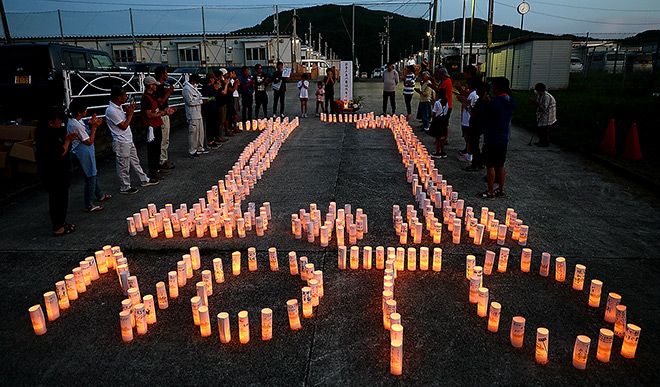
VOX POPULI: A year after the quake, the scars of Okunoto heal slowly, painfully
December 30, 2024
Disaster-affected youths start new jobs, open new pages in lives
April 1, 2024
Florida man fuses old-school music amp with Wajima lacquer
November 17, 2024











A peek through the music industry’s curtain at the producers who harnessed social media to help their idols go global.

A series based on diplomatic documents declassified by Japan’s Foreign Ministry

Here is a collection of first-hand accounts by “hibakusha” atomic bomb survivors.

Cooking experts, chefs and others involved in the field of food introduce their special recipes intertwined with their paths in life.

A series about Japanese-Americans and their memories of World War II

 Teachers and classmates enter the Wajima Junior High School graduation ceremony venue with a photo of Hanon Kiso on March 14 in Wajima, Ishikawa Prefecture. (Tatsuo Kanai)


