January 29, 2025 at 14:42 JST
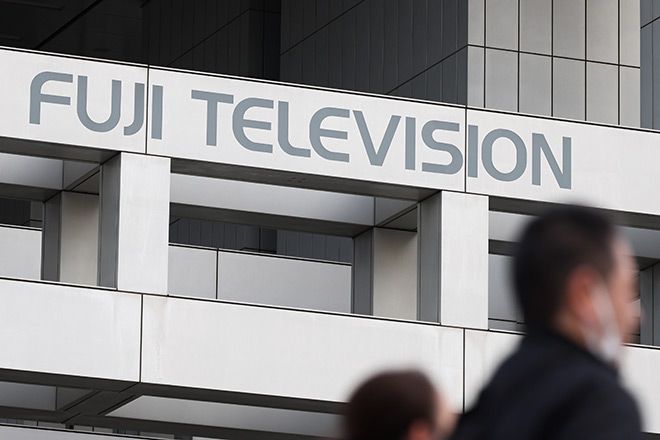 The headquarters of Fuji Television Network Inc. in Tokyo’s Minato Ward on Jan. 27 (Shota Tomonaga)
Top executives of Fuji Television Network Inc. have resigned over a scandal that was brought to light by the weekly Shukan Bunshun magazine and other publications.
The articles allege that a problem of a sexual nature had occurred between a woman and Masahiro Nakai, a former TV personality.
The issue raises multiple layers of questions.
What was the exact nature of that problem? Was there any involvement by Fuji TV executives? And did the broadcaster handle the problem appropriately after grasping the situation?
Fuji Television President Koichi Minato, who announced his resignation at a news conference co-hosted by Fuji Media Holdings Inc., the parent company of Fuji Television, acknowledged that “this matter suggests the possibility that human rights were violated.”
As for why a show featuring Nakai continued to air for as long as about 18 months after the program’s termination came under consideration, Minato explained that he was “afraid of triggering something that might harm the woman’s health.”
He also said that he wanted to fully respect her desire to return to work without anyone knowing about her predicament.
Minato then expressed his regret for failing to seek the advice of the company’s compliance promotion office and other departments to explore how best to proceed.
Being concerned about the woman’s health is all too natural. But that should never be the reason for inaction when a human rights violation is suspected.
And for someone who does not want anyone to know about her problem—which is totally understandable--“not rocking the boat” could not possibly be her only option for keeping her job.
Questions raised by this scandal also have to do with corporate culture that formed the backdrop.
Has it ever been a custom at Fuji Television to “use” women to entertain VIPs such as showbiz celebrities?
Have the company’s executives ever resorted to that custom themselves, or turned a blind eye to it when someone else did? And hasn’t Hisashi Hieda, the chairman of Fujisankei Communications Group and an adviser to both Fuji Television and Fuji Media Holdings, held complete control over their top personnel affairs for years?
At the news conference, questions were repeatedly asked about Hieda’s absence from the scene and why he is remaining in his post.
Ryunosuke Endo, Fuji Television’s vice chairman, went no further than to say that every full-time executive “should take their own responsibility” once the findings of a third-party investigative committee become available.
Asked about Fuji Television’s corporate culture, Chairman Shuji Kano, who announced his resignation, mentioned “freedom” and explained that because of it, the company has been “loose in matters of compliance” and “out of step with society’s norms.”
These traits have always been there, but they became more visible over the changing times--that’s all there was to it.
And we suspect that one of the reasons why the company did not understand the gravity of the situation and failed to take prompt corrective measures was the “homogeneity” of older men who occupied the great majority of the company’s top management positions.
This definitely calls for further corporate renovation.
Even after the news conference, many questions still remain unanswered.
What happened? How should Fuji Television have handled the scandal? We demand a thorough scrutiny by the third-party investigative committee as well as by Fuji Television itself.
Does the company possess sufficient sensitivity or awareness about human rights and the homogeneity of its top-tier executives? This is something that the political community as well as all corporations must ask themselves in earnest.
The scandal could serve as a cue for everyone to reflect upon themselves.
--The Asahi Shimbun, Jan. 29

Resignations of Fuji Television execs fail to win back advertisers
January 28, 2025
Fuji Television workers demand resignations of top management
January 24, 2025
Fuji TV leaders to resign, say they lack awareness of human rights
January 27, 2025
Fuji TV boss says third-party panel will investigate Nakai scandal
January 17, 2025
Fuji TV executive kept Nakai on air after learning about incident
January 23, 2025
EDITORIAL: Scandal expands beyond Nakai, signals corporate culture of sleaze
January 27, 2025













A peek through the music industry’s curtain at the producers who harnessed social media to help their idols go global.

A series based on diplomatic documents declassified by Japan’s Foreign Ministry

Here is a collection of first-hand accounts by “hibakusha” atomic bomb survivors.

Cooking experts, chefs and others involved in the field of food introduce their special recipes intertwined with their paths in life.

A series about Japanese-Americans and their memories of World War II



