December 17, 2024 at 14:20 JST
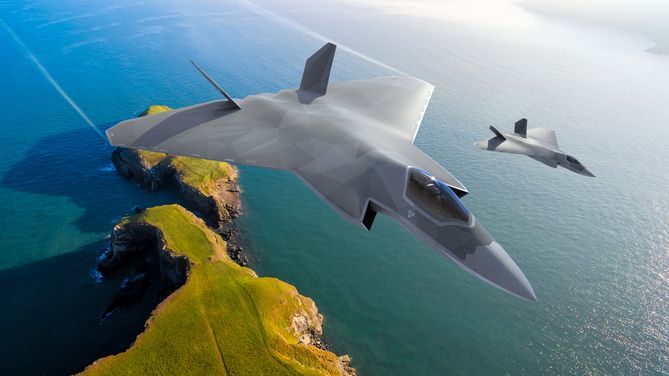 An artist’s rendition of the next-generation fighter jet that Japan, Britain and Italy have been developing (Provided by BAE Systems)
The three-nation project to develop a next-generation fighter jet involving Japan, Britain and Italy is rapidly gaining momentum.
A treaty establishing the tri-national governmental agency “GIGO,” tasked with coordinating among participating companies and managing exports of the fighter jet, has come into effect.
Headquartered in Britain, the agency’s inaugural chief will be a former senior Japanese Defense Ministry official. It has also been decided to establish a joint venture with equal investments from companies of the three countries.
This multilateral project to develop a stealth fighter has raised serious concerns in Japan.
In March this year, the previous administration of then Prime Minister Fumio Kishida made a controversial Cabinet decision allowing Japan to directly export completed fighter jets to third countries.
Editorials in The Asahi Shimbun have criticized this government decision, which has opened the door to Japanese exports of fighter jets, nothing short of lethal weapons, as gutting post-war Japan’s fundamental policy of strictly self-restricting arms exports under its pacifist Constitution.
Recently, another worrisome development has emerged. Saudi Arabia has expressed strong interest in joining the collaborative fighter jet program.
While Japan remains cautious about the prospect, citing potential delays to the 2035 deployment target, both Britain and Italy have reportedly welcomed Saudi Arabia’s potential involvement, drawn to the significant financial resources the oil-rich nation could bring to the project, which is estimated to cost trillions of yen.
Saudi Arabia, aiming to diversify its economy beyond dependence on oil, views participation as a means to develop its aviation and military industries.
It is expected that Saudi Arabia would play a role that falls short of full formal partnership under the treaty as its contribution in technological aspects is limited.
Since the development and production of fighter jets require huge amounts of capital, international joint development has become the global trend.
Riyadh’s participation, however, would introduce new issues and complexities to the project. While Japan shares fundamental values such as democracy and human rights with its British and Italian partners, collaborating with Saudi Arabia presents a different set of considerations.
As a major power in the volatile Middle East, Saudi Arabia operates within a complex web of competing interests and geopolitical sensitivities, where numerous nations vie for influence and resources.
It has been pointed out that the Eurofighter, jointly developed by four European countries including Britain and Italy, was used in airstrikes during Saudi Arabia’s intervention in the civil war in neighboring Yemen.
Japan’s fundamental policy has been, and should continue to be, to prevent actions that might exacerbate international conflicts.
Since the oil crisis of the 1970s, maintaining good diplomatic relations with all Middle Eastern countries has been Tokyo’s key diplomatic stance, and involving Saudi Arabia in the project could jeopardize this advantageous position.
Last month, when the leaders of Japan, Britain and Italy held talks on the sidelines of the Group of 20 summit in Brazil, they reportedly discussed Saudi Arabia’s participation.
However, Defense Minister Gen Nakatani has avoided referring to the possibility of Saudi Arabia’s participation in the program.
“It is not yet time to make presumptions about the participation of any third country,” he has said.
At a recent ordinary session of the Diet, where the treaty to establish GIGO was approved, then-Defense Minister Minoru Kihara stated, “There are no specific plans for other countries to join.”
If the situation has changed, the government must clearly state it, and the Diet needs to engage in a thorough debate on issues related to the fighter jet project, including the question of whether it is acceptable to allow Saudi Arabia to join in.
--The Asahi Shimbun, Dec. 16

Companies from U.K., Italy and Japan to form joint venture for new fighter jet
December 14, 2024
Japan, Britain, Italy eye Saudi Arabia in fighter jet project
November 21, 2024
Japan, U.K. and Italy to expedite next-generation fighter jet to replace F-2s and Eurofighter Typhoons
October 21, 2024
EDITORIAL: Japan makes security policy switch without public discourse
March 27, 2024
EDITORIAL: S. Korea needs dialogue amid turmoil to regain public confidence
December 16, 2024
EDITORIAL: Deeper cuts in greenhouse gas emissions is only way forward
December 14, 2024












A peek through the music industry’s curtain at the producers who harnessed social media to help their idols go global.

A series based on diplomatic documents declassified by Japan’s Foreign Ministry

Here is a collection of first-hand accounts by “hibakusha” atomic bomb survivors.

Cooking experts, chefs and others involved in the field of food introduce their special recipes intertwined with their paths in life.

A series about Japanese-Americans and their memories of World War II



