By SATOSHI SHINDEN/ Staff Writer
March 31, 2024 at 07:00 JST
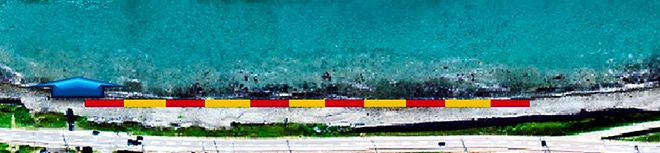
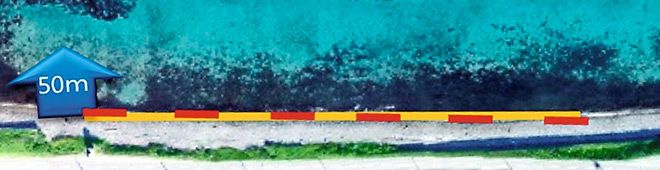
 “Konbu” kelp restored through an endeavor to supply iron to the ocean in Hokkaido’s Mashike (Provided by Nippon Steel Corp.)

Initiatives to have carbon dioxide (CO2) absorbed and captured in seaweed and seagrass are taking root across Japan, where the population is known for having a taste for a wide range of aquatic plants.
Those environmental efforts aim to not only combat climate change but also offer other benefits, including improving fisheries resources and seawater quality.
A framework to trade blue carbon credits has already been adopted in the nation.
NUMEROUS BENEFITS
The CO2 abrorbed by oceanic ecosystems is called blue carbon. Meanwhile, the CO2 absorbed by forests and thickets on land is called green carbon.
A state-designated organization certifies blue carbon and issues credits, which can be sold and bought on a trial basis under a newly introduced system.
Starting in fiscal 2020, the Japan Blue Economy (JBE) Association began looking at efforts to reconstruct seaweed colonies nationwide.
Certificates for economic values, called J Blue Credits, are issued, taking into account the amounts of CO2 absorbed through the initiatives.
Operators forging ahead with the projects can raise funds for businesses under this system through selling their credits to enterprises wanting to offset the carbon footprints they fail to reduce.
A total of 26 programs were certified through fiscal 2022. Credits for a total of 3,800 tons of CO2 were issued.
Credits are reportedly being traded this fiscal year for an average of 65,000 yen ($438) per ton, six times higher than the approximately 10,000 yen per ton for forest-linked credits.
“Fewer blue credits are provided compared with their forest-connected counterparts,” explained Tomohiro Kuwae, president of the JBE Association. “Another likely reason is that purchasers are content with a lot of benefits brought on by restored seaweed beds, such as improved fishing grounds and water quality as well as CO2 absorption.”
Working with Nippon Steel Corp., the Mashike fisheries cooperative association in Mashike, northwestern Hokkaido, embarked on rebuilding a local seaweed population in 2004.
They buried iron slag generated from the steelmaker’s production process in coastal areas to supply iron to the sea for the growth of “konbu” kelp.
In one zone, the industrial waste was applied to a 270-meter coastal strip in 2014. The area of the colony of konbu and other sorts of seaweed rose more than fivefold from 0.6 hectares in 2015 to 3.3 hectares in 2022.
Apart from carbon footprint reduction, the sea urchin catch jumped by up to 1.8 times because the marine creature consumes konbu.
“Our incomes have become higher, too,” said Hiroyuki Aiuchi, managing director of the fisheries cooperative association.
Nippon Steel is currently flooded with inquiries from fishermen’s cooperatives and other entities plagued by shrinking seaweed populations throughout Japan.
Inspired by the success in Mashike, similar countermeasures have been implemented in upward of 50 locations nationwide.
Also among certified programs is the transplanting of eelgrass seedlings that has contributed to the reintroduction of the species’ colony at Yokohama Port in Yokohama. In the Hyogo Canal in Kobe, an artificially developed tidal flat succeeded in growing the sea lettuce and other variants.
Another initiative has recently gotten under way in Hokkaido, in the hope of measuring blue carbon at the production areas of the famed Hidaka Konbu and Rishiri Konbu.
Seaweed farming can be considered as effective in reining in carbon footprints, given aquatic plants’ possible contribution to blue carbon via their growth processes.
SHARED WITH THE U.N.
How to evaluate the effects of blue carbon has yet to be established in the international community.
No countries have included the absorption of CO2 by seaweed and seagrass in their reports on greenhouse gas emissions that are submitted annually to the United Nations.
While botanical species under the sea surface take in CO2 via photosynthesis in the same way as trees in forests, the carbon storage performance is assessed differently in both categories.
Trees are thought to store absorbed carbon as they live for dozens to hundreds of years.
Seagrass and seaweed, which wither or are eaten by animals within several years, cannot serve as permanent containers for carbon storage by themselves.
The volume of CO2 in withered and torn fragments of oceanic plants that can remain undecomposed for hundreds to thousands of years is often deemed solely as fixed.
On top of that, there are no standardized ways to measure the seaweed beds and weights comprehensively and accurately.
The Japanese government thus proposed a technique to estimate how broad seaweed colonies are nationwide based on satellite images, geographic features, water temperatures and other factors.
Tokyo officials likewise incorporated a calculating method for CO2 absorption for different types of seaweed and seagrass.
Taking full advantage of those methods, Japan plans to become the first nation the world over in April to present the details of its carbon absorption associated with aquatic plants to the United Nations.
Japan’s blue carbon footprint for fiscal 2022 is estimated at 360,000 tons, compared with the total CO2 absorption for fiscal 2021 of 47.6 million tons reported last year in connection primarily with forests and thickets on land.
“We will be leading the initiative to devise global criteria” for blue carbon, said a land ministry official.

Iwate to issue 1st green, blue bonds to protect its marine resources
June 26, 2023
Fisheries look to fish farming as the demand for seafood explodes
January 29, 2024
Japan’s greenhouse gas emissions rose 2% in FY21/22 as economy recovered
April 21, 2023
POINT OF VIEW/ Race to restore Asia-Pacific's sustainable ocean economy
March 4, 2021
Japan’s FY 2021 greenhouse gas emissions up for 1st time in 8 years
May 21, 2023












A peek through the music industry’s curtain at the producers who harnessed social media to help their idols go global.

A series based on diplomatic documents declassified by Japan’s Foreign Ministry

Here is a collection of first-hand accounts by “hibakusha” atomic bomb survivors.

Cooking experts, chefs and others involved in the field of food introduce their special recipes intertwined with their paths in life.

A series about Japanese-Americans and their memories of World War II



