THE ASAHI SHIMBUN
May 23, 2024 at 19:04 JST
 Prime Minister Fumio Kishida wears a nametag showing his full name, while his wife, Yuko, left, wears one that reads “Wife of Fumio Kishida” at the annual spring garden party hosted by the imperial couple at the Akasaka Imperial Garden in Tokyo on April 23. (Koichi Ueda)


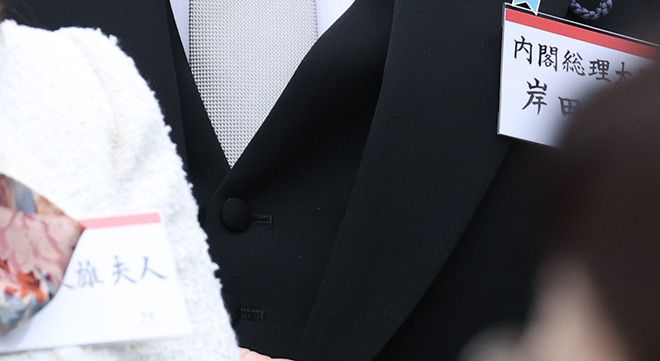
If attendees at the imperial couple's spring garden party didn't know the prime minister's wife's first name, they could address her only as "Mrs. Fumio Kishida."
That was written on Yuko Kishida's nametag, which she was given on arrival at the April 23 gathering.
The omission of spouse's first names on nametags drew criticism on X when a user saw a photo from the garden party, which is held at the Akasaka Imperial Garden in Tokyo every spring and fall.
Hundreds of distinguished guests in various fields are invited.
Seo Daegyo, editor-in-chief of the online media The Korea Focus, took exception to Yuko Kishida's nametag.
Seo saw a picture posted on X by Shun Otokita, an Upper House member of Nippon Ishin (Japan Innovation Party), which he took at the party with the prime minister and his wife.
Seo reposted Otokita’s post and added his comments criticizing the omission of Yuko's name.
“I felt dizzy when I saw the nametag ‘Wife of Fumio Kishida.’ What is going on with Japanese society’s awareness of human rights? Didn’t anyone think something was wrong while preparing for the garden party?”
In a check of all photos taken at the garden party by The Asahi Shimbun, it was discovered that not only the wives of the invited guests but also the husbands of the invited attendees did not have their first names on their nametags.
The husbands' nametags read “Husband of (wife’s full name).”
Seo’s criticism was spread on X and users of the social media website posted comments such as, “It treats their partners as accessories” and “It is disrespectful.”
PRECEDENCE DICTATES PRACTICE
The Imperial Household Agency was asked why it does not write the full name on spouses’ nametags.
An agency representative said that the names of the spouses of the invited guests, both men and women, are not written on their nametags.
The badges are made by the staff of the department in charge of imperial festivals and ceremonies, in line with precedents, the representative said.
The agency does not know when such a practice started because it does not have old documents, the representative said.
The representative said the agency “refrains from responding to every single comment on social networking sites and has no plans to change the rules at this stage.”
However, there used to be a time when only the nametags for wives of the guests omitted her full name, while husbands of the guests had their first names included.
Masae Ido, who was a Lower House member of the Constitutional Democratic Party of Japan from 2009 until 2012, said she attended a garden party once during her Diet tenure.
She said she was asked if her spouse would attend, too, and she went to the party with him.
“My husband, who attended as a spouse, wore a nametag with his full name on it. But a female spouse of another guest was wearing one that read ‘Wife of XX.’ I found it inequitable and looked odd.”
There was an exchange at a Diet session over the nametags issue.
Hisae Mitsuishi, a late politician who was an Upper House member of the then Japan Socialist Party, raised the issue at a meeting of the Upper House’s legal affairs committee in March 1995.
Mitsuishi cited a garden party where she brought her husband along. She said wives wore a nametag that just read “Wife of XX” while male companions wore one that listed their full names.
Mitsuishi asked, “Shouldn’t the name of female spouses, not just the 'Wife of' title, be written on her nametag from the standpoint of human rights?”
In response, Isao Maeda, then justice minister, said, “I regret once again that I was not particularly conscious about the issue, or rather, that I was oblivious to it, as it has been a long-standing practice.”
INFRINGEMENT OF PERSONAL RIGHTS
Experts pointed to the influence of the prewar “family system,” which denied the individual, as well as a lack of awareness of the right to be called by one’s own name.
Shoji Yazawa, an emeritus professor at Senshu University’s Graduate School of Law who is knowledgeable of the issue, said in Japanese society, the influence of the family system, in which the house and husband are central and the wife is treated as an appendage, remains strong.
In many cases, he said, the name of the individual is taken lightly.
Citing a Supreme Court case that held that names constitute a content of personal rights, Yazawa said, “In Japan, the idea that infringement of name rights lead to infringement of personal rights is not yet widespread.”
Regarding the nametag issue, he said, “There is a possibility that it is an infringement of personal rights,” urging the Imperial Household Agency to “view this as a human rights issue and make improvements.”
Naoko Tateishi, a professor at Aichi University who specializes in family law and gender law, also finds the omission of a full name, which is a symbol of personality, from the nametag problematic.
“It would mean that the Imperial Household Agency is not respecting the individual," she said. "It would be natural to specify not only the relationship but also the name.”
(This article was written by Takahiro Ogawa and Tomoko Yamashita.)

Surname woes vented in column 50 years ago still relevant today
July 15, 2021
Imperial couple mingle with guests at autumn garden party
November 3, 2023
Kiko turns 56, yearns to take a stroll with daughter Mako
September 11, 2022

U.S., Japan plant White House cherry tree to mark friendship
April 18, 2023









A peek through the music industry’s curtain at the producers who harnessed social media to help their idols go global.

A series based on diplomatic documents declassified by Japan’s Foreign Ministry

Here is a collection of first-hand accounts by “hibakusha” atomic bomb survivors.

Cooking experts, chefs and others involved in the field of food introduce their special recipes intertwined with their paths in life.

A series about Japanese-Americans and their memories of World War II



